
Free Safe Operating Procedure (Fuel Hydrant Cart) Template
Download our free Safe Operating Procedure for Fuel Hydrant Carts.
Free Safe Operating Procedure (Fuel Hydrant Cart) Template
DOCX • 126 KB + PDF
Updated Oct 2026
No signup required
Purpose of the Free Safe Operating Procedure (Fuel Hydrant Cart) Template
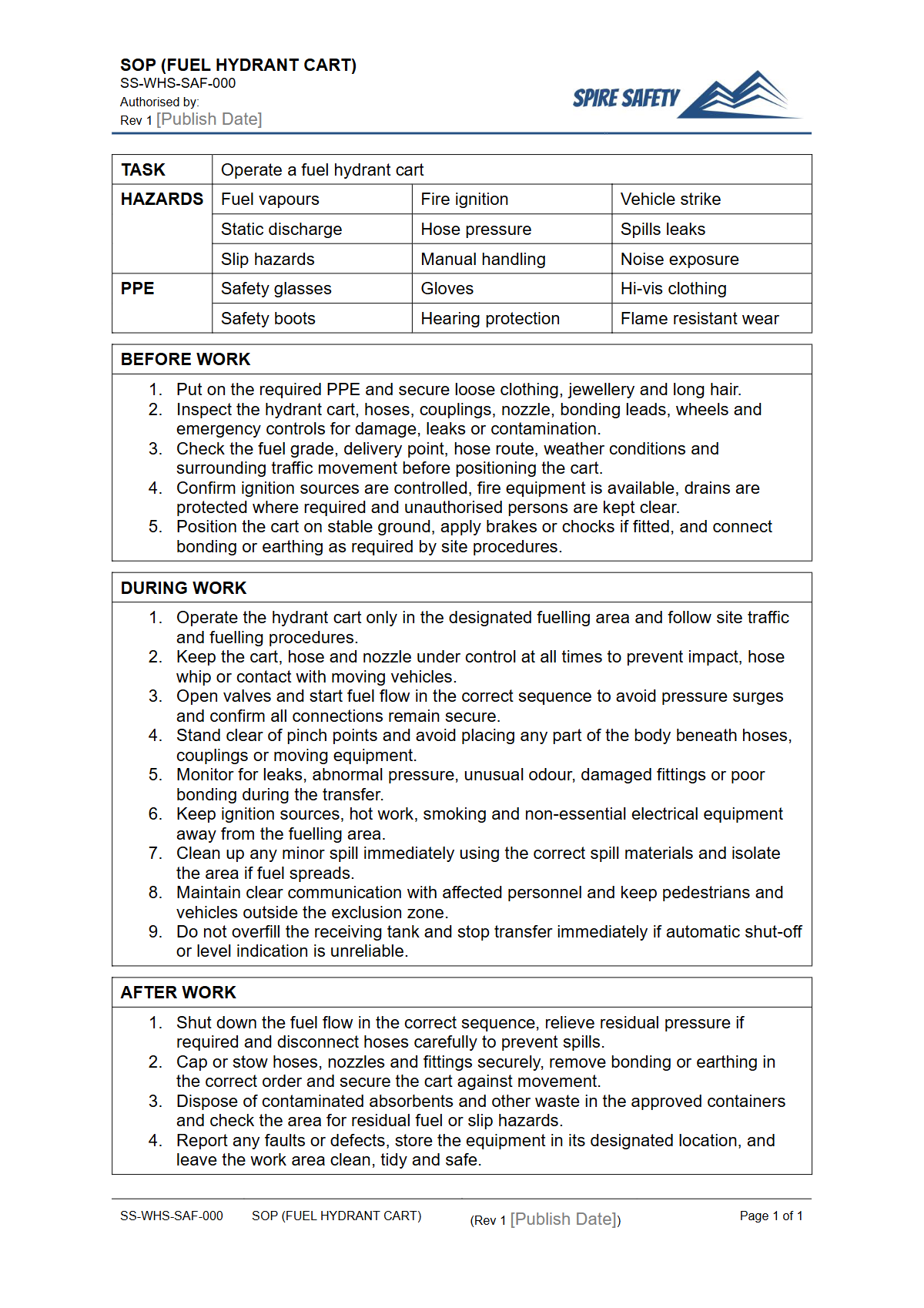
This free Safe Operating Procedure (Fuel Hydrant Cart) Template provides a comprehensive starting point for organisations to document the required steps for the safe operation of fuel hydrant carts. These units are critical pieces of ground support equipment, primarily used in aviation for refuelling aircraft from a fixed hydrant system.
Operating them involves significant risks, including fire, explosion, chemical exposure, and environmental contamination from fuel spills. A detailed SOP is a fundamental tool for managing these high-consequence hazards.
A well-drafted SOP outlines control measures for key risks such as static electricity discharge, incorrect bonding and grounding, hose or coupling failure, and vehicle collisions on a busy apron or worksite. By clearly defining pre-start checks, operational steps, and emergency procedures, this template helps ensure that all tasks are performed consistently and safely.
It serves as a critical component of a robust WHS management system, providing clear instructions to operators and forming a basis for training and competency assessment.
Video walkthrough
How to use the Free Safe Operating Procedure (Fuel Hydrant Cart) Template
This template is available in both DOCX and PDF formats for your convenience. The DOCX file is fully editable, allowing you to tailor the content to your specific operational needs.
The procedure should detail the exact steps for connecting to the hydrant pit, bonding the cart and aircraft, managing fuel flow, and safely disconnecting. It should also specify the required Personal Protective Equipment (PPE), such as anti-static footwear, safety glasses, and fuel-resistant gloves.
Important Customisation Note
This document provides a foundational structure. It is essential that you customise this template to reflect the specific make and model of your fuel hydrant cart, your site-specific hazards (e.g., apron congestion, weather conditions), your organisation’s emergency response plans, and relevant Australian Standards. We are not liable for any incidents arising from the use of this document; it is a starting point, not a complete, ready-to-use safety solution. Similar to our boom pump SOP template, this procedure must be adapted to your unique context.
When to use a Fuel Hydrant Cart Safe Operating Procedure
A Safe Operating Procedure for a fuel hydrant cart should be a living document, integrated into your daily operations. It is used in several key situations:
- Operator Training: As a primary training document for new and existing ground crew to ensure they understand the approved, safe method of operation.
- Pre-operational Checks: The checklist within the SOP guides operators through essential pre-start inspections of the cart’s safety systems, hoses, and interlocks.
- Competency Assessments: Supervisors can use the SOP as a benchmark to observe and formally assess an operator’s competency.
- Incident Investigations: In the event of a fuel spill, near miss, or accident, the SOP serves as a reference to determine if procedures were followed and where they might need improvement.
- Audits and Reviews: The procedure provides clear criteria for internal or external WHS compliance audits, helping to verify that safe work practices are documented and implemented.
Who should use this Safe Operating Procedure
This template is designed for use by a range of personnel within organisations that handle bulk aviation or industrial fuels. The primary users include:
- WHS Managers and Advisors: To develop and implement a formal, documented procedure as part of the overall safety management system.
- Ground Operations and Line Managers: To manage the day-to-day safety of refuelling activities, conduct training, and enforce compliance with the procedure.
- Supervisors and Team Leaders: For direct supervision of refuelling tasks, conducting toolbox talks, and verifying operator competency against the SOP.
- Fuel Hydrant Cart Operators: As a direct reference for performing their tasks safely and consistently, and for conducting mandatory pre-start checks. The complexity of this machinery is similar to other specialised mobile plant, and having a specific SOP is just as crucial as it is for our Telehandler SOP template.
Furthermore, this document can be used to inform emergency services about your procedures. Having a clear guide for shutdown and isolation, such as the steps outlined in our defibrillator operation SOP, is crucial for effective emergency response.
For more templates covering a wide range of equipment and tasks, please browse our complete free WHS resources library. We are continually adding new documents to help Australian businesses improve their safety outcomes.
Common mistakes
Common mistakes to avoid
- Failing to properly bond the cart, aircraft, and fuelling nozzle in the correct sequence before starting fuel flow.
- Neglecting pre-start checks of critical safety features like emergency stops, fire extinguishers, and hose condition.
- Operating the cart at excessive speeds or without a clear view of the surrounding apron area, increasing collision risk.
- Inadequate training or drills on emergency shutdown procedures and spill response actions.
Legal references
Legal considerations
The following legal requirements may be relevant to this type of work.
- Work Health and Safety Act (Harmonised) — Provides the primary duties for protecting workers and other people from work health and safety risks.
- Work Health and Safety Regulations (Harmonised) — Sets out requirements supporting the management of workplace hazards and risks.
The following codes may be relevant to this type of work.
- Managing WHS Risks Code of Practice — Provides practical guidance on identifying hazards, assessing risks and applying effective controls.
- Work Health and Safety Consultation, Cooperation and Coordination Code of Practice — Provides practical guidance on consulting workers and coordinating with other duty holders.
- Managing the Work Environment and Facilities Code of Practice — Provides practical guidance on safe work environments, workplace facilities and related controls.
Did you know
Static Risk
A person walking across a synthetic surface can generate up to 12,000 volts of static electricity. Proper bonding and grounding are critical during refuelling to prevent a static spark from igniting fuel vapours.
Hydrant Systems
Airport fuel hydrant systems use underground pipes to deliver fuel to aircraft stands. Hydrant carts then control the final connection and pressure, reducing the need for large tanker trucks on the apron and improving safety.
FAQ
Frequently asked questions
01What are the main hazards when operating a fuel hydrant cart?
02Is a Safe Operating Procedure a legal requirement for fuel hydrant carts in Australia?
03How often should we review our fuel hydrant cart SOP?
04What training is essential for a fuel hydrant cart operator?
Share this resource
Free Safe Operating Procedure (Fuel Hydrant Cart) Template
Browse Categories
How To Use It
- 1Download and open in Word or PDF.
- 2Replace the placeholders with your business details.
- 3Get it reviewed by a WHS specialist before rollout.
Need it customised?
Our WHS consultants can adapt this template to your site, run a gap analysis, or audit what you already have in place.
Book a Free Consultation WHS consulting servicesor call 1300 156 382
Related templates
- Free Safe Operating Procedure (Fuel Line Disconnect) Template
- Free Safe Operating Procedure (Fuel Spill Mat Setup) Template
- Free Safe Operating Procedure (Fuel Tank Draining) Template
- Free Safe Operating Procedure (Fuel Transfer Pump) Template
- Free Safe Operating Procedure (Fume Cupboard) Template
- Free Safe Operating Procedure (Funeral Equipment Clean) Template