
Free Safe Operating Procedure (Fruit Sorting) Template
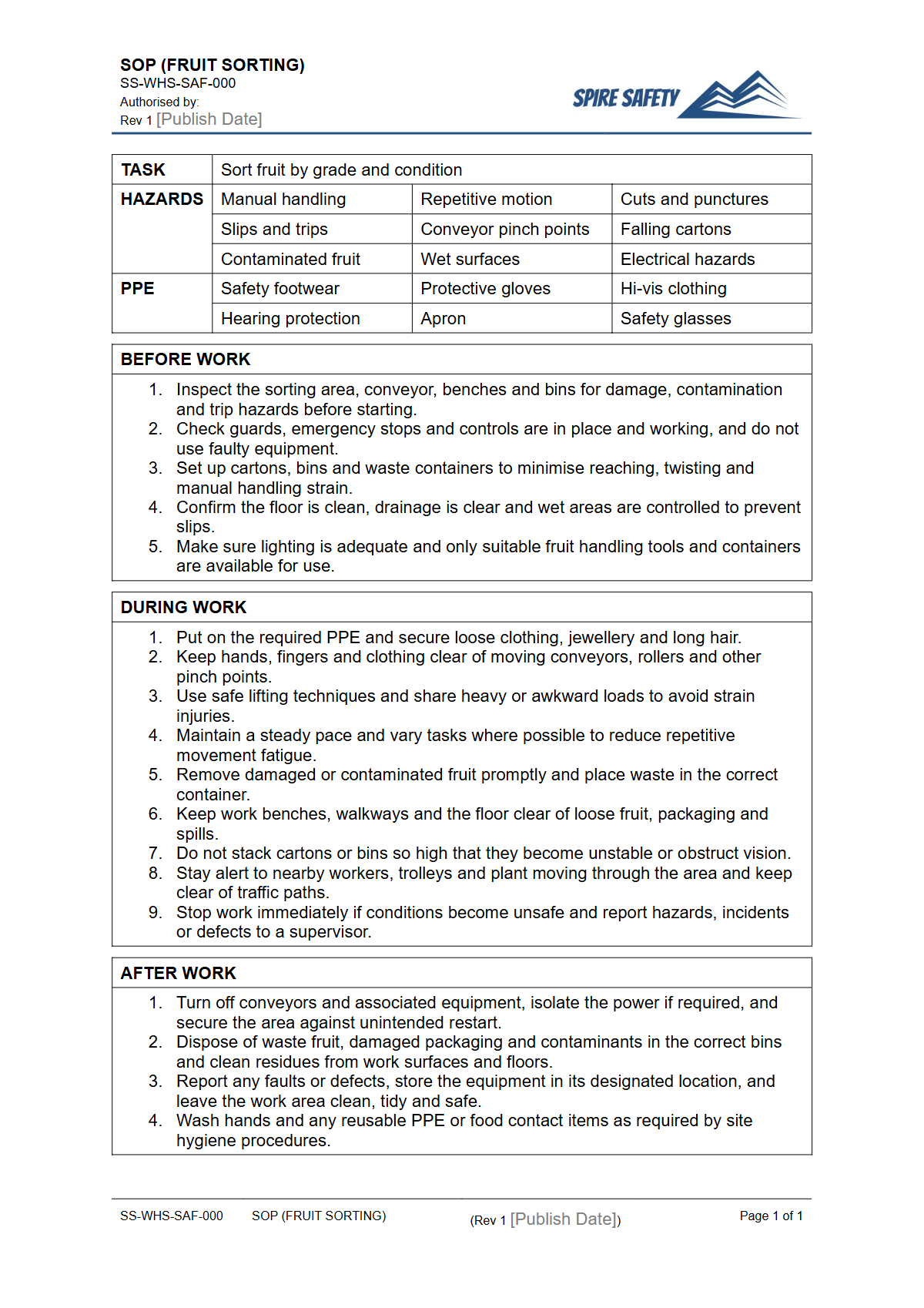
Download our free Safe Operating Procedure (Fruit Sorting) Template. This customisable DOCX and PDF helps formalise safe work practices for fruit sorting.
Free Safe Operating Procedure (Fruit Sorting) Template
DOCX • 126 KB + PDF
Updated Oct 2026
No signup required
Purpose of the Free Safe Operating Procedure (Fruit Sorting) Template
This free Safe Operating Procedure (Fruit Sorting) Template provides a structured framework for documenting the safe methods required for sorting fruit by hand or using machinery. It is designed to assist organisations in the agricultural and food processing sectors to manage workplace risks effectively.
By outlining step-by-step instructions, required personal protective equipment (PPE), and emergency protocols, this SOP helps ensure workers clearly understand how to perform their tasks safely, reducing the risk of injury from manual handling, machinery entanglement, and slips or trips.
A well-developed SOP is a fundamental component of a proactive safety culture. It serves as a key training document for new and existing employees and acts as a benchmark for performance and supervision.
Formalising your procedures demonstrates a commitment to safety and is an essential part of robust WHS management systems, helping your business meet its obligations under Australian work health and safety legislation.
Video walkthrough
How to use the Free Safe Operating Procedure (Fruit Sorting) Template
This template is available for download as a fully editable DOCX file, allowing for comprehensive customisation, as well as a PDF for easy printing and distribution. To use this resource effectively, you must adapt it to the specific context of your workplace.
This involves conducting a site-specific risk assessment to identify all relevant hazards associated with your fruit sorting processes, machinery, and environment.
It is crucial to remember that this document is a starting point. We recommend you customise it thoroughly to reflect the specific equipment (e.g., conveyors, sorting tables, washing stations), chemicals, and work practices unique to your site.
You should involve your workers in the customisation process, as their direct experience is invaluable for identifying practical risks and controls. Similarly, procedures for other common tasks, like using ladders for maintenance, should be documented; our FREE Step Ladder SOP Template can provide a useful guide for this.
Key Elements to Include in Your SOP
A comprehensive Safe Operating Procedure for fruit sorting should cover several critical areas to be effective. Ensure your customised document includes:
- Hazards and Risks: List all identified hazards, such as repetitive strain from manual handling, pinch points on conveyors, noise from machinery, slip hazards from water or fruit debris, and exposure to cleaning chemicals.
- Control Measures: Detail the controls implemented to eliminate or minimise these risks. This includes engineering controls (e.g., machine guarding), administrative controls (e.g., job rotation to reduce ergonomic strain), and required PPE (e.g., gloves, non-slip footwear, hearing protection).
- Pre-Operational Checks: Outline the safety checks that must be performed on all machinery and equipment before starting work. This ensures equipment is in safe working order and helps prevent breakdowns or incidents during operation.
- Step-by-Step Instructions: Provide a clear, logical sequence of steps for performing the fruit sorting task safely from start to finish. Use simple language and avoid jargon wherever possible.
- Emergency Procedures: Detail the procedures for responding to foreseeable emergencies, such as machinery entanglement, chemical spills, or medical incidents. Include the location of first aid kits, emergency stops, and contact information for first aid officers and emergency services.
Documenting procedures for all high-risk plant is a key part of WHS compliance. If your site uses other agricultural equipment, consider developing specific SOPs for those as well.
For example, our FREE Grain Drill SOP Template offers a framework for documenting the safe use of that machinery.
When to use this Safe Operating Procedure
This SOP should be used as the primary guide for all fruit sorting activities. It is a critical tool for inducting new employees and providing refresher training for experienced staff.
The procedure should be readily available at the point of work for easy reference. It is also a vital document during incident investigations and workplace safety audits, helping to identify whether established procedures were followed. For sites with more complex machinery, like those using lifting equipment to move fruit bins, you may need additional procedures like our FREE Telehandler SOP Template.
Who should use this document
This template is intended for use by Persons Conducting a Business or Undertaking (PCBUs), farm managers, packhouse supervisors, and WHS professionals in the agricultural and food production industries. It is their responsibility to develop, implement, and review the SOP.
All workers and operators tasked with fruit sorting must be trained in the final, site-specific procedure and be deemed competent before undertaking the task without direct supervision. If you need expert assistance in developing a complete suite of safety documentation for your business, consider engaging professional WHS consulting services.
After customising this template, you may find other relevant documents in our free WHS resources library to help build out your safety management system.
Common mistakes
Common mistakes to avoid
- Using the generic template without customising it for specific workplace machinery and conditions.
- Failing to adequately train all workers on the finalised SOP and confirm their understanding.
- Neglecting to address ergonomic hazards like repetitive motion and awkward postures.
- Forgetting to schedule and conduct regular reviews of the SOP, especially after an incident or process change.
Legal references
Legal considerations
The following legal requirements may be relevant to this type of work.
- Work Health and Safety Act (Harmonised) — Provides the primary duties for protecting workers and other people from work health and safety risks.
- Work Health and Safety Regulations (Harmonised) — Sets out requirements supporting the management of workplace hazards and risks.
The following codes may be relevant to this type of work.
- Managing WHS Risks Code of Practice — Provides practical guidance on identifying hazards, assessing risks and applying effective controls.
- Work Health and Safety Consultation, Cooperation and Coordination Code of Practice — Provides practical guidance on consulting workers and coordinating with other duty holders.
- Managing the Work Environment and Facilities Code of Practice — Provides practical guidance on safe work environments, workplace facilities and related controls.
Did you know
Ergonomic Risk
Musculoskeletal disorders (MSDs) are a significant issue in the agriculture and food processing sectors. Safe Work Australia data shows that body stressing, often from repetitive manual tasks like sorting, accounts for a large percentage of serious workers' compensation claims.
FAQ
Frequently asked questions
01What hazards should a fruit sorting SOP cover?
02Is a Safe Operating Procedure legally required for fruit sorting in Australia?
03How often should we review our fruit sorting SOP?
04Can this template be used for vegetable sorting as well?
Share this resource
Free Safe Operating Procedure (Fruit Sorting) Template
Browse Categories
How To Use It
- 1Download and open in Word or PDF.
- 2Replace the placeholders with your business details.
- 3Get it reviewed by a WHS specialist before rollout.
Need it customised?
Our WHS consultants can adapt this template to your site, run a gap analysis, or audit what you already have in place.
Book a Free Consultation WHS consulting servicesor call 1300 156 382
Related templates
- Free Safe Operating Procedure (Fuel Dock Operation) Template
- Free Safe Operating Procedure (Fuel Hydrant Cart) Template
- Free Safe Operating Procedure (Fuel Line Disconnect) Template
- Free Safe Operating Procedure (Fuel Spill Mat Setup) Template
- Free Safe Operating Procedure (Fuel Tank Draining) Template
- Free Safe Operating Procedure (Fuel Transfer Pump) Template