
Free Safe Operating Procedure (Freight Segregation) Template
Download our free Safe Operating Procedure (Freight Segregation) Template. This customisable DOCX & PDF helps define safe systems for separating freight.
Free Safe Operating Procedure (Freight Segregation) Template
DOCX • 126 KB + PDF
Updated Oct 2026
No signup required
Purpose of the Free Safe Operating Procedure (Freight Segregation) Template
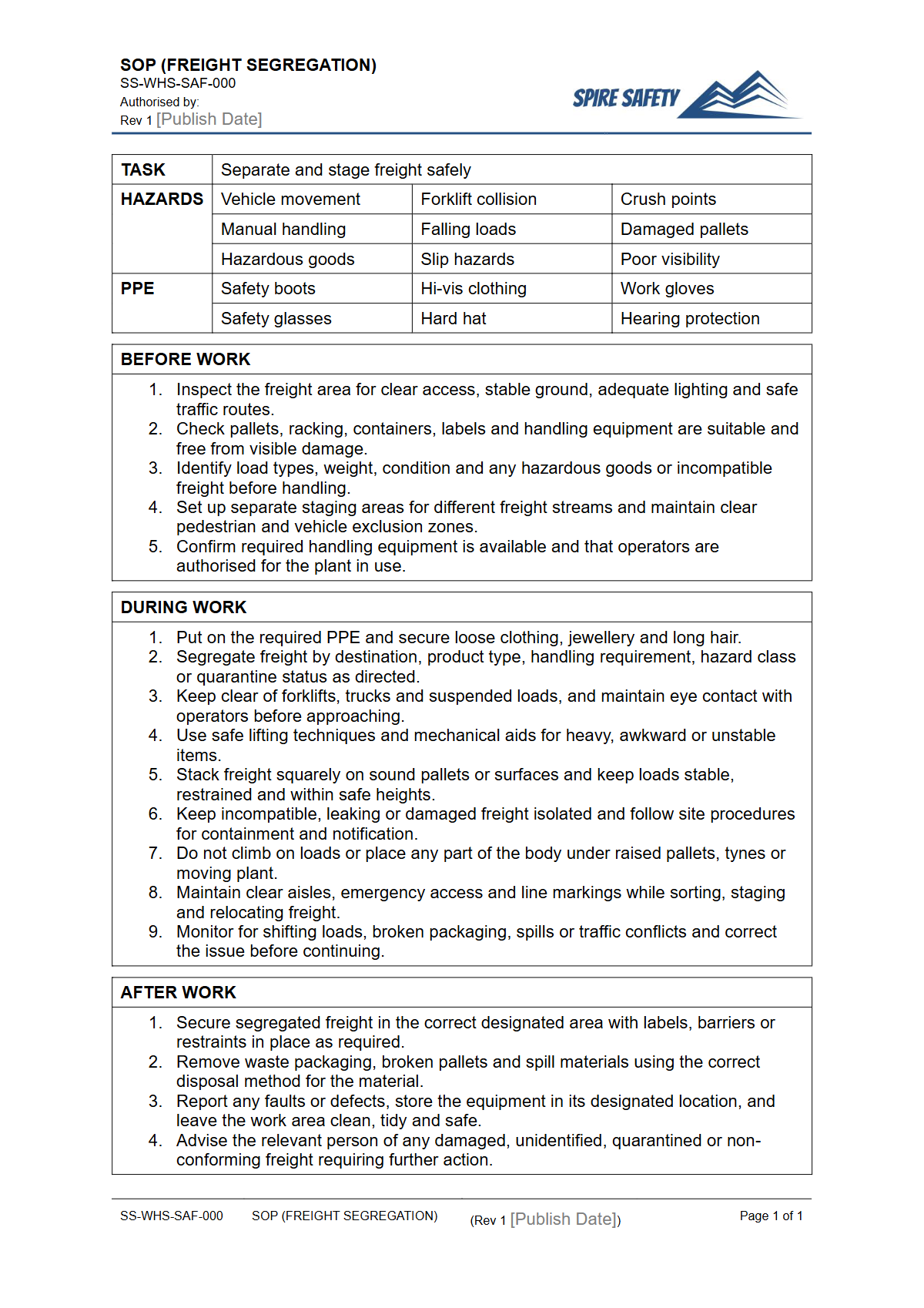
This Free Safe Operating Procedure (Freight Segregation) Template provides a structured starting point for developing procedures to safely separate and handle different types of freight in your workplace. Proper segregation is critical in transport, logistics, and warehousing to prevent adverse reactions between incompatible goods, cross-contamination, and physical damage.
Using a formal SOP helps your organisation manage risks associated with moving and storing mixed cargo, ensuring goods like foodstuffs, hazardous chemicals, and fragile items are handled correctly to protect workers and maintain product integrity. This document is designed to be adapted to your specific operational needs and risk profile.
Implementing a clear Safe Operating Procedure for freight segregation is a fundamental part of a robust safety framework. It formalises the steps workers must take to identify, separate, and secure different categories of goods during loading, unloading, and storage.
This not only helps in meeting safety obligations but also improves operational efficiency by minimising errors and potential incidents. Effective procedures are essential when handling materials with equipment like telehandlers, requiring a specific FREE Telehandler SOP (Safe Operating Procedure) Template.
Video walkthrough
How to use the Free Safe Operating Procedure (Freight Segregation) Template
This template is provided in both DOCX and PDF formats to serve as a comprehensive foundation for your internal safety documentation. To use it effectively, you must systematically work through each section and replace the placeholder text with information specific to your site, equipment, and the types of freight you handle.
This includes detailing the specific segregation rules, required Personal Protective Equipment (PPE), communication protocols, and emergency procedures relevant to your operations. The document should be integrated into your broader WHS management systems to ensure consistency and effectiveness.
Important: This is a template only. It is not a complete or ready-to-use document.
To be effective, we strongly recommend you customise this Safe Operating Procedure to reflect the specific hazards, risks, and freight types present in your workplace. You must consult with your workers, supervisors, and health and safety representatives during this process to ensure the final SOP is practical, understood by all, and addresses all relevant risks.
When to use it
A Safe Operating Procedure for freight segregation should be used whenever there is a risk of interaction between different types of goods. This is especially critical in environments like distribution centres, transport depots, and storage facilities.
Use this SOP as a guide for daily tasks such as loading mixed pallets, organising warehouse racking, and preparing vehicles for transport. It is particularly important when handling incompatible classes of dangerous goods, separating food products from chemicals, or isolating heavy items that could crush fragile ones. Even simple tasks like accessing high shelves require clear procedures, as covered in a FREE Step Ladder SOP Template.
Who should use it
This SOP is intended for all personnel involved in the freight handling process. This includes warehouse operators, forklift drivers, transport workers, logistics coordinators, and supervisors.
It should also be used by WHS advisors and managers to establish, review, and enforce safety standards. Workers must be trained on the contents of the final, customised SOP to ensure they understand their responsibilities for correctly segregating goods.
Regular reviews, potentially as part of a formal WHS compliance auditing program, ensure the procedure remains current and effective.
Furthermore, this document serves as an essential training tool for new employee inductions, ensuring from day one that all team members are aware of the correct procedures for handling and segregating freight. Being prepared for emergencies is crucial, which includes having a clear Safe Operating Procedure for Defibrillator Operation accessible in the workplace.
You can explore our complete free WHS resources library for more templates to support your safety management system.
Common mistakes
Common mistakes to avoid
- Failing to consult segregation charts for dangerous goods, leading to incorrect storage.
- Using unclear or damaged labels, making it difficult for workers to identify freight categories.
- Neglecting to secure segregated loads, allowing them to shift and mix during transport.
- Providing inadequate training on segregation rules and emergency procedures.
Legal references
Legal considerations
The following legal requirements may be relevant to this type of work.
- Work Health and Safety Act (Harmonised) — Provides the primary duties for protecting workers and other people from work health and safety risks.
- Work Health and Safety Regulations (Harmonised) — Sets out requirements supporting the management of workplace hazards and risks.
The following codes may be relevant to this type of work.
- Managing WHS Risks Code of Practice — Provides practical guidance on identifying hazards, assessing risks and applying effective controls.
- Work Health and Safety Consultation, Cooperation and Coordination Code of Practice — Provides practical guidance on consulting workers and coordinating with other duty holders.
- Managing the Work Environment and Facilities Code of Practice — Provides practical guidance on safe work environments, workplace facilities and related controls.
Did you know
Incompatibility Risks
Some seemingly harmless substances can become dangerous when stored together. For example, storing oxidising agents (like pool chlorine) near flammable liquids (like petrol) can create a severe fire and explosion hazard.
Logistics Safety
According to Safe Work Australia, the Transport, Postal & Warehousing industry has one of the highest rates of serious workers' compensation claims, highlighting the importance of robust safety procedures like freight segregation.
FAQ
Frequently asked questions
01What is freight segregation in WHS?
02Why is separating incompatible goods important?
03Does this SOP template cover dangerous goods?
04How often should a freight segregation SOP be reviewed?
Share this resource
Free Safe Operating Procedure (Freight Segregation) Template
Browse Categories
How To Use It
- 1Download and open in Word or PDF.
- 2Replace the placeholders with your business details.
- 3Get it reviewed by a WHS specialist before rollout.
Need it customised?
Our WHS consultants can adapt this template to your site, run a gap analysis, or audit what you already have in place.
Book a Free Consultation WHS consulting servicesor call 1300 156 382
Related templates
- Free Safe Operating Procedure (Freight Transfer) Template
- Free Safe Operating Procedure (Fruit Bin Handling) Template
- Free Safe Operating Procedure (Fruit Grader) Template
- Free Safe Operating Procedure (Fruit Picking) Template
- Free Safe Operating Procedure (Fruit Sorting) Template
- Free Safe Operating Procedure (Fuel Dock Operation) Template