
Free Safe Operating Procedure (Freight Transfer) Template
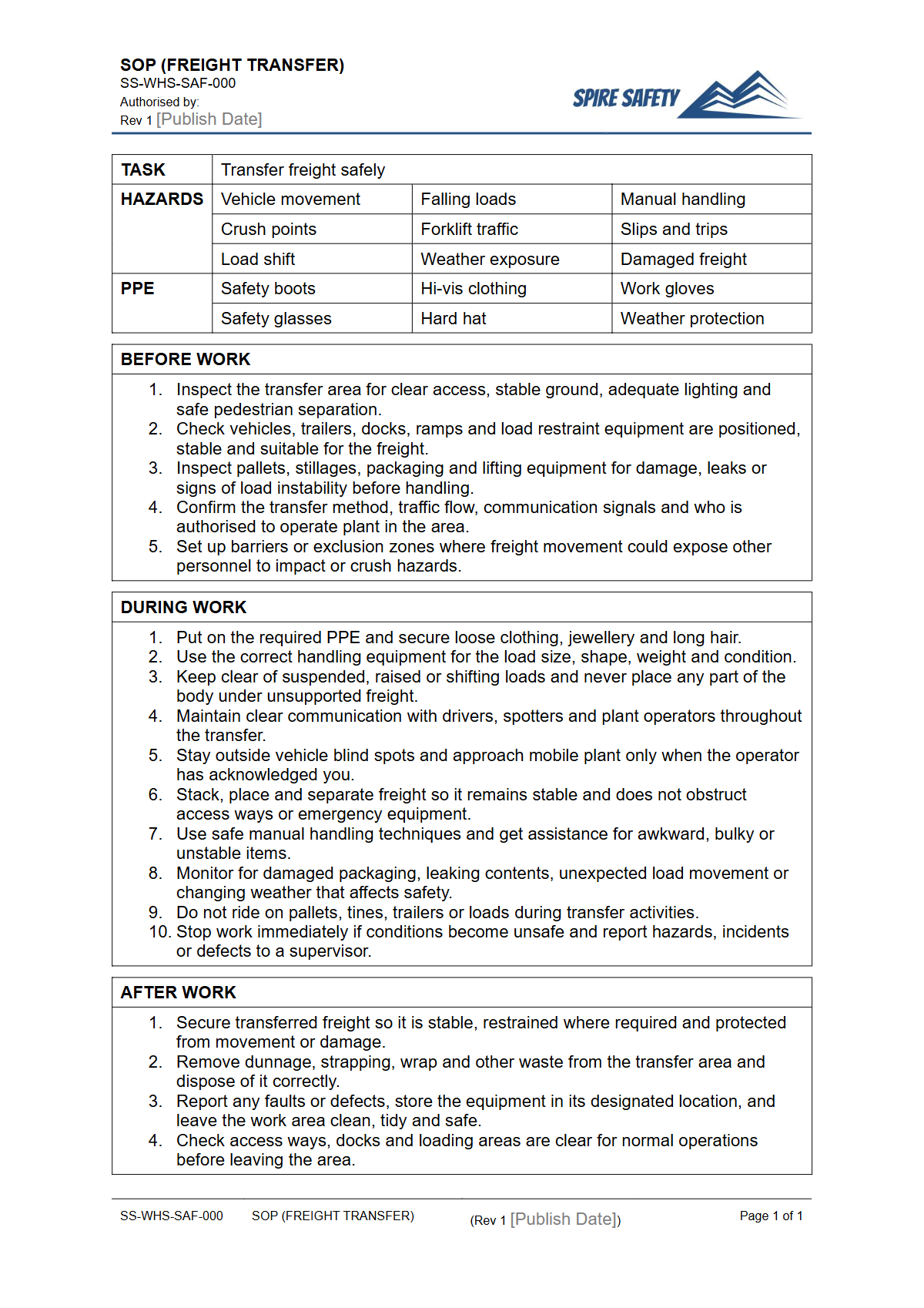
Download our free Safe Operating Procedure (Freight Transfer) template.
Free Safe Operating Procedure (Freight Transfer) Template
DOCX • 126 KB + PDF
Updated Oct 2026
No signup required
Purpose of the Free Safe Operating Procedure (Freight Transfer) Template
Managing the movement of goods in a warehouse, transport depot, or on a client site involves significant WHS risks. This Free Safe Operating Procedure (Freight Transfer) Template provides a structured document for outlining the safest way to perform tasks like loading, unloading, and securing freight.
Its primary purpose is to standardise procedures, minimise risk, and provide a clear, repeatable process for all workers involved.
A well-drafted SOP for freight transfer helps your business control major hazards. These include vehicle and pedestrian interaction in loading bays, musculoskeletal injuries from hazardous manual handling, falls from trucks or loading docks, and incidents caused by unsecured loads.
By documenting required PPE, pre-start checks, and step-by-step instructions, the SOP becomes a critical tool within your broader WHS management system, demonstrating a commitment to proactive risk management and worker safety.
Video walkthrough
How to use the Free Safe Operating Procedure (Freight Transfer) Template
This template is designed as a comprehensive starting point, aligned with Australian WHS principles. To make it effective, you must adapt it to the unique context of your workplace.
Start by downloading the DOCX file and reviewing it with the people who actually perform the work—drivers, forklift operators, and warehouse staff. Their direct input is essential for creating a practical and effective procedure that accurately reflects on-the-ground reality.
During customisation, you must add site-specific information. This includes details about your facility layout, designated traffic management plans, the types of vehicles and freight handled, and the specific equipment used.
For example, if your operations involve specialised machinery, you may need to reference other SOPs, such as a FREE Telehandler SOP Template for heavy or awkward lifts. Update the document with your company branding, emergency contact information, and specific review dates.
Important Note on Customisation
This template provides a structured foundation, but to be effective, you must customise it for your business. We have not seen your site or spoken to your workers.
You must conduct your own risk assessment and adapt this document to reflect your specific hazards, equipment, and control measures. If you require assistance with this process, engaging a WHS consulting service can provide expert guidance.
When to use a Safe Operating Procedure
A freight transfer SOP should not be a document that just sits in a folder. It is an active tool used for day-to-day operations and training.
It should be introduced to new workers during their induction and onboarding process. Use it as the basis for practical, hands-on training to ensure every team member understands the established safe work method.
The SOP should also be readily accessible in the work area, such as in loading bays or vehicle cabins, for easy reference.
The procedure is also a key document during safety reviews and audits. It serves as a benchmark against which actual work practices can be measured.
We recommend reviewing your SOP annually, after any incident or near-miss, or when a new piece of equipment or process is introduced. Regular reviews ensure the document remains relevant and effective, which is a key focus of any WHS compliance audit.
Who should use this procedure
This Safe Operating Procedure is intended for use by a range of personnel within any organisation involved in logistics, transport, warehousing, or manufacturing. This includes:
- Truck Drivers and Operators: To follow step-by-step instructions for safely loading, restraining, and unloading their vehicles.
- Forklift Operators and Warehouse Staff: To understand their role in the freight transfer process, including safe interaction with vehicles and correct manual handling techniques.
- Supervisors and Team Leaders: To train workers, monitor compliance, and enforce the established safety standards on the floor.
- WHS Managers and Officers: To use as a key document for risk assessments, training programs, and incident investigations.
Ultimately, the SOP is a tool for everyone. Clear, documented procedures are vital for coordinating activities safely, especially in a dynamic environment with moving vehicles and people.
This clarity also extends to emergency preparedness, where having documented processes such as a defibrillator operation procedure can save lives. You can explore our complete free WHS resources library for more templates to support your safety management system.
Common mistakes
Common mistakes to avoid
- Using a generic template without customising it with site-specific hazards, equipment, and controls.
- Failing to consult with drivers, operators, and warehouse staff when drafting or reviewing the procedure.
- Not providing adequate training to ensure all workers understand and can follow the SOP.
- Forgetting to review and update the SOP after an incident, near-miss, or a change in process.
Legal references
Legal considerations
The following legal requirements may be relevant to this type of work.
- Work Health and Safety Act (Harmonised) — Provides the primary duties for protecting workers and other people from work health and safety risks.
- Work Health and Safety Regulations (Harmonised) — Sets out requirements supporting the management of workplace hazards and risks.
The following codes may be relevant to this type of work.
- Managing WHS Risks Code of Practice — Provides practical guidance on identifying hazards, assessing risks and applying effective controls.
- Work Health and Safety Consultation, Cooperation and Coordination Code of Practice — Provides practical guidance on consulting workers and coordinating with other duty holders.
- Managing the Work Environment and Facilities Code of Practice — Provides practical guidance on safe work environments, workplace facilities and related controls.
Did you know
A High-Risk Industry
The transport, postal, and warehousing industry has one of the highest rates of serious injury claims in Australia. Incidents involving vehicles are a leading cause of both fatalities and serious injuries.
The Cost of Sprains and Strains
Musculoskeletal disorders, particularly sprains and strains from hazardous manual handling tasks like lifting and carrying freight, are among the most common and costly types of workplace injuries in the logistics sector.
FAQ
Frequently asked questions
01What is a Safe Operating Procedure for freight transfer?
02Who is responsible for creating a freight transfer SOP?
03How often should a freight transfer SOP be reviewed?
04Does this template cover Chain of Responsibility (CoR) laws?
Share this resource
Free Safe Operating Procedure (Freight Transfer) Template
Browse Categories
How To Use It
- 1Download and open in Word or PDF.
- 2Replace the placeholders with your business details.
- 3Get it reviewed by a WHS specialist before rollout.
Need it customised?
Our WHS consultants can adapt this template to your site, run a gap analysis, or audit what you already have in place.
Book a Free Consultation WHS consulting servicesor call 1300 156 382
Related templates
- Free Safe Operating Procedure (Fruit Bin Handling) Template
- Free Safe Operating Procedure (Fruit Grader) Template
- Free Safe Operating Procedure (Fruit Picking) Template
- Free Safe Operating Procedure (Fruit Sorting) Template
- Free Safe Operating Procedure (Fuel Dock Operation) Template
- Free Safe Operating Procedure (Fuel Hydrant Cart) Template