
Free Safe Operating Procedure (Freight Repackaging) Template
Download our free Safe Operating Procedure (Freight Repackaging) template.
Free Safe Operating Procedure (Freight Repackaging) Template
DOCX • 126 KB + PDF
Updated Oct 2026
No signup required
Purpose of the Free Safe Operating Procedure (Freight Repackaging) Template
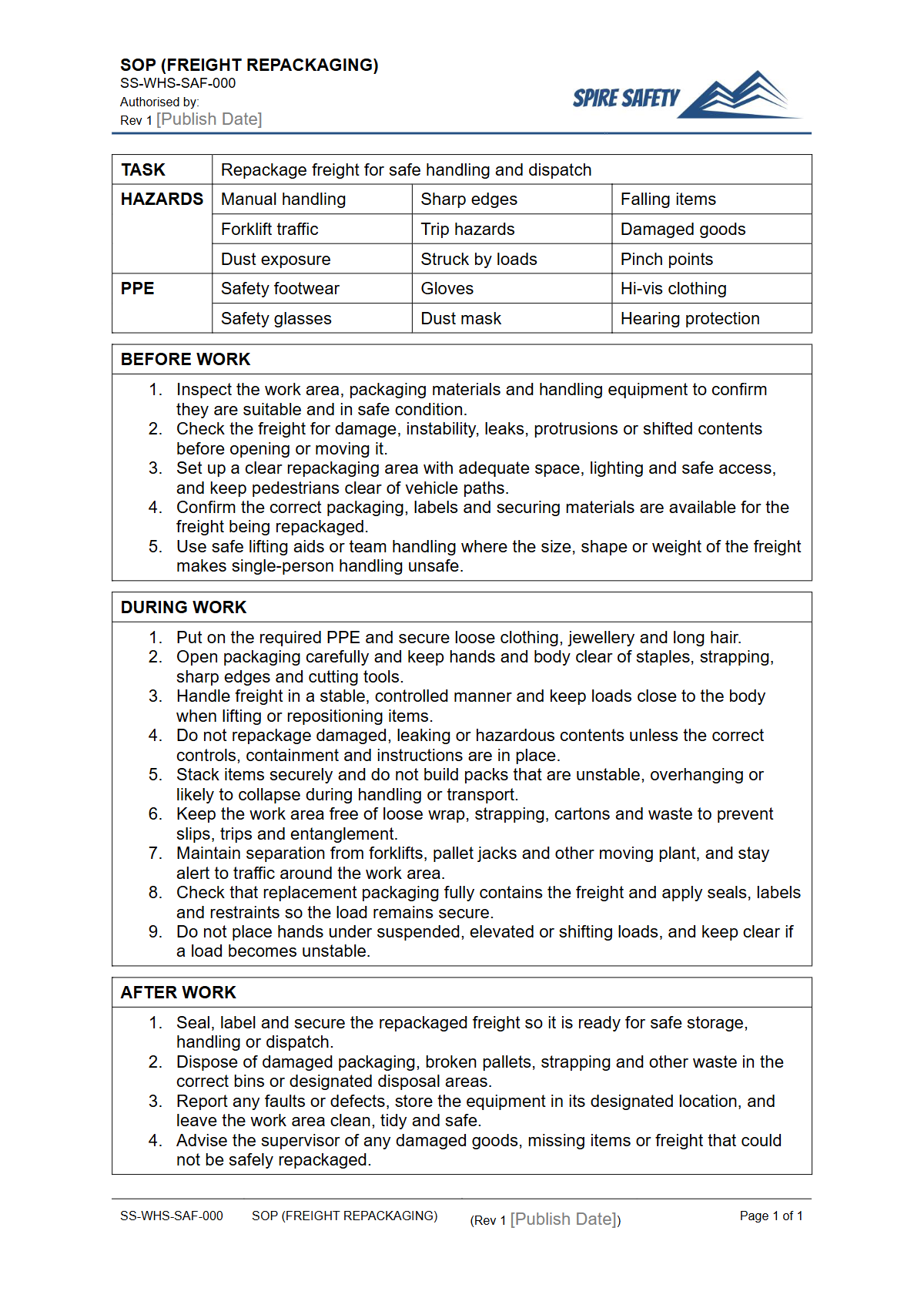
This Free Safe Operating Procedure (Freight Repackaging) Template provides a structured starting point for documenting the risks and controls associated with repackaging goods in a warehouse or logistics environment. Repackaging freight, whether it's breaking down bulk deliveries, consolidating orders, or relabelling items, involves numerous hazards.
These include manual handling injuries, cuts from packing tools, and slips or trips from discarded packaging. Using a standardised SOP helps to ensure all workers perform the task in the same safe, efficient manner every time.
A well-drafted SOP is a fundamental tool for managing workplace risks. It serves as a key training document for new and existing employees, a reference for supervisors, and a benchmark for performance.
Documenting your processes demonstrates a commitment to safety and forms a critical part of more comprehensive WHS management systems, helping your organisation meet its duty of care obligations under Australian WHS legislation.
Key elements covered:
- Required Personal Protective Equipment (PPE) such as gloves and safety footwear.
- Pre-operational checks of the work area and equipment.
- A logical sequence of steps for safely opening, handling, and resealing packages.
- Identification of potential hazards at each step.
- Established risk control measures to eliminate or minimise harm.
- Emergency procedures and shutdown protocols.
Video walkthrough
How to use the Free Safe Operating Procedure (Freight Repackaging) Template
This template is designed for ease of use. It is available for download as a fully editable DOCX file, allowing you to tailor every section to your specific operational needs.
A PDF version is also provided for easy printing and distribution. To effectively implement this procedure, you must first conduct a thorough risk assessment of your freight repackaging tasks in consultation with your workers.
Important: This document is a template only. We are not WHS consultants, and this document does not constitute legal advice.
To ensure it is effective and suitable for your workplace, you must customise it. This involves identifying the specific equipment used (e.g., pallet jacks, box cutters, strapping machines), the types of freight handled, and the unique layout of your work environment. The effectiveness of any safety procedure depends on its relevance and practical application, which can be verified through regular WHS compliance auditing.
When to use a Freight Repackaging SOP
A Safe Operating Procedure for freight repackaging should be a core part of your daily operations. It should be used consistently whenever these tasks are performed. Specific times to refer to the SOP include:
- Worker Training and Induction: Use the SOP as the primary training document to ensure new workers understand the established safe method before they begin the task.
- Pre-Task Planning: Workers and supervisors can review the SOP during pre-start meetings or toolbox talks to refresh their knowledge of hazards and controls.
- Incident Investigation: Following a near miss or injury, the SOP should be reviewed to determine if the procedure was followed and whether it needs to be updated to prevent a recurrence.
- Process Changes: If you introduce new packaging materials, tools, or methods, the SOP must be reviewed and updated accordingly. For complex changes, seeking advice from specialist WHS consulting services can help ensure all new risks are captured.
Who should use this Safe Operating Procedure
This SOP is intended for a broad range of personnel within any organisation that handles and repackages freight. Key users include:
- Workers: The primary users are the employees who perform the repackaging tasks. The procedure should be written in clear, simple language and be easily accessible to them in their work area.
- Supervisors and Team Leaders: Responsible for ensuring workers are trained on the SOP and follow it correctly. They use it to monitor work practices and enforce safety standards.
- WHS Managers and Advisors: Responsible for developing, implementing, and reviewing the SOP as part of the overall safety management system. They ensure it aligns with relevant legislation and codes of practice.
Freight repackaging often involves other tasks, such as working at heights to retrieve stock from racking. It is essential to have procedures for all associated activities. For instance, if workers use ladders to access goods, they must also be trained on your company's ladder safety procedures, which you can develop using our free Step Ladder SOP.
This document is one of many available in our growing free WHS resources library, designed to help Australian businesses build safer workplaces. Explore the library for more templates, checklists, and guides to support your safety efforts.
Common mistakes
Common mistakes to avoid
- Using a generic template without customising it for site-specific hazards and equipment.
- Failing to consult with workers who actually perform the task when drafting the procedure.
- Not providing adequate training to ensure all relevant workers understand and can follow the SOP.
- Forgetting to review and update the SOP after a near miss, incident, or change in process.
Legal references
Legal considerations
The following legal requirements may be relevant to this type of work.
- Work Health and Safety Act (Harmonised) — Provides the primary duties for protecting workers and other people from work health and safety risks.
- Work Health and Safety Regulations (Harmonised) — Sets out requirements supporting the management of workplace hazards and risks.
The following codes may be relevant to this type of work.
- Managing WHS Risks Code of Practice — Provides practical guidance on identifying hazards, assessing risks and applying effective controls.
- Work Health and Safety Consultation, Cooperation and Coordination Code of Practice — Provides practical guidance on consulting workers and coordinating with other duty holders.
- Managing the Work Environment and Facilities Code of Practice — Provides practical guidance on safe work environments, workplace facilities and related controls.
Did you know
Manual Tasks are a Major Issue
According to Safe Work Australia, musculoskeletal disorders resulting from hazardous manual tasks are the most common type of workplace injury, accounting for a significant portion of serious workers' compensation claims.
FAQ
Frequently asked questions
01What should be included in a freight repackaging SOP?
02How often should a Safe Operating Procedure be reviewed?
03Is a Safe Work Method Statement (SWMS) the same as an SOP?
04What are the main hazards in freight repackaging?
Share this resource
Free Safe Operating Procedure (Freight Repackaging) Template
Browse Categories
How To Use It
- 1Download and open in Word or PDF.
- 2Replace the placeholders with your business details.
- 3Get it reviewed by a WHS specialist before rollout.
Need it customised?
Our WHS consultants can adapt this template to your site, run a gap analysis, or audit what you already have in place.
Book a Free Consultation WHS consulting servicesor call 1300 156 382
Related templates
- Free Safe Operating Procedure (Freight Screening) Template
- Free Safe Operating Procedure (Freight Segregation) Template
- Free Safe Operating Procedure (Freight Transfer) Template
- Free Safe Operating Procedure (Fruit Bin Handling) Template
- Free Safe Operating Procedure (Fruit Grader) Template
- Free Safe Operating Procedure (Fruit Picking) Template