
Free Safe Operating Procedure (Freight Bay Allocation) Template
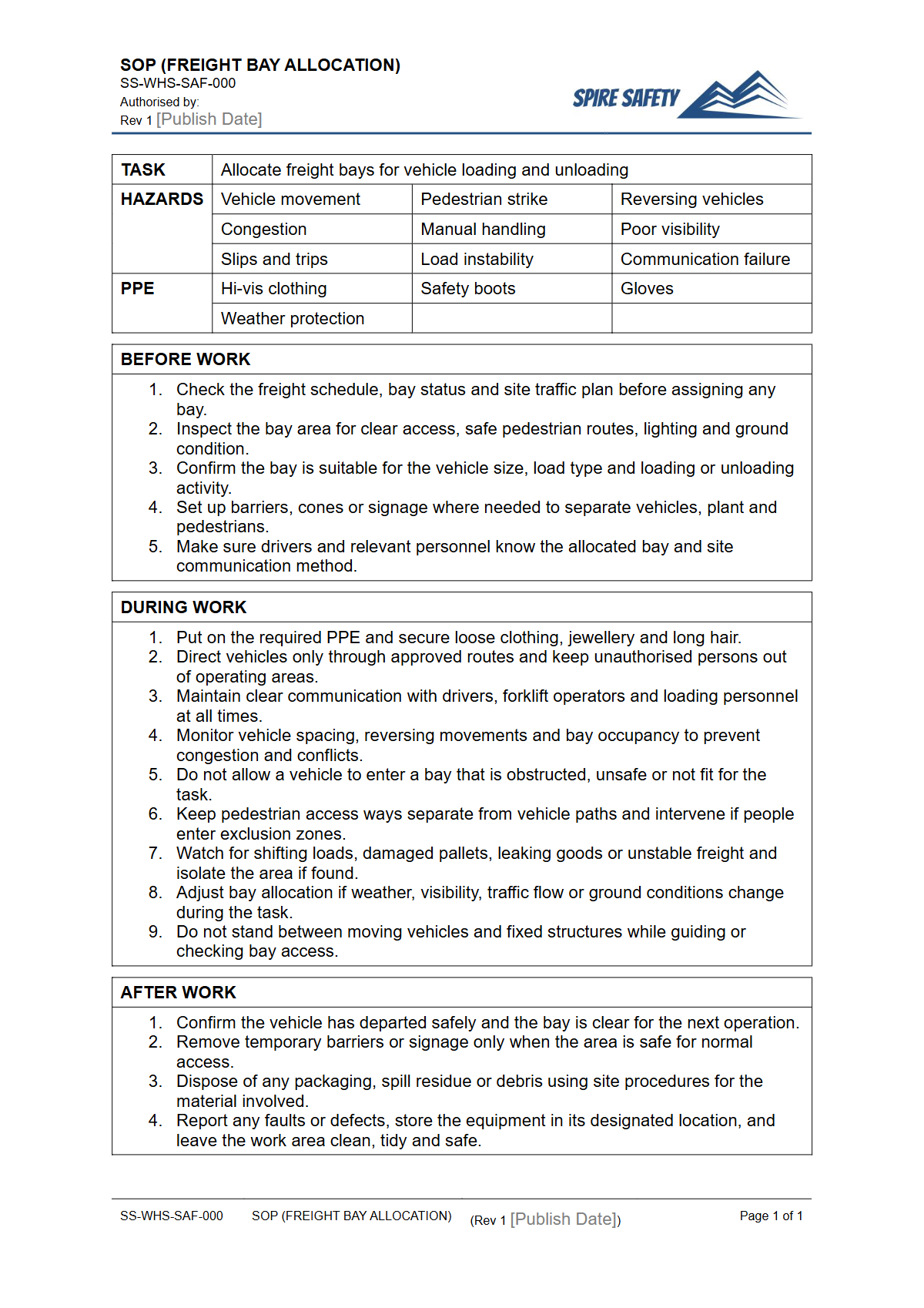
Download our Free Safe Operating Procedure for Freight Bay Allocation template. This customisable DOCX and PDF helps manage traffic and loading/unloading risks.
Free Safe Operating Procedure (Freight Bay Allocation) Template
DOCX • 126 KB + PDF
Updated Oct 2026
No signup required
Purpose of the Free Safe Operating Procedure (Freight Bay Allocation) Template
Managing the movement of vehicles, plant, and people in a freight bay is a high-risk activity. This Free Safe Operating Procedure (Freight Bay Allocation) Template provides a structured framework for controlling these risks in your workplace.
Its purpose is to establish a clear, documented process for assigning vehicles to bays, managing traffic flow, and outlining safe loading and unloading practices. By implementing a formal SOP, you can significantly reduce the likelihood of collisions, crush injuries, falls, and other incidents common in transport and logistics environments.
A systematic approach helps ensure that all personnel, including employees and visiting drivers, understand their roles and responsibilities. This procedure forms a critical component of a broader safety framework, helping your organisation meet its duty of care. Integrating this SOP into your operations demonstrates a proactive commitment to creating a safer work environment and can be a key document within your overall WHS management systems.
Video walkthrough
How to use the Free Safe Operating Procedure (Freight Bay Allocation) Template
This document is a starting point designed for customisation. Download the DOCX file and adapt it to the unique conditions of your site.
You will need to add specific details such as site maps, designated vehicle and pedestrian routes, communication protocols (e.g., using two-way radios), and contact information for key personnel. The procedure should detail the step-by-step process from vehicle arrival to departure, including driver induction, bay assignment, chocking wheels, and final safety checks.
Important: We have developed this template as a guide; you must adapt it to the specific vehicles, loads, layout, and risks of your workplace. A generic procedure is not sufficient for compliance or safety.
Be sure to consult with your workers, including drivers and forklift operators, when customising the document to ensure it is practical and effective. For tasks involving specific equipment like telehandlers, you may also need a supplementary FREE Telehandler SOP (Safe Operating Procedure) Template.
When to use it
This Safe Operating Procedure should be the standard process for any workplace that manages the loading and unloading of goods vehicles. This includes warehouses, distribution centres, manufacturing facilities, construction sites, and large retail operations.
It should be implemented as the default procedure for all freight bay activities, covering both scheduled deliveries and ad-hoc arrivals. The SOP is a vital tool for inducting new workers and visiting drivers, ensuring they are immediately aware of your site's safety rules.
It should also be a central document for regular refresher training and toolbox talks to reinforce safe work practices.
The effectiveness of this SOP should be reviewed periodically as part of your standard safety processes. Regular WHS compliance auditing can help verify that the documented procedures are being followed correctly and remain effective in controlling risks.
Updates may be required if you change the layout of your yard, introduce new types of vehicles or plant, or after any incident or near miss.
Who should use it
This SOP is intended for a range of personnel involved in logistics and site management. Key users include:
- Warehouse and Logistics Managers: To establish and enforce site-wide traffic management and safety rules.
- Supervisors: For day-to-day oversight, worker instruction, and ensuring compliance with the procedure.
- WHS/HSE Officers: As part of risk assessments, incident investigations, and the development of safety systems.
- Workers: Forklift operators, pickers, and packers must understand the procedures for safely interacting with vehicles and moving around the freight bay.
- Vehicle Drivers: Both internal and external drivers must be made aware of the SOP as part of their site induction to understand traffic flow, speed limits, and communication requirements.
If you require expert assistance in tailoring this procedure or developing a comprehensive traffic management plan for your site, our WHS consulting services can provide practical support. It is crucial that procedures are clear and accessible to everyone who works in or enters the area.
The SOP can also reference other critical safety protocols. For example, in the event of a medical emergency within the bay, having a clear and practiced response is essential.
You may consider implementing a procedure such as our Free Safe Operating Procedure (Defibrillator Operation) Template for your first aid team.
For minor tasks at height, like adjusting tarps or inspecting loads where it is safe to do so, workers must use the right equipment. Procedures like a FREE Step Ladder SOP (Safe Operating Procedure) Template can help standardise safe usage.
This freight bay SOP is one of many documents that contribute to a safe system of work, and you can explore our entire free WHS resources library for more templates to support your operations.
Common mistakes
Common mistakes to avoid
- Failing to separate pedestrians from moving vehicles and mobile plant.
- Assuming visiting drivers are familiar with site-specific safety rules and hazards.
- Poor communication between drivers, forklift operators, and other warehouse staff.
- Inadequate lighting or poor housekeeping in the freight bay area, creating trip and slip hazards.
Legal references
Legal considerations
The following legal requirements may be relevant to this type of work.
- Work Health and Safety Act (Harmonised) — Provides the primary duties for protecting workers and other people from work health and safety risks.
- Work Health and Safety Regulations (Harmonised) — Sets out requirements supporting the management of workplace hazards and risks.
The following codes may be relevant to this type of work.
- Managing WHS Risks Code of Practice — Provides practical guidance on identifying hazards, assessing risks and applying effective controls.
- Work Health and Safety Consultation, Cooperation and Coordination Code of Practice — Provides practical guidance on consulting workers and coordinating with other duty holders.
- Managing the Work Environment and Facilities Code of Practice — Provides practical guidance on safe work environments, workplace facilities and related controls.
Did you know
Traffic Management is Key
According to Safe Work Australia, the transport, postal, and warehousing industry has one of the highest rates of serious workers' compensation claims, with vehicle incidents being a major cause.
Loading and Unloading Risks
A significant number of injuries in logistics occur not from driving, but during loading and unloading activities, including falls from vehicles and being struck by falling objects.
FAQ
Frequently asked questions
01What is a Safe Operating Procedure for freight bay allocation?
02Why is traffic management important in a loading bay?
03Does this template cover load restraint?
04Who is responsible for enforcing the freight bay SOP?
Share this resource
Free Safe Operating Procedure (Freight Bay Allocation) Template
Browse Categories
How To Use It
- 1Download and open in Word or PDF.
- 2Replace the placeholders with your business details.
- 3Get it reviewed by a WHS specialist before rollout.
Need it customised?
Our WHS consultants can adapt this template to your site, run a gap analysis, or audit what you already have in place.
Book a Free Consultation WHS consulting servicesor call 1300 156 382
Related templates
- Free Safe Operating Procedure (Freight Damage Reporting) Template
- Free Safe Operating Procedure (Freight Label Check) Template
- Free Safe Operating Procedure (Freight Repackaging) Template
- Free Safe Operating Procedure (Freight Screening) Template
- Free Safe Operating Procedure (Freight Segregation) Template
- Free Safe Operating Procedure (Freight Transfer) Template