
Free Safe Operating Procedure (Forwarder) Template
Download our free Safe Operating Procedure (Forwarder) Template to formalise safe work practices for operating forwarders. Customisable DOCX & PDF.
Free Safe Operating Procedure (Forwarder) Template
DOCX • 126 KB + PDF
Updated Oct 2026
No signup required
Purpose of the Free Safe Operating Procedure (Forwarder) Template
Operating a forwarder involves significant risks, from rollovers on uneven terrain to hazards associated with loading, unloading, and transporting heavy logs. This free Safe Operating Procedure (Forwarder) Template provides a structured framework for documenting the step-by-step process required to operate this machinery safely.
Formalising these steps is a critical control measure for any organisation using heavy plant. An effective SOP is a key document within a comprehensive WHS management system, helping to ensure tasks are performed consistently and safely by all operators.
This template is designed to help you outline key safety requirements, from pre-start checks to emergency shutdown procedures. It serves as a vital tool for operator training, competency assessments, and demonstrating due diligence in managing workplace hazards.
By clearly defining expected behaviours and safety protocols, you can significantly reduce the risk of incidents, equipment damage, and serious injuries on your worksite, particularly in forestry, civil construction, or large-scale agriculture.
Video walkthrough
How to use the Free Safe Operating Procedure (Forwarder) Template
This Safe Operating Procedure template is provided as a fully editable DOCX file, allowing for easy customisation, and a PDF for quick printing and distribution. To use it effectively, download the document and begin adapting it to the specific context of your operations.
Important: This is a template, not a finished document. We strongly advise that you customise it to reflect the specific forwarder models, attachments, site conditions, local hazards, and operational procedures unique to your workplace.
Consultation is key; involve experienced operators, supervisors, and health and safety representatives in the drafting and review process to ensure the SOP is practical, accurate, and reflects how the work is actually done. You can also reference other relevant documents, like our free Dozer SOP template, for similar heavy equipment.
When to use a Forwarder Safe Operating Procedure
A Safe Operating Procedure for a forwarder should be a living document that is used consistently throughout the equipment's lifecycle at your workplace. It is not a document to be filed away and forgotten. It should be used:
- As a primary training document for new or inexperienced operators.
- During inductions for any worker required to operate or work near the forwarder.
- As a reference for pre-operational inspections and post-start checks.
- For conducting refresher training to prevent complacency and reinforce safe habits.
- As a basis for toolbox talks focusing on specific forwarder-related hazards.
- During investigations following an incident or near-miss to identify procedural gaps.
- When a new model of forwarder is introduced to the workplace, requiring updated procedures.
Using the SOP consistently helps embed a culture of safety and ensures that standards do not slip over time. It can be used alongside procedures for other earthmoving equipment, such as the process outlined in our free Scraper SOP template.
Who should use this Safe Operating Procedure
This SOP is intended for a range of personnel within an organisation to ensure a shared understanding of safety requirements. The primary users are:
- Forwarder Operators: To understand and follow the approved, safe method for completing their tasks.
- Supervisors and Managers: To train workers, monitor compliance, and enforce safe work standards on site.
- WHS/HSE Professionals: To develop, implement, and review safety documentation as part of the overall WHS management system.
- Trainers and Assessors: To conduct and verify operator competency against an established benchmark.
Ultimately, the Person Conducting a Business or Undertaking (PCBU) is responsible for providing safe systems of work. This SOP is a tool that helps them fulfil that duty. Its implementation and effectiveness can be verified through processes like regular WHS compliance auditing.
Key elements of a robust Forwarder SOP
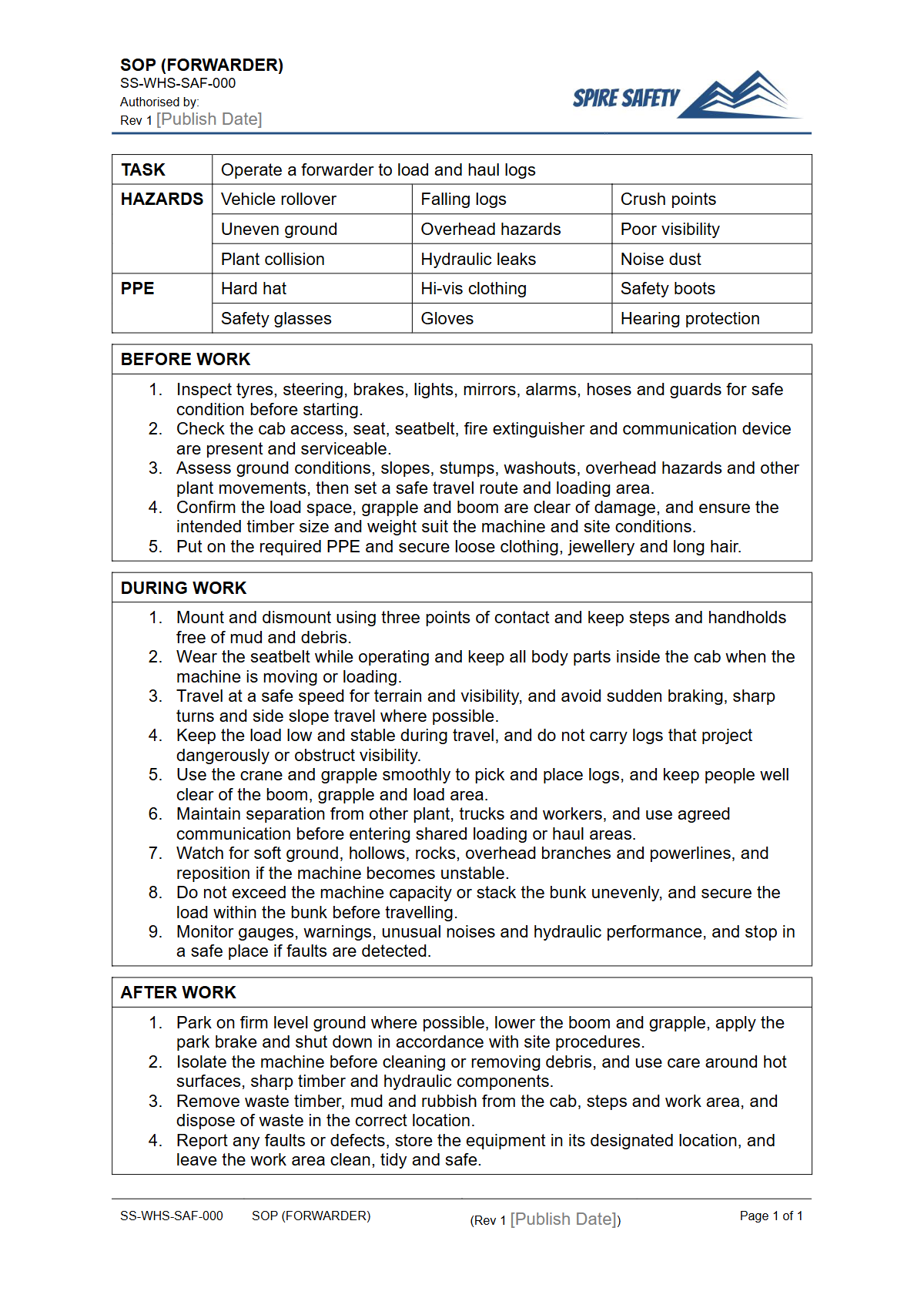
A thorough forwarder SOP moves beyond generic statements and provides clear, actionable instructions. Our template guides you to include critical safety information across several key areas to ensure comprehensive coverage. These sections include:
- Required PPE: Specifies mandatory personal protective equipment, such as high-visibility clothing, steel-capped boots, hard hats, gloves, and hearing protection.
- Pre-Operational Checks: A detailed checklist for inspecting the machine before use, covering fluid levels, tyre condition, hydraulic systems, guards, lights, and control functions.
- Operational Procedures: Step-by-step guidance for starting, operating on various gradients, interacting with other vehicles, using the crane and grapple, and safely loading and unloading materials. It's crucial this section is tailored to your site's specific terrain and tasks, similar to how our free Telehandler SOP template addresses load management.
- Shutdown Procedures: The correct sequence for parking the machine, lowering attachments, shutting down the engine, and securing it against unauthorised use.
- Emergency Procedures: Clear instructions for dealing with fire, mechanical failure, hydraulic fluid spills, or rollover incidents.
By thoroughly completing each section, you create a document that is both a compliance tool and a practical guide for operators. If you require further assistance tailoring these documents, consider engaging professional WHS consulting services.
Common mistakes
Common mistakes to avoid
- Using the template without customising it for specific machine models and site conditions.
- Writing the SOP without consulting the experienced operators who use the equipment daily.
- Failing to review and update the SOP after an incident or when operational processes change.
- Not providing adequate training on the SOP, assuming workers will read and understand it on their own.
Legal references
Legal considerations
The following legal requirements may be relevant to this type of work.
- Work Health and Safety Act (Harmonised) — Provides the primary duties for protecting workers and other people from work health and safety risks.
- Work Health and Safety Regulations (Harmonised) — Sets out requirements supporting the management of workplace hazards and risks.
The following codes may be relevant to this type of work.
- Managing WHS Risks Code of Practice — Provides practical guidance on identifying hazards, assessing risks and applying effective controls.
- Work Health and Safety Consultation, Cooperation and Coordination Code of Practice — Provides practical guidance on consulting workers and coordinating with other duty holders.
- Managing the Work Environment and Facilities Code of Practice — Provides practical guidance on safe work environments, workplace facilities and related controls.
Did you know
Operator Competency
In Australia, incidents involving powered mobile plant are a leading cause of workplace fatalities and serious injuries. A well-developed SOP is a critical part of ensuring operators are competent and aware of the risks.
Machine Capacity
Modern forwarders are powerful machines capable of carrying loads exceeding 20 tonnes. Operating beyond the machine's rated capacity, especially on slopes, is a primary contributor to stability-related incidents like rollovers.
FAQ
Frequently asked questions
01What are the main hazards of operating a forwarder?
02Is an SOP a legal requirement for operating a forwarder in Australia?
03How often should a forwarder SOP be reviewed?
04Can I use a generic SOP for different types of heavy machinery?
Share this resource
Free Safe Operating Procedure (Forwarder) Template
Browse Categories
How To Use It
- 1Download and open in Word or PDF.
- 2Replace the placeholders with your business details.
- 3Get it reviewed by a WHS specialist before rollout.
Need it customised?
Our WHS consultants can adapt this template to your site, run a gap analysis, or audit what you already have in place.
Book a Free Consultation WHS consulting servicesor call 1300 156 382
Related templates
- Free Safe Operating Procedure (Freezer Stocking) Template
- Free Safe Operating Procedure (Freight Bay Allocation) Template
- Free Safe Operating Procedure (Freight Damage Reporting) Template
- Free Safe Operating Procedure (Freight Label Check) Template
- Free Safe Operating Procedure (Freight Repackaging) Template
- Free Safe Operating Procedure (Freight Screening) Template