
Free Safe Operating Procedure (Forklift - Battery LPG Changeover) Template
Download our free Safe Operating Procedure (Forklift - Battery LPG Changeover) Template.
Free Safe Operating Procedure (Forklift - Battery LPG Changeover) Template
DOCX • 145 KB + PDF
Updated Oct 2026
No signup required
Purpose of the Free Safe Operating Procedure (Forklift - Battery LPG Changeover) Template
Effectively managing forklift operations involves more than just driving. The maintenance tasks of changing batteries on electric models and swapping LPG cylinders on gas-powered units present significant hazards.
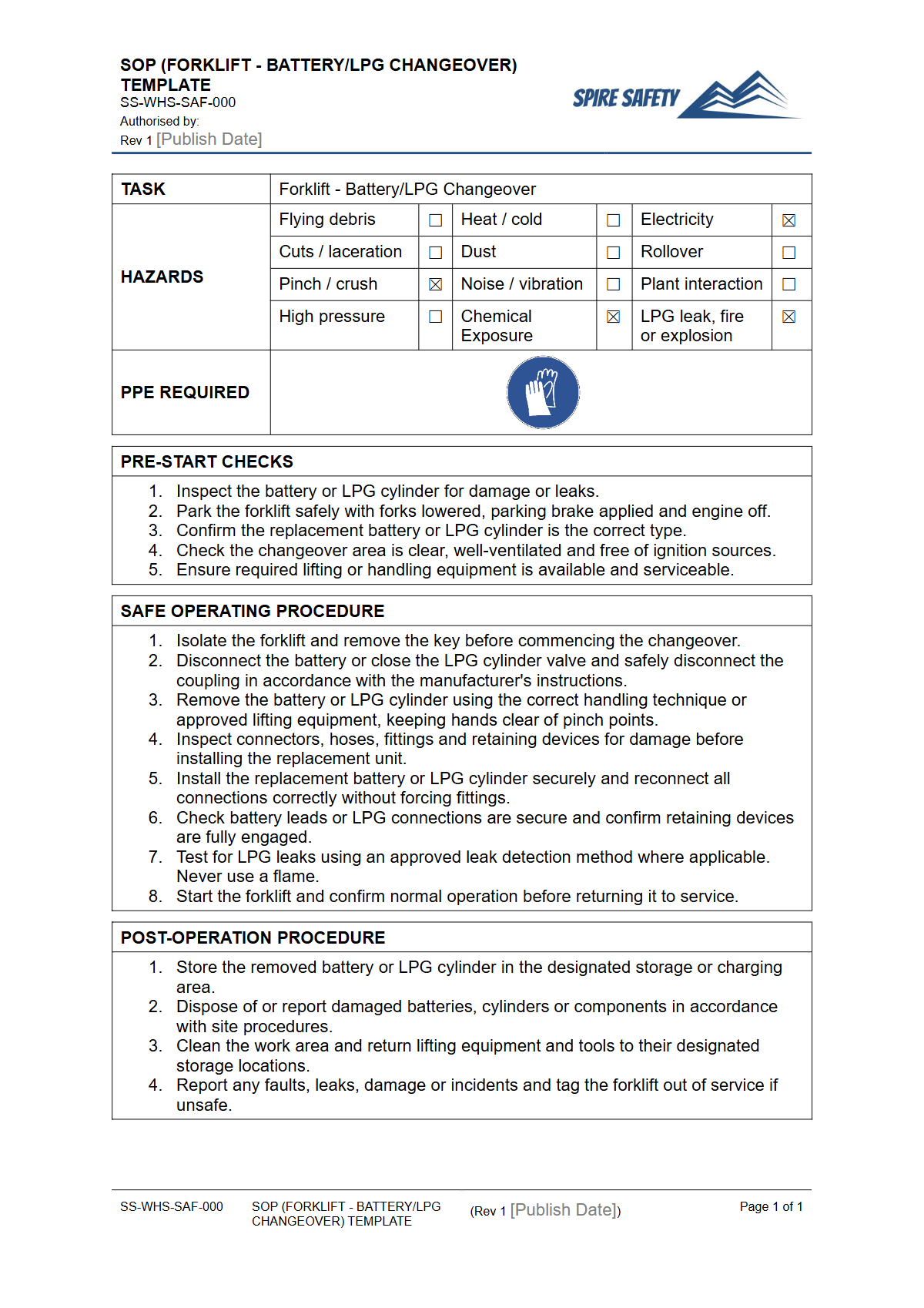
This free Safe Operating Procedure (Forklift - Battery LPG Changeover) Template provides a structured framework for documenting the specific, step-by-step controls required to perform these tasks safely. Using this template helps standardise your process, reduce the risk of incidents like acid spills, electric shock, fires, or musculoskeletal injuries, and provides a clear basis for worker training and competency verification.
A dedicated SOP for this task is a crucial component of your overall forklift safety protocols. While a general forklift operation SOP covers driving and load handling, this document isolates the specific risks associated with energy source changeovers.
It guides operators through pre-task checks, required personal protective equipment (PPE), safe disconnection and connection sequences, and post-task verifications, ensuring a consistent and safe method is followed every time.
Video walkthrough
How to use the Free Safe Operating Procedure (Forklift - Battery LPG Changeover) Template
This document is a template and must be customised to your specific workplace. We provide this as a starting point; it is your responsibility to ensure it is adapted to your site's unique environment, equipment, and legal obligations.
To use the template effectively, you should conduct a specific risk assessment for the battery and LPG changeover tasks at your site. Incorporate details from your forklift manufacturer’s operating manual, the specifications of your battery charging equipment, and the layout of your LPG cylinder storage area.
Your customisation should include details such as the specific type of lifting equipment used for batteries (e.g., gantry crane, specialised cart), the location of emergency eyewash stations and fire extinguishers, and contact details for supervisors or first aid officers. This detailed procedure then becomes an integral part of your broader WHS management system, providing auditable evidence of your commitment to managing high-risk tasks. For forklifts with specialised attachments, it's also important to have dedicated procedures, like our FREE Forklift Jib SOP Template.
Key Areas to Customise:
- Personal Protective Equipment (PPE): Specify the exact type of gloves (e.g., acid-resistant, thermal), eye protection (e.g., face shield, goggles), and footwear required.
- Equipment Details: Name the specific forklift makes and models the SOP applies to.
- Battery Changeover: Detail the steps for using your specific battery lifting/transfer equipment and connecting to your charging station.
- LPG Changeover: Outline the process for moving the forklift to the designated, well-ventilated refuelling area and the method for checking the new connection for leaks (e.g., soapy water solution).
- Emergency Procedures: List site-specific steps for responding to an acid spill, gas leak, fire, or injury.
When to use this Safe Operating Procedure
This Safe Operating Procedure should be the primary reference document whenever a forklift battery is changed or an LPG cylinder is replaced. It forms the foundation for several key WHS activities.
It must be used during the initial training and induction of any worker authorised to perform these tasks. It should also be used for periodic refresher training and when conducting competency assessments to verify that operators retain the required knowledge and skills.
Placing a laminated copy in the battery charging bay and near the LPG storage cage ensures it is always accessible at the point of use.
Who should use this Safe Operating Procedure
The primary users of this SOP are the trained and authorised workers who physically perform the battery or LPG cylinder changeover. They must follow the documented steps without deviation.
Supervisors and team leaders also use the SOP as a tool for monitoring work practices, conducting safety observations, and leading pre-start toolbox talks on the task. WHS managers and personnel are responsible for developing, reviewing, and updating the SOP in consultation with workers, ensuring it remains current and reflects best practices.
For organisations needing assistance with developing and implementing such procedures, engaging with WHS consulting professionals can provide valuable expertise.
Regularly reviewing and updating your SOPs is a critical part of maintaining a safe workplace. This review can be triggered by an incident, a change in equipment or process, or as part of a scheduled WHS compliance audit. This ensures your documented procedures never become outdated.
Similar rigorous procedures are essential for other high-risk plant, and our template for a Front End Loader SOP follows the same principles. You can find many more structured templates in our complete free WHS resources library to help build out your safety system.
Common mistakes
Common mistakes to avoid
- Wearing rings, watches, or other metal jewellery while working with batteries, which creates a severe electric shock risk.
- Failing to check for leaks using a soapy water solution after connecting a new LPG cylinder.
- Attempting to manually move or adjust a heavy battery without the correct mechanical lifting aids.
- Performing a battery or LPG changeover in a poorly ventilated area or near an ignition source.
Legal references
Legal considerations
The following legal requirements may be relevant to this type of work.
- Work Health and Safety Act (Harmonised) — Provides the primary duties for protecting workers and other people from work health and safety risks.
- Work Health and Safety Regulations (Harmonised) — Sets out requirements supporting the management of workplace hazards and risks.
The following codes may be relevant to this type of work.
- Managing WHS Risks Code of Practice — Provides practical guidance on identifying hazards, assessing risks and applying effective controls.
- Work Health and Safety Consultation, Cooperation and Coordination Code of Practice — Provides practical guidance on consulting workers and coordinating with other duty holders.
- Managing the Work Environment and Facilities Code of Practice — Provides practical guidance on safe work environments, workplace facilities and related controls.
Did you know
Heavy Lifting
A typical industrial forklift battery can weigh between 500 kg and 1,800 kg, making mechanical lifting equipment an absolute necessity for safe handling.
Gas Properties
LPG is heavier than air. In the event of a leak in an enclosed space, the vapour can accumulate in low-lying areas like service pits, creating a serious and often invisible fire or explosion hazard.
FAQ
Frequently asked questions
01What PPE is required for changing a forklift battery?
02How do you safely disconnect an LPG cylinder from a forklift?
03Is a Safe Operating Procedure a legal requirement in Australia?
04How often should an SOP for forklift battery/LPG changeover be reviewed?
Share this resource
Free Safe Operating Procedure (Forklift - Battery LPG Changeover) Template
Browse Categories
How To Use It
- 1Download and open in Word or PDF.
- 2Replace the placeholders with your business details.
- 3Get it reviewed by a WHS specialist before rollout.
Need it customised?
Our WHS consultants can adapt this template to your site, run a gap analysis, or audit what you already have in place.
Book a Free Consultation WHS consulting servicesor call 1300 156 382
Related templates
- Free Safe Operating Procedure (Forwarder) Template
- Free Safe Operating Procedure (Freezer Stocking) Template
- Free Safe Operating Procedure (Freight Bay Allocation) Template
- Free Safe Operating Procedure (Freight Damage Reporting) Template
- Free Safe Operating Procedure (Freight Label Check) Template
- Free Safe Operating Procedure (Freight Repackaging) Template