
Free Safe Operating Procedure (Footpath Cleaning) Template
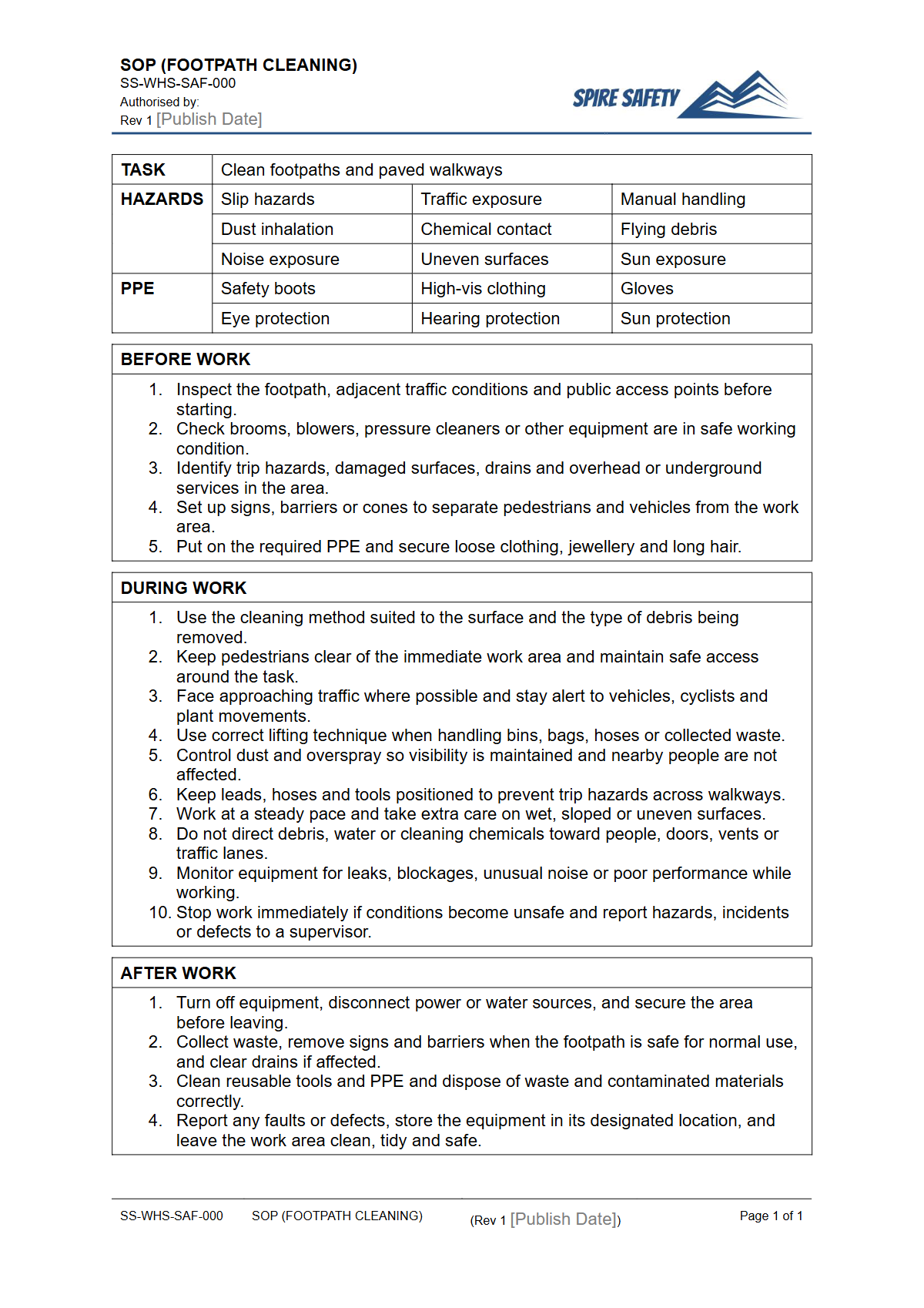
Download our free Safe Operating Procedure (Footpath Cleaning) Template. This customisable DOCX and PDF helps you document safe work practices for your team.
Free Safe Operating Procedure (Footpath Cleaning) Template
DOCX • 126 KB + PDF
Updated Oct 2026
No signup required
Purpose of the Free Safe Operating Procedure (Footpath Cleaning) Template
Footpath cleaning, while seemingly straightforward, involves a range of hazards that must be carefully managed. This free Safe Operating Procedure (Footpath Cleaning) template provides a structured framework for documenting the step-by-step process for this task, helping your organisation meet its work health and safety obligations.
It prompts you to consider hazards such as high-pressure water, slips and trips, public interaction, noise, and potential chemical exposure.
A well-defined SOP is a cornerstone of any effective WHS management system, ensuring that safety standards are applied consistently across all jobs and by all personnel. Using this template helps standardise your approach, reduce the risk of incidents, and demonstrate a commitment to safe work practices.
Video walkthrough
How to use the Free Safe Operating Procedure (Footpath Cleaning) Template
This resource is available as both a DOCX file for easy editing and a PDF for universal access. To use it effectively, follow these steps:
- Download the template in your preferred format.
- Carefully review each section, including pre-operational checks, operational steps, and post-operational procedures.
- Customise the document to reflect the specific equipment (e.g., pressure washer model), cleaning agents, and typical work environments your team encounters.
- Incorporate the findings from your own site-specific risk assessments.
It's vital to remember that this is a template, not a finished document. We have designed it as a comprehensive starting point, but you must adapt it to your unique operational context.
If you are unsure how to tailor this document or conduct the necessary risk assessments, engaging professional WHS consulting services can provide expert guidance.
Integrating with Risk Management
An SOP is most effective when it is born from a thorough risk assessment. The process of customising this template should involve identifying all potential hazards associated with footpath cleaning in your specific context.
This includes evaluating risks to operators, the public, and the surrounding environment. While this SOP covers a specific task, your workplace likely has other equipment requiring formal procedures, such as those detailed in our free Air Compressor SOP.
Part of a thorough risk assessment involves preparing for worst-case scenarios. Ensuring your team is trained using a defibrillator operation procedure can be a life-saving component of your emergency plan for any worksite.
When to use it
A Safe Operating Procedure for footpath cleaning should be a living document integrated into your daily operations. It is not a file to be completed once and archived. Use it for:
- Worker Training: Inducting new employees or training existing staff on the correct, safe method for footpath cleaning.
- Pre-start Meetings: Reviewing the SOP during toolbox talks before work begins to refresh knowledge and highlight site-specific hazards.
- On-the-Job Reference: Providing a quick reference for workers to consult if they are unsure about a step in the process.
- Incident Investigation: Using it as a benchmark to understand if procedural deviations contributed to a near miss or incident.
Regular reviews of your procedures are essential for maintaining a safe workplace. A formal WHS compliance audit can help verify that your documented procedures are being followed correctly in practice and remain effective.
Who should use it
This template is designed for use by various personnel within an organisation:
- Operators: The primary users are the workers who perform the footpath cleaning. The SOP provides clear, sequential instructions to guide their work safely.
- Supervisors and Team Leaders: Managers use the SOP to supervise work, supports your compliance efforts with safety standards, and conduct competency assessments.
- WHS Managers and Advisors: Safety professionals use the template as a foundation for developing and implementing a key part of their safety management system.
If your cleaning tasks involve reaching even slightly elevated areas to clean awnings or building facades, you must also consider fall hazards. In such cases, you may need additional procedures like our free Step Ladder SOP template to manage those specific risks.
By implementing and consistently using this SOP, your organisation can promote a proactive safety culture. Explore our complete free WHS resources library for more templates and guides to support your safety management efforts.
Common mistakes
Common mistakes to avoid
- Failing to erect adequate barriers and warning signs to protect pedestrians from slip hazards and high-pressure spray.
- Creating trip hazards by running hoses across active walkways without proper covers or management.
- Not managing water and chemical runoff, potentially causing environmental harm or creating slip hazards in adjacent areas.
- Using incorrect pressure settings or nozzles, which can damage the footpath surface or increase the risk of injury.
Legal references
Legal considerations
The following legal requirements may be relevant to this type of work.
- Work Health and Safety Act (Harmonised) — Provides the primary duties for protecting workers and other people from work health and safety risks.
- Work Health and Safety Regulations (Harmonised) — Sets out requirements supporting the management of workplace hazards and risks.
The following codes may be relevant to this type of work.
- Managing WHS Risks Code of Practice — Provides practical guidance on identifying hazards, assessing risks and applying effective controls.
- Work Health and Safety Consultation, Cooperation and Coordination Code of Practice — Provides practical guidance on consulting workers and coordinating with other duty holders.
- Managing the Work Environment and Facilities Code of Practice — Provides practical guidance on safe work environments, workplace facilities and related controls.
Did you know
Slips, Trips, and Falls
According to Safe Work Australia, slips, trips and falls are a leading cause of serious workplace injuries, making management of wet surfaces and hoses during cleaning a critical safety control.
High-Pressure Injection Injury
High-pressure water from a pressure washer can penetrate the skin and cause a severe injection injury. These injuries often appear minor initially but can lead to serious complications, including tissue damage and infection, requiring immediate medical attention.
FAQ
Frequently asked questions
01What are the main hazards in footpath cleaning?
02Do I need a Safe Work Method Statement (SWMS) for footpath cleaning?
03How should I manage public access during footpath cleaning?
04What PPE is typically required for footpath cleaning?
Share this resource
Free Safe Operating Procedure (Footpath Cleaning) Template
Browse Categories
How To Use It
- 1Download and open in Word or PDF.
- 2Replace the placeholders with your business details.
- 3Get it reviewed by a WHS specialist before rollout.
Need it customised?
Our WHS consultants can adapt this template to your site, run a gap analysis, or audit what you already have in place.
Book a Free Consultation WHS consulting servicesor call 1300 156 382
Related templates
- Free Safe Operating Procedure (Footstool Cleaning) Template
- Free Safe Operating Procedure (Forestry Harvester) Template
- Free Safe Operating Procedure (Forklift - Battery LPG Changeover) Template
- Free Safe Operating Procedure (Forwarder) Template
- Free Safe Operating Procedure (Freezer Stocking) Template
- Free Safe Operating Procedure (Freight Bay Allocation) Template