
Free Safe Operating Procedure (Footstool Cleaning) Template
Download our free Safe Operating Procedure (Footstool Cleaning) template.
Free Safe Operating Procedure (Footstool Cleaning) Template
DOCX • 126 KB + PDF
Updated Oct 2026
No signup required
Purpose of the Free Safe Operating Procedure (Footstool Cleaning) Template
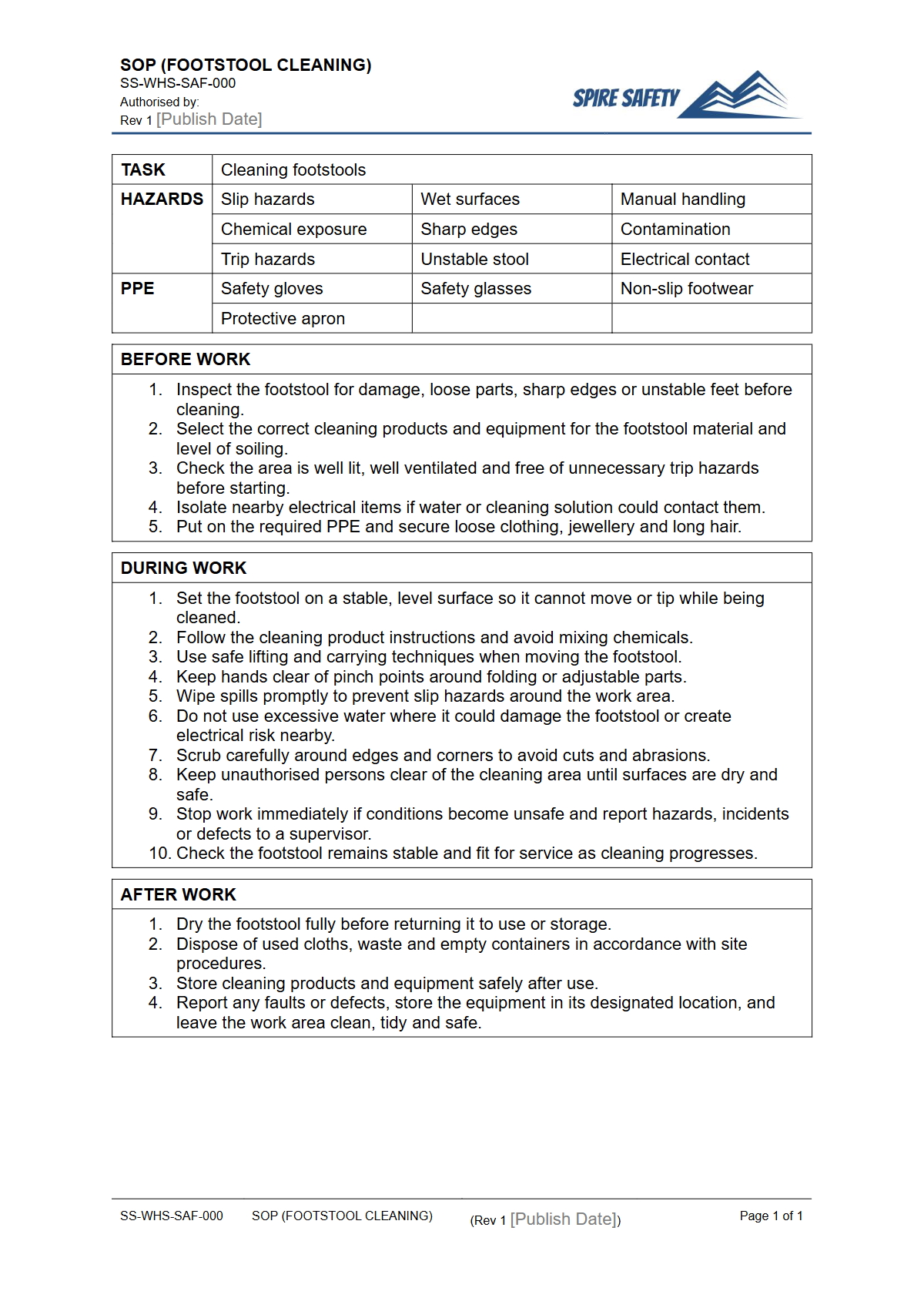
Establishing clear, documented processes is fundamental to workplace safety. This free Safe Operating Procedure (Footstool Cleaning) template provides a structured starting point for formalising how your team should safely clean footstools and similar low-level platforms.
The primary purpose of this Safe Operating Procedure is to standardise the task, ensuring it is performed consistently and safely every time, regardless of who is performing it.
By clearly outlining the steps, required personal protective equipment (PPE), and potential hazards, this SOP helps control risks associated with the task. These risks can include manual handling injuries from moving the item, exposure to cleaning chemicals, ergonomic strain from awkward postures, and creating slip or trip hazards. Implementing this procedure is a practical step towards fulfilling your duty of care and is a core component of effective WHS management systems.
Video walkthrough
How to use the Free Safe Operating Procedure (Footstool Cleaning) Template
This resource is available as a fully editable DOCX file and a print-ready PDF. To get the most value, you should use the DOCX version and adapt it to the specific context of your workplace.
A generic procedure is not sufficient; it must reflect your unique environment, equipment, and chemicals.
Note: This document is a template only. We strongly advise that you customise it by consulting with your workers to ensure it addresses all site-specific hazards. You must add details such as:
- Specific names and models of the footstools in use.
- The exact cleaning chemicals approved for use (referencing their Safety Data Sheets).
- Site-specific emergency procedures and contact details.
- The type of PPE required, based on your risk assessment.
- Pre-operational checks, such as inspecting the footstool for cracks or instability before cleaning begins.
For guidance on structuring procedures for similar equipment, you might consider our FREE Step Ladder SOP (Safe Operating Procedure) Template, which addresses risks associated with low-level access equipment.
When to use it
A Safe Operating Procedure for footstool cleaning should be used in several key situations. It forms the basis of training for new employees or existing staff who are assigned the task for the first time.
It ensures they understand the approved method and associated risks from day one.
The SOP also serves as a crucial reference document for periodic refresher training, helping to prevent procedural drift and the formation of unsafe habits. It should be readily accessible in the work area for workers to consult if they are unsure about a step.
Furthermore, it becomes a key document during WHS compliance auditing and can be reviewed as part of any incident investigation involving cleaning tasks or the use of a footstool.
Who should use it
This Safe Operating Procedure is primarily intended for the workers who perform the cleaning task, such as cleaners, maintenance staff, or general duties officers. They are the end-users who must understand and follow the procedure to ensure their own safety and the safety of others.
Supervisors and managers also have a critical role. They must use the SOP to train their teams, supervise the work to ensure it is being followed correctly, and initiate reviews of the procedure when necessary.
WHS professionals can use this template as a foundation for developing a comprehensive suite of cleaning procedures across the organisation. If you need help tailoring this and other documents to your specific operational needs, consider seeking professional guidance through our WHS consulting services. For more templates and checklists, browse our complete free WHS resources library.
Common mistakes
Common mistakes to avoid
- Using a generic cleaning procedure that doesn't account for the footstool's specific material (e.g., fabric vs. plastic vs. metal).
- Failing to let the footstool dry completely before returning it to service, creating a slip hazard for the next user.
- Neglecting to inspect the footstool for damage (e.g., cracks, loose parts) before or after cleaning.
- Storing cleaning chemicals incorrectly or in unlabelled containers.
Legal references
Legal considerations
The following legal requirements may be relevant to this type of work.
- Work Health and Safety Act (Harmonised) — Provides the primary duties for protecting workers and other people from work health and safety risks.
- Work Health and Safety Regulations (Harmonised) — Sets out requirements supporting the management of workplace hazards and risks.
The following codes may be relevant to this type of work.
- Managing WHS Risks Code of Practice — Provides practical guidance on identifying hazards, assessing risks and applying effective controls.
- Work Health and Safety Consultation, Cooperation and Coordination Code of Practice — Provides practical guidance on consulting workers and coordinating with other duty holders.
- Managing the Work Environment and Facilities Code of Practice — Provides practical guidance on safe work environments, workplace facilities and related controls.
Did you know
Slips, Trips, and Falls
Slips, trips, and falls are a leading cause of serious injuries in Australian workplaces, making proper cleaning and drying procedures for all floor-level items critically important.
Chemical Safety
Even common cleaning products can be hazardous. A Safety Data Sheet (SDS) must be available for every chemical used, outlining its risks and first aid measures.
FAQ
Frequently asked questions
01What are the main hazards when cleaning a footstool?
02Is a Safe Operating Procedure legally required for cleaning a footstool?
03How often should a footstool cleaning SOP be reviewed?
04Can I use this template for cleaning other small items of furniture?
Share this resource
Free Safe Operating Procedure (Footstool Cleaning) Template
Browse Categories
How To Use It
- 1Download and open in Word or PDF.
- 2Replace the placeholders with your business details.
- 3Get it reviewed by a WHS specialist before rollout.
Need it customised?
Our WHS consultants can adapt this template to your site, run a gap analysis, or audit what you already have in place.
Book a Free Consultation WHS consulting servicesor call 1300 156 382
Related templates
- Free Safe Operating Procedure (Forestry Harvester) Template
- Free Safe Operating Procedure (Forklift - Battery LPG Changeover) Template
- Free Safe Operating Procedure (Forwarder) Template
- Free Safe Operating Procedure (Freezer Stocking) Template
- Free Safe Operating Procedure (Freight Bay Allocation) Template
- Free Safe Operating Procedure (Freight Damage Reporting) Template