
Free Safe Operating Procedure (Food Tray Delivery) Template
Download our free Safe Operating Procedure (Food Tray Delivery) template.
Free Safe Operating Procedure (Food Tray Delivery) Template
DOCX • 126 KB + PDF
Updated Oct 2026
No signup required
Purpose of the Free Safe Operating Procedure (Food Tray Delivery) Template
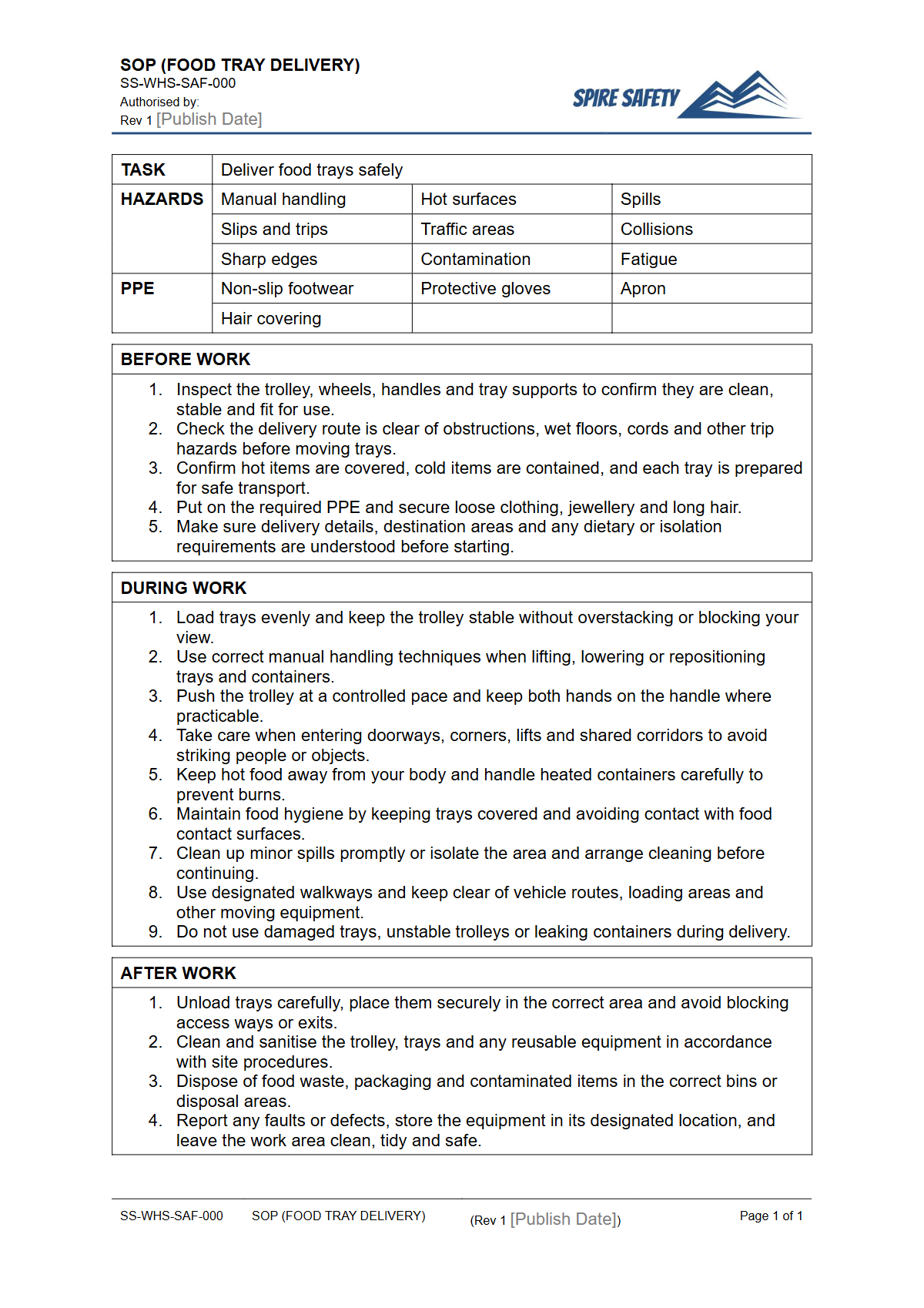
This Free Safe Operating Procedure (Food Tray Delivery) Template provides a structured framework for documenting the safest way to perform food and beverage tray delivery tasks. It is designed to help persons conducting a business or undertaking (PCBUs) manage common risks associated with this activity, which is prevalent in healthcare, aged care, hospitality, and room service environments.
The primary goal is to minimise the risk of injury, particularly musculoskeletal disorders from hazardous manual tasks, as well as slips, trips, and falls.
By implementing a clear, step-by-step procedure, your organisation can standardise safe work practices, improve worker training, and demonstrate a commitment to health and safety. This SOP helps you identify potential hazards, assess their risks, and implement effective control measures to ensure trays are delivered without incident.
It serves as a critical tool for consultation with workers and for formalising agreed-upon safety protocols.
Video walkthrough
How to use the Free Safe Operating Procedure (Food Tray Delivery) Template
This template is available as a fully editable DOCX file, allowing for complete customisation to your specific operational needs. Simply download the document and adapt the content to reflect the unique environment, equipment, and tasks at your worksite.
We also provide a PDF version for easy distribution and printing once your customisations are complete.
Important: This document is a template only. It must be customised in consultation with your workers to suit the specific hazards and control measures relevant to your workplace.
We make no claims that this document is a complete safety solution. Its effectiveness relies on its proper adaptation, implementation, and ongoing review as part of your broader WHS management systems.
Key Hazards in Food Tray Delivery
The task of delivering food trays, while seemingly simple, presents several significant workplace hazards. A thorough risk assessment should be conducted to identify and control these issues. Key hazards include:
- Musculoskeletal Injuries: Lifting, carrying, and lowering trays can lead to sprains and strains, especially to the back, shoulders, and wrists. Factors like tray weight, carrying distance, awkward postures, and repetitive movements increase the risk.
- Slips, Trips, and Falls: Workers often navigate busy corridors, kitchens, and patient rooms where floor surfaces can be wet or obstructed. Carrying a tray can obscure a person's view of the ground, heightening the risk of a fall.
- Burns and Scalds: Trays frequently carry hot food and beverages. Spills can cause serious burns to the worker or others nearby.
- Environmental Factors: Poor lighting, uneven surfaces, and obstacles in walkways all contribute to the risk profile. Accessing stored items may also require using equipment like ladders; these tasks should be covered by their own procedures, such as a step ladder SOP.
When to use this Safe Operating Procedure
A Safe Operating Procedure for food tray delivery should be an active document used in daily operations. It is most effective when integrated into your workplace's safety culture. Key applications include:
- Worker Training and Induction: Use the SOP as a primary training tool for new and existing employees to ensure they understand the established safe method for performing the task.
- Routine Task Guidance: Workers can refer to the SOP to refresh their knowledge of the correct procedure, particularly for non-routine or complex deliveries.
- Supervision and Monitoring: Supervisors can use the SOP as a benchmark to monitor performance and ensure work is being conducted safely.
- Incident Investigation: Following a near miss or injury, the SOP serves as a reference point to determine if the procedure was followed and whether it needs to be updated. Regular reviews are a crucial part of demonstrating due diligence and can be verified through a formal WHS compliance auditing process.
Who should use it
This SOP is intended for a range of personnel within an organisation where food trays are handled and delivered. This includes, but is not limited to:
- Workers: Kitchen staff, patient services assistants, hotel room service staff, and other employees who physically perform the task.
- Supervisors and Team Leaders: Those responsible for overseeing work, providing direct instruction, and ensuring procedures are followed.
- WHS Managers and Advisors: Safety professionals who develop, implement, and review safety documentation as part of the overall WHS framework. They ensure procedures like this one are supported by other critical protocols, such as the steps outlined in our Free Safe Operating Procedure (Defibrillator Operation) template.
- Management and PCBUs: Business owners and senior leaders who hold ultimate responsibility for providing a safe work environment. If you require expert guidance in developing or implementing these procedures, our WHS consulting team can provide tailored support.
By using this template, you can take a proactive step towards building a safer workplace. For more tools and templates, explore our complete free WHS resources library.
Common mistakes
Common mistakes to avoid
- Using the template without customising it to the specific workplace environment and equipment.
- Failing to consult with workers who actually perform the task when drafting or reviewing the procedure.
- Not providing practical training and verifying that staff understand and can follow the SOP.
- Forgetting to review and update the SOP after an incident, near miss, or when new equipment is introduced.
Legal references
Legal considerations
The following legal requirements may be relevant to this type of work.
- Work Health and Safety Act (Harmonised) — Provides the primary duties for protecting workers and other people from work health and safety risks.
- Work Health and Safety Regulations (Harmonised) — Sets out requirements supporting the management of workplace hazards and risks.
The following codes may be relevant to this type of work.
- Managing WHS Risks Code of Practice — Provides practical guidance on identifying hazards, assessing risks and applying effective controls.
- Work Health and Safety Consultation, Cooperation and Coordination Code of Practice — Provides practical guidance on consulting workers and coordinating with other duty holders.
- Managing the Work Environment and Facilities Code of Practice — Provides practical guidance on safe work environments, workplace facilities and related controls.
Did you know
Manual Handling Risk
According to Safe Work Australia, hazardous manual tasks are a leading cause of workplace injury, with body stressing accounting for 37% of all serious workers' compensation claims.
FAQ
Frequently asked questions
01What should be included in a food tray delivery SOP?
02How does an SOP for food delivery reduce injuries?
03Is this template suitable for NDIS providers or aged care facilities?
04Who is responsible for training staff on this Safe Operating Procedure?
Share this resource
Free Safe Operating Procedure (Food Tray Delivery) Template
Browse Categories
How To Use It
- 1Download and open in Word or PDF.
- 2Replace the placeholders with your business details.
- 3Get it reviewed by a WHS specialist before rollout.
Need it customised?
Our WHS consultants can adapt this template to your site, run a gap analysis, or audit what you already have in place.
Book a Free Consultation WHS consulting servicesor call 1300 156 382
Related templates
- Free Safe Operating Procedure (Food Tray Stacking) Template
- Free Safe Operating Procedure (Food Waste Bin Cleaning) Template
- Free Safe Operating Procedure (Footpath Cleaning) Template
- Free Safe Operating Procedure (Footstool Cleaning) Template
- Free Safe Operating Procedure (Forestry Harvester) Template
- Free Safe Operating Procedure (Forklift - Battery LPG Changeover) Template