
Free Safe Operating Procedure (Food Tray Collection) Template
Download our free Safe Operating Procedure (Food Tray Collection) template.
Free Safe Operating Procedure (Food Tray Collection) Template
DOCX • 126 KB + PDF
Updated Oct 2026
No signup required
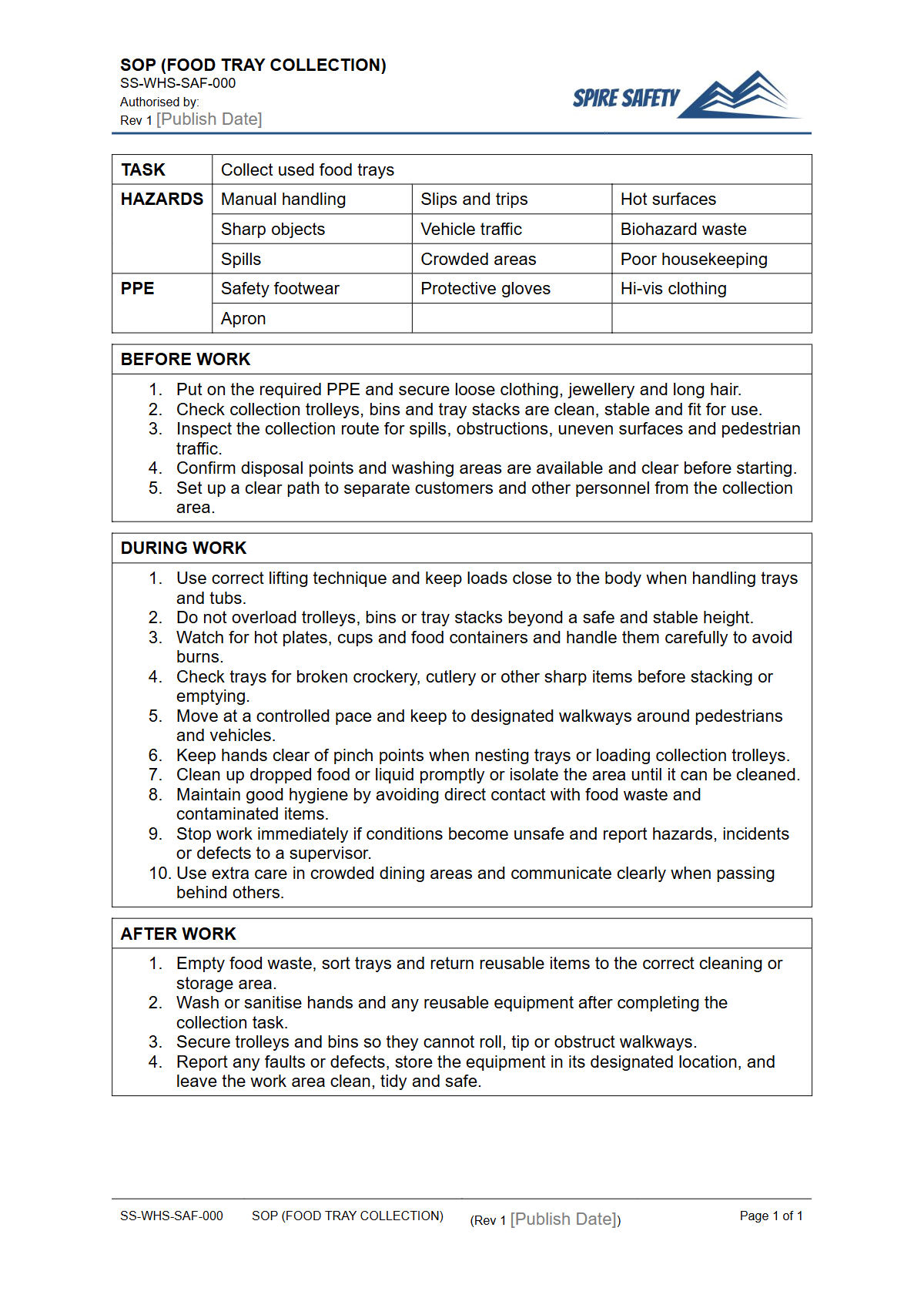
Purpose of the Free Safe Operating Procedure (Food Tray Collection) Template
Collecting food trays, whether in a hospital, aged care facility, hotel, or cafeteria, involves specific risks that must be managed to ensure worker safety. This task often includes manual handling, potential exposure to biological hazards, and risks of slips, trips, and falls.
Our Free Safe Operating Procedure (Food Tray Collection) Template provides a structured framework for documenting the safest way to perform this common but hazardous task. By clearly outlining the steps, required personal protective equipment (PPE), and hazard controls, this SOP helps organisations meet their primary duty of care under Australian WHS legislation.
A well-drafted SOP is a critical component of any safety management system. It serves as a training tool for new employees and a reference for experienced staff, promoting consistent and safe work practices.
This template helps formalise your process for tray collection, covering aspects from trolley preparation and movement to waste disposal and cleaning. Implementing a clear procedure minimises the likelihood of musculoskeletal injuries from lifting, bending, or pushing carts, and reduces the risk of incidents related to spills or contaminated items.
For tailored advice on integrating such procedures into your workplace, consider engaging professional WHS consulting services.
Video walkthrough
How to use the Free Safe Operating Procedure (Food Tray Collection) Template
This template is provided in both DOCX and PDF formats for your convenience. The DOCX file is fully editable, allowing you to tailor the content to the specific equipment, environment, and policies of your workplace.
To use the template effectively, a competent person should review each section and add or remove information to reflect your unique operational context. This includes detailing the types of trolleys used, specific routes to be taken, locations for waste disposal, and the exact PPE required for the task.
Important: This document is a template only. It is not a complete or ready-to-use Safe Operating Procedure.
You must customise it with your site-specific details. We recommend a thorough risk assessment be conducted for the task of food tray collection to ensure all potential hazards are identified and controlled.
The finished SOP should be integrated into your broader WHS management systems, which includes providing training to all relevant workers on the finalised procedure.
When to use a Food Tray Collection SOP
A Safe Operating Procedure for food tray collection should be used as a primary document for training and operational guidance. It is essential during the induction of new staff in hospitality, healthcare, or food service roles to establish safe habits from the outset.
It should also be used for regular refresher training to reinforce correct procedures and introduce any updates. Furthermore, this SOP is a vital reference tool before commencing the task each day or shift, reminding workers of the key steps and safety checks.
Following an incident, near miss, or the identification of a new hazard associated with tray collection, the SOP should be reviewed and updated. This ensures it remains a living document that reflects best practices and addresses real-world risks.
If the task involves reaching onto high shelves or multi-level trolleys, it's critical to have procedures for related equipment. You may find our free Step Ladder SOP template a useful supplementary resource.
Who should use this Safe Operating Procedure
This SOP is designed for use by a range of individuals within an organisation. Primarily, it is for workers who perform the task of collecting food trays, including patient services assistants, kitchen hands, catering staff, and cleaners.
It provides them with clear, step-by-step instructions to perform their duties safely. Supervisors and managers should also use the SOP to oversee work, conduct safety observations, and supports your compliance efforts with established procedures.
They are responsible for ensuring staff understand and follow the SOP correctly.
WHS managers, advisors, and committee members will find this template valuable for developing and reviewing safety documentation as part of their risk management activities. It provides a solid foundation aligned with Australian WHS principles.
Ensuring staff are also trained in immediate response measures is part of a comprehensive safety approach. Procedures for emergencies can be documented using documents like our Safe Operating Procedure for Defibrillator Operation. All our templates can be found in our extensive free WHS resources library, available for immediate download.
Common mistakes
Common mistakes to avoid
- Failing to specify correct manual handling techniques for lifting trays and pushing/pulling trolleys.
- Neglecting to include procedures for cleaning up spills immediately.
- Not clearly defining the required Personal Protective Equipment (PPE), such as gloves and non-slip footwear.
- Overlooking the process for segregating and disposing of different types of waste (general, recyclable, clinical).
Legal references
Legal considerations
The following legal requirements may be relevant to this type of work.
- Work Health and Safety Act (Harmonised) — Provides the primary duties for protecting workers and other people from work health and safety risks.
- Work Health and Safety Regulations (Harmonised) — Sets out requirements supporting the management of workplace hazards and risks.
The following codes may be relevant to this type of work.
- Managing WHS Risks Code of Practice — Provides practical guidance on identifying hazards, assessing risks and applying effective controls.
- Work Health and Safety Consultation, Cooperation and Coordination Code of Practice — Provides practical guidance on consulting workers and coordinating with other duty holders.
- Managing the Work Environment and Facilities Code of Practice — Provides practical guidance on safe work environments, workplace facilities and related controls.
Did you know
Manual Handling Impact
According to Safe Work Australia, manual handling injuries account for approximately 40% of all serious workers' compensation claims. A structured SOP is a key control measure to reduce this risk.
Slips and Trips
Slips, trips, and falls are the second leading cause of serious workers' compensation claims in Australia. Procedures for managing spills during tray collection are essential for preventing these common incidents.
FAQ
Frequently asked questions
01What are the main hazards in food tray collection?
02Why is an SOP needed for a 'simple' task like collecting food trays?
03How often should we review our Food Tray Collection SOP?
04Can this template be used in any industry?
Share this resource
Free Safe Operating Procedure (Food Tray Collection) Template
Browse Categories
How To Use It
- 1Download and open in Word or PDF.
- 2Replace the placeholders with your business details.
- 3Get it reviewed by a WHS specialist before rollout.
Need it customised?
Our WHS consultants can adapt this template to your site, run a gap analysis, or audit what you already have in place.
Book a Free Consultation WHS consulting servicesor call 1300 156 382
Related templates
- Free Safe Operating Procedure (Food Tray Delivery) Template
- Free Safe Operating Procedure (Food Tray Stacking) Template
- Free Safe Operating Procedure (Food Waste Bin Cleaning) Template
- Free Safe Operating Procedure (Footpath Cleaning) Template
- Free Safe Operating Procedure (Footstool Cleaning) Template
- Free Safe Operating Procedure (Forestry Harvester) Template