
Free Safe Operating Procedure (Food Recall Isolation) Template
Download our free Safe Operating Procedure (Food Recall Isolation) template.
Free Safe Operating Procedure (Food Recall Isolation) Template
DOCX • 126 KB + PDF
Updated Oct 2026
No signup required
Purpose of the Free Safe Operating Procedure (Food Recall Isolation) Template
A food recall is a critical event for any business in the food industry. Having a documented, clear process is essential for protecting public health, maintaining customer trust, and managing regulatory obligations.
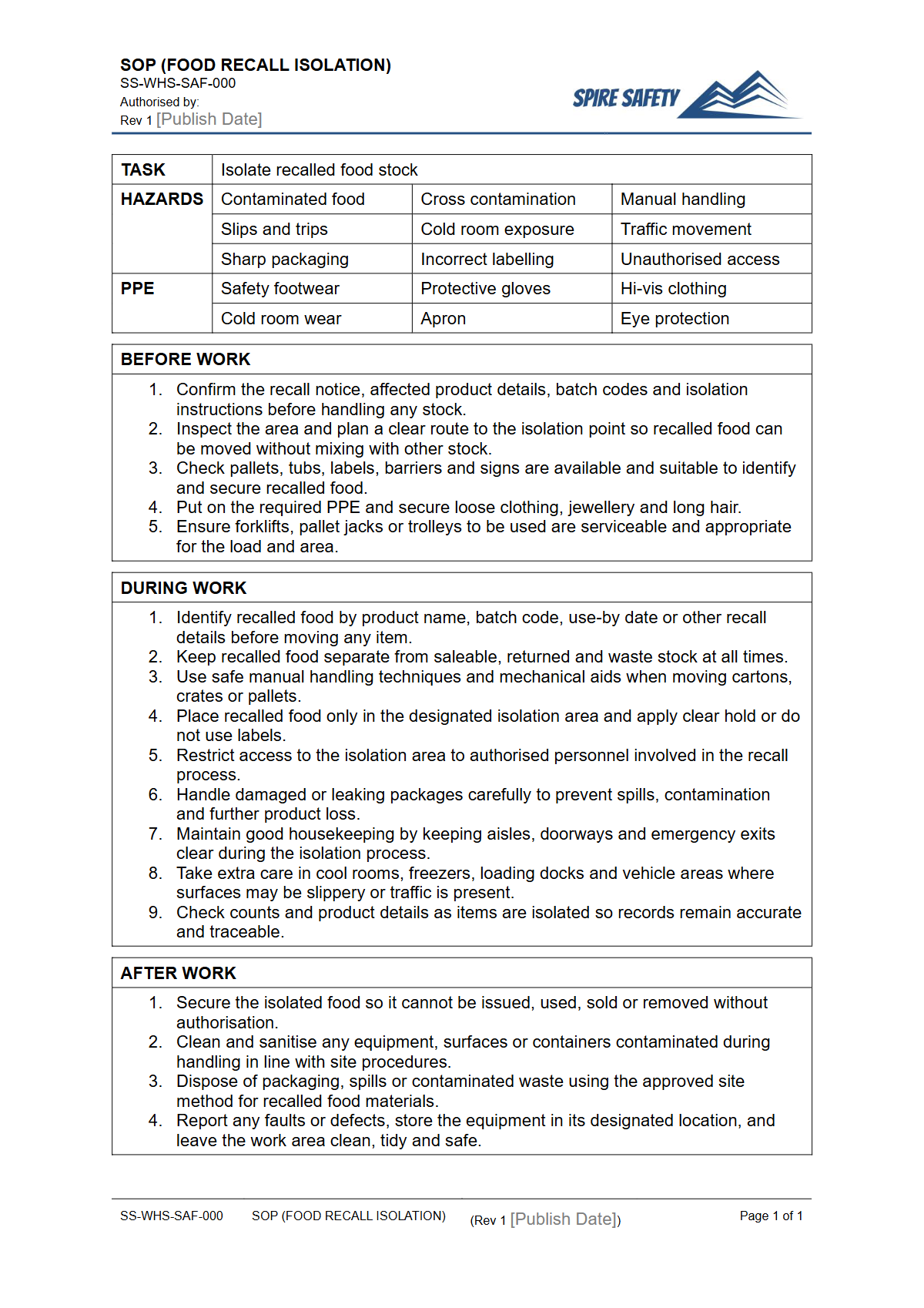
This Free Safe Operating Procedure (Food Recall Isolation) Template provides a structured starting point for developing your own internal protocol. It guides your team through the essential steps of promptly and effectively finding, securing, and controlling recalled food products to prevent them from reaching consumers.
An effective SOP for this task is a vital component of broader comprehensive WHS management systems that also encompass food safety.
Video walkthrough
How to use the Free Safe Operating Procedure (Food Recall Isolation) Template
Our Safe Operating Procedure for Food Recall Isolation is designed for immediate use and straightforward customisation. After downloading the DOCX file, you can edit it to reflect your specific operational environment.
It's crucial to integrate details such as your site layout, designated quarantine areas, key personnel contact details, and specific product handling requirements. This SOP should not be used as-is; its effectiveness depends on its relevance to your unique setting.
Please note: this template provides a structured foundation. To be effective, you must customise it with your specific workplace details, including site layouts, storage locations, key personnel, and contact information.
We cannot guarantee its suitability for your specific circumstances without customisation and professional review.
Key Steps in the Isolation Process
A robust isolation procedure generally involves the following actions:
- Notification: Immediately inform all relevant staff to cease the sale, use, or distribution of the affected product.
- Identification: Locate all stock of the recalled product, checking all possible locations including warehouses, cool rooms, retail shelves, and in-process areas. This may require specific equipment, and staff should always follow safety protocols, such as using a Safe Operating Procedure for step ladder use when accessing high storage racks.
- Segregation: Move all identified products to a designated, secure quarantine area, physically separated from other food items to prevent cross-contamination or accidental use.
- Labelling: Clearly and securely label all segregated stock with highly visible signs stating "RECALLED PRODUCT – DO NOT USE OR SELL".
- Control & Reconciliation: Secure the quarantine area and conduct a stocktake to account for all units of the recalled product, comparing physical counts against inventory records.
When to use this Safe Operating Procedure
This SOP should be activated immediately upon receiving confirmation of a food recall. This notification may come from various sources, including Food Standards Australia New Zealand (FSANZ), a state health department, a supplier or manufacturer, or as a result of your own internal quality control testing.
Regular drills and mock recalls are also key opportunities to test and refine this procedure. The effectiveness of these procedures can be formally assessed during routine WHS compliance audits, ensuring your team is always prepared.
Who should use this Safe Operating Procedure
Executing a food recall isolation is a team effort involving several key roles within a food business. While a designated Food Safety Supervisor or Quality Assurance Manager typically leads the process, their success relies on the cooperation of other personnel.
This includes warehouse staff responsible for locating and moving stock, kitchen or production staff who must stop using the product, and managers who oversee the process and communication. Ensuring all team members are trained on their specific responsibilities is as critical as having a documented plan for other emergencies, as detailed in an SOP for defibrillator operation.
In larger facilities, moving entire pallets of recalled goods may be necessary. In these cases, operators of heavy equipment must be competent and follow strict safety protocols, such as those outlined in a telehandler safe operating procedure, to prevent injuries during a high-pressure situation.
Once you have customised this document, explore our free WHS resources library for other templates to support your safety management system.
Common mistakes
Common mistakes to avoid
- Failing to clearly label and securely segregate isolated stock, leading to accidental use.
- Inadequate training that causes staff confusion and delays during a time-critical recall event.
- Poor or incomplete record-keeping, making it impossible to accurately account for all recalled product units.
- Forgetting to check all potential storage locations, including back-of-house, returns areas, and retail displays.
Legal references
Legal considerations
The following legal requirements may be relevant to this type of work.
- Work Health and Safety Act (Harmonised) — Provides the primary duties for protecting workers and other people from work health and safety risks.
- Work Health and Safety Regulations (Harmonised) — Sets out requirements supporting the management of workplace hazards and risks.
The following codes may be relevant to this type of work.
- Managing WHS Risks Code of Practice — Provides practical guidance on identifying hazards, assessing risks and applying effective controls.
- Work Health and Safety Consultation, Cooperation and Coordination Code of Practice — Provides practical guidance on consulting workers and coordinating with other duty holders.
- Managing the Work Environment and Facilities Code of Practice — Provides practical guidance on safe work environments, workplace facilities and related controls.
Did you know
Recall Coordination
Food Standards Australia New Zealand (FSANZ) is the national body that coordinates food recalls. Each year, dozens of recalls are conducted for reasons ranging from microbial contamination and undeclared allergens to physical contamination.
FAQ
Frequently asked questions
01What is the main purpose of isolating recalled food products?
02Who is responsible for initiating a food recall isolation procedure?
03Does this template cover the entire food recall process?
04How often should our Food Recall Isolation SOP be reviewed?
Share this resource
Free Safe Operating Procedure (Food Recall Isolation) Template
Browse Categories
How To Use It
- 1Download and open in Word or PDF.
- 2Replace the placeholders with your business details.
- 3Get it reviewed by a WHS specialist before rollout.
Need it customised?
Our WHS consultants can adapt this template to your site, run a gap analysis, or audit what you already have in place.
Book a Free Consultation WHS consulting servicesor call 1300 156 382
Related templates
- Free Safe Operating Procedure (Food Scale Cleaning) Template
- Free Safe Operating Procedure (Food Smoker) Template
- Free Safe Operating Procedure (Food Tray Collection) Template
- Free Safe Operating Procedure (Food Tray Delivery) Template
- Free Safe Operating Procedure (Food Tray Stacking) Template
- Free Safe Operating Procedure (Food Waste Bin Cleaning) Template