
Free Safe Operating Procedure (Food Scale Cleaning) Template
Download our free Safe Operating Procedure (Food Scale Cleaning) template.
Free Safe Operating Procedure (Food Scale Cleaning) Template
DOCX • 126 KB + PDF
Updated Oct 2026
No signup required
Purpose of the Free Safe Operating Procedure (Food Scale Cleaning) Template
In any environment where food is handled, maintaining impeccable hygiene is non-negotiable. Food scales are a critical control point for both portion control and food safety, but they can easily become a source of cross-contamination if not cleaned correctly.
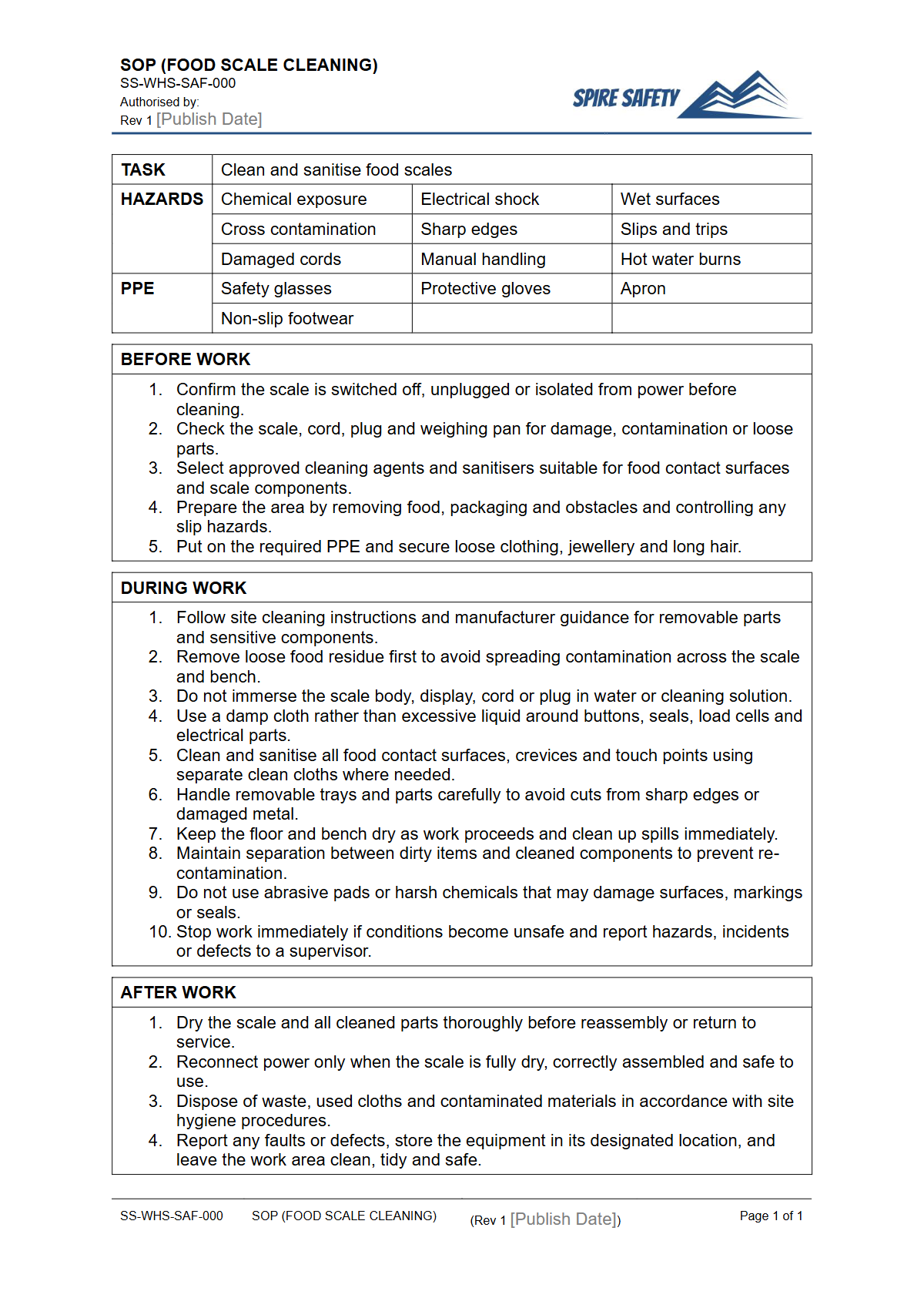
This Free Safe Operating Procedure (Food Scale Cleaning) Template provides a structured framework for documenting the safe, effective, and consistent cleaning of food weighing equipment.
The primary purpose of this Safe Operating Procedure is to standardise the cleaning process, ensuring every team member follows the same steps to eliminate pathogens, allergens, and food residue. A documented procedure helps your organisation meet its obligations under Australian food safety standards and demonstrates due diligence to regulators.
It acts as a vital component of your broader WHS management systems, reinforcing a culture of safety and quality.
Key Elements Included in the Template
Our template is designed to be comprehensive yet easy to adapt. It provides sections to detail:
- Responsibilities: Clearly defining who is responsible for performing, checking, and supervising the cleaning tasks.
- Personal Protective Equipment (PPE): Specifying required PPE such as gloves to protect workers from cleaning chemicals and contaminants.
- Pre-Cleaning Checks: Steps to take before cleaning begins, like disconnecting power and removing loose debris.
- Step-by-Step Procedure: A logical sequence for disassembly (if applicable), cleaning, sanitising, rinsing, and drying the scale.
- Post-Cleaning Verification: Instructions for inspecting the scale to ensure it is clean and ready for use.
- Frequency: Defining how often the procedure should be performed (e.g., after each use, at the end of a shift, weekly).
Video walkthrough
How to use the Free Safe Operating Procedure (Food Scale Cleaning) Template
This resource is available as a DOCX file for easy editing and customisation, as well as a PDF for straightforward printing and distribution. To use the template effectively, you should review each section and modify it to reflect the specific equipment, cleaning chemicals, and processes used in your workplace.
A generic procedure is not sufficient; it must be site-specific to be effective.
Important: This document is a template and must be customised to suit the unique requirements of your workplace. We recommend a Person Conducting a Business or Undertaking (PCBU) consults with workers and reviews the specific scale manufacturer's guidelines, safety data sheets (SDS) for cleaning chemicals, and any site-specific risks before finalising and implementing the procedure.
Thorough customisation ensures the SOP is practical and addresses all relevant hazards.
When to Use This Safe Operating Procedure
A formal SOP for food scale cleaning should be followed consistently. It is essential for daily operations, particularly when switching between different food types, such as from raw meats to ready-to-eat products, to prevent cross-contamination.
The procedure should be used at the end of each shift as part of routine shutdown and sanitation protocols.
This SOP also serves as a critical training document for new employees and a refresher for existing staff. Regular reviews of this procedure should be part of your operational schedule, a practice that is often checked during a WHS compliance auditing process to ensure ongoing effectiveness and compliance.
It formalises an essential task that is too important to be left to memory or informal instruction.
Who Should Use It
This Safe Operating Procedure is designed for use by a range of personnel within a food handling business. This includes:
- Food Handlers and Kitchen Staff: The primary users who will follow the step-by-step instructions to perform the cleaning task.
- Supervisors and Managers: To train staff, enforce standards, and verify that procedures are being followed correctly.
- WHS and Quality Assurance Officers: To integrate the procedure into the overall safety and quality management system and use it as a basis for audits and continuous improvement.
Developing and implementing robust procedures can be complex. For businesses seeking expert guidance on creating comprehensive safety systems that go beyond a single task, our WHS consulting services provide tailored support to help you manage your obligations effectively.
Integrating the SOP into Broader Safety Practices
A single procedure is most effective when it's part of a holistic approach to workplace safety. This SOP for food scale cleaning should exist alongside other critical procedures that address all identified risks in your environment.
For example, your safety library might also include a Free Safe Operating Procedure (Defibrillator Operation) template for medical emergencies or procedures for other equipment.
By building a complete set of documented procedures, you create a safer, more organised, and more professional workplace. This template is just one of many documents available in our free WHS resources library, designed to help Australian businesses strengthen their safety frameworks.
Common mistakes
Common mistakes to avoid
- Using incorrect or non-food-safe cleaning chemicals that can contaminate food.
- Forgetting to clean underneath or around the scale platform where residue accumulates.
- Not allowing the scale to air dry completely before reuse, which can promote bacterial growth.
- Failing to document the cleaning task, leading to a lack of accountability and poor records for audits.
Legal references
Legal considerations
The following legal requirements may be relevant to this type of work.
- Work Health and Safety Act (Harmonised) — Provides the primary duties for protecting workers and other people from work health and safety risks.
- Work Health and Safety Regulations (Harmonised) — Sets out requirements supporting the management of workplace hazards and risks.
The following codes may be relevant to this type of work.
- Managing WHS Risks Code of Practice — Provides practical guidance on identifying hazards, assessing risks and applying effective controls.
- Work Health and Safety Consultation, Cooperation and Coordination Code of Practice — Provides practical guidance on consulting workers and coordinating with other duty holders.
- Managing the Work Environment and Facilities Code of Practice — Provides practical guidance on safe work environments, workplace facilities and related controls.
Did you know
Cross-Contamination Risk
Poorly cleaned food scales are a significant source of cross-contamination, capable of transferring allergens or pathogens like Salmonella and E. coli between different food items.
Calibration and Cleaning
The accuracy of digital food scales can be affected by dirt and debris build-up under the weighing plate. Regular cleaning as part of an SOP is essential for both hygiene and measurement accuracy.
FAQ
Frequently asked questions
01What should be included in an SOP for cleaning food scales?
02How often do food scales need to be cleaned according to a Safe Operating Procedure?
03Are chemical cleaning agents safe to use on food scales?
04Why is a specific SOP for food scale cleaning necessary?
Share this resource
Free Safe Operating Procedure (Food Scale Cleaning) Template
Browse Categories
How To Use It
- 1Download and open in Word or PDF.
- 2Replace the placeholders with your business details.
- 3Get it reviewed by a WHS specialist before rollout.
Need it customised?
Our WHS consultants can adapt this template to your site, run a gap analysis, or audit what you already have in place.
Book a Free Consultation WHS consulting servicesor call 1300 156 382
Related templates
- Free Safe Operating Procedure (Food Smoker) Template
- Free Safe Operating Procedure (Food Tray Collection) Template
- Free Safe Operating Procedure (Food Tray Delivery) Template
- Free Safe Operating Procedure (Food Tray Stacking) Template
- Free Safe Operating Procedure (Food Waste Bin Cleaning) Template
- Free Safe Operating Procedure (Footpath Cleaning) Template