
Free Safe Operating Procedure (Food Display Cleaning) Template
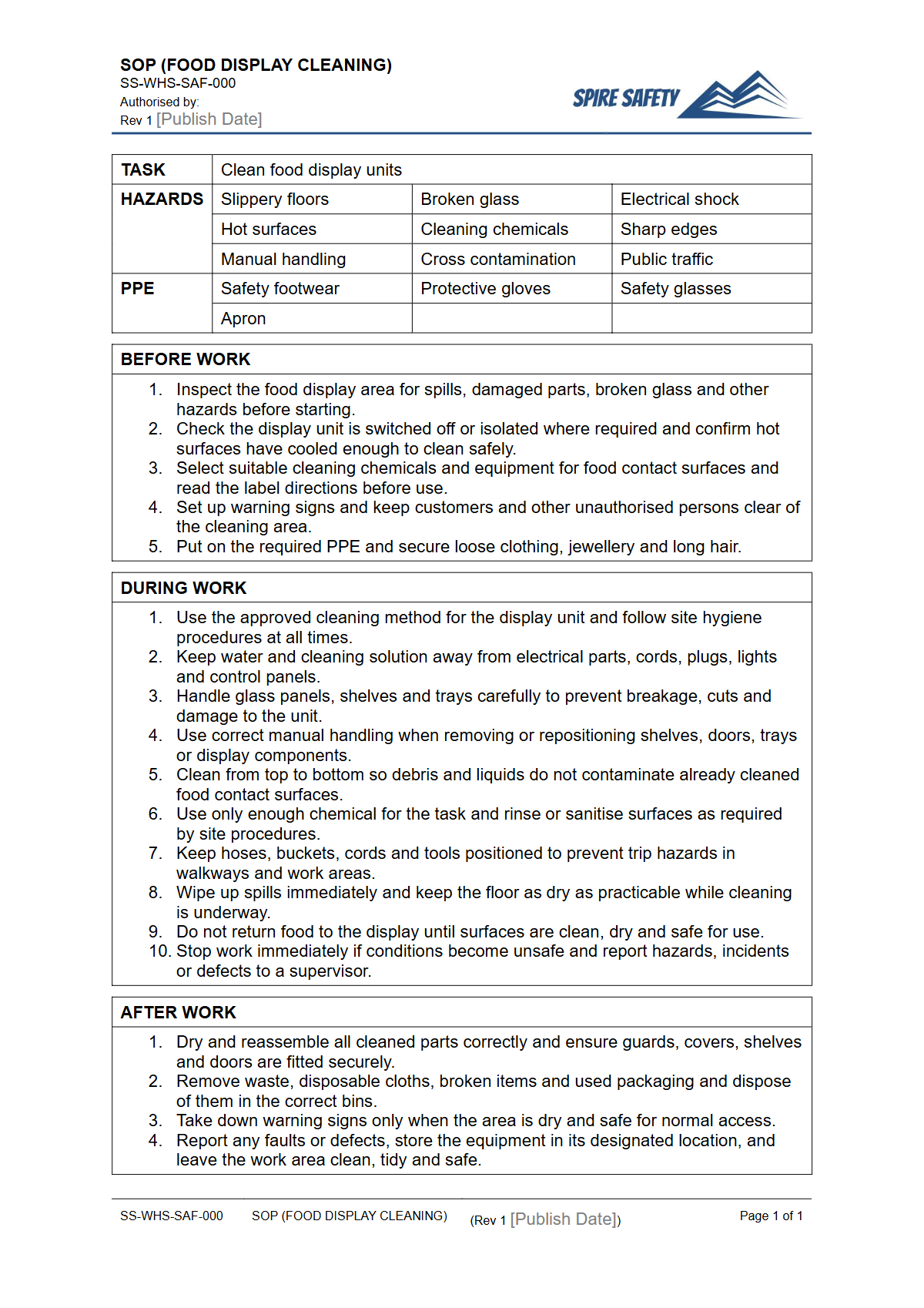
Download our free Safe Operating Procedure (Food Display Cleaning) Template. This customisable DOCX & PDF helps standardise your cleaning processes.
Free Safe Operating Procedure (Food Display Cleaning) Template
DOCX • 126 KB + PDF
Updated Oct 2026
No signup required
Purpose of the Free Safe Operating Procedure (Food Display Cleaning) Template
Maintaining hygiene in food service environments is non-negotiable. This free Safe Operating Procedure (Food Display Cleaning) Template provides a structured framework for cleaning and sanitising food display units like bain-maries, refrigerated cabinets, and hot boxes.
A documented SOP ensures that cleaning tasks are performed consistently and safely every time, which is critical for preventing foodborne illnesses, managing cross-contamination risks, and meeting food safety standards.
Using a standardised procedure helps control common workplace hazards associated with this task. These include exposure to hazardous cleaning chemicals, slips and trips from wet floors, manual handling injuries from moving components, and electrical risks from powered equipment.
A clear SOP is a fundamental tool for demonstrating due diligence and fulfilling your duty of care as a Person Conducting a Business or Undertaking (PCBU).
Video walkthrough
How to use the Free Safe Operating Procedure (Food Display Cleaning) Template
This template is designed as a starting point. Download the DOCX file and adapt it to reflect the specific equipment, cleaning agents, and unique environmental factors of your workplace.
You should clearly list the personal protective equipment (PPE) required, the step-by-step cleaning and sanitising process, and the responsible personnel. Once customised, this document becomes a key part of your broader safety framework.
Integrating SOPs into comprehensive WHS management systems ensures that safe work methods are embedded in your organisation’s daily operations.
Important: This document is a template and must be customised to suit the specific equipment, chemicals, and processes used in your workplace. The user is responsible for ensuring the final document is accurate and suitable for their needs.
We are not liable for any incidents arising from the use of this document.
When to use this Safe Operating Procedure
A Safe Operating Procedure for cleaning food displays should be used consistently as part of your daily and periodic cleaning schedules. It is an essential reference document for several key activities:
- Training: Use it to train new food handlers and cleaning staff on the correct, safe method for the task.
- Task execution: Refer to it during cleaning activities to ensure no steps are missed, especially regarding chemical dilution and contact times.
- Refresher training: Incorporate it into regular staff training sessions to maintain high standards of hygiene and safety.
- Incident investigation: Use it as a benchmark to review procedures following a near miss or incident, such as a chemical splash or slip.
Regularly reviewing your SOPs is also a core part of the continuous improvement cycle. This process can be formalised through scheduled WHS compliance auditing to verify that documented procedures are being followed correctly on the floor.
Who should use it
This SOP is intended for anyone involved in the cleaning and maintenance of food display equipment. This typically includes:
- Food Handlers & Kitchen Staff: The primary users who perform the cleaning tasks daily.
- Cleaning Personnel: Dedicated cleaners responsible for end-of-day or periodic deep cleaning.
- Supervisors & Managers: Responsible for ensuring staff are trained on the SOP and are following it correctly. They also oversee record-keeping and resource allocation (e.g., correct chemicals and PPE).
- WHS Representatives: Use the SOP as a tool for risk assessments, training needs analysis, and workplace inspections.
All workers should also be familiar with general site safety procedures. For example, knowing the location and use of first aid equipment is crucial, which is why our Free Safe Operating Procedure (Defibrillator Operation) Template is a valuable resource for any workplace.
If cleaning requires accessing high shelves or the tops of large units, a separate procedure for working at height may be necessary. Our FREE Step Ladder SOP (Safe Operating Procedure) Template provides a solid foundation for safely using this common piece of equipment. For a wider range of procedural documents, you can browse our complete free WHS resources library.
Common mistakes
Common mistakes to avoid
- Using the same cloth to wipe multiple surfaces without sanitising, leading to cross-contamination.
- Failing to disconnect electrical equipment from power before cleaning with water or liquid chemicals.
- Not allowing the correct contact time for sanitisers to work effectively, rendering the process useless.
- Applying cleaning chemicals directly to warm surfaces, which can create harmful fumes and damage the surface.
Legal references
Legal considerations
The following legal requirements may be relevant to this type of work.
- Work Health and Safety Act (Harmonised) — Provides the primary duties for protecting workers and other people from work health and safety risks.
- Work Health and Safety Regulations (Harmonised) — Sets out requirements supporting the management of workplace hazards and risks.
The following codes may be relevant to this type of work.
- Managing WHS Risks Code of Practice — Provides practical guidance on identifying hazards, assessing risks and applying effective controls.
- Work Health and Safety Consultation, Cooperation and Coordination Code of Practice — Provides practical guidance on consulting workers and coordinating with other duty holders.
- Managing the Work Environment and Facilities Code of Practice — Provides practical guidance on safe work environments, workplace facilities and related controls.
Did you know
Cross-Contamination Hotspots
Cleaning cloths are one of the biggest cross-contamination risks in a kitchen. A single cloth can spread bacteria between surfaces if not managed correctly through a colour-coded system and regular sanitising.
The Two-Hour/Four-Hour Rule
In Australia, the 'two-hour/four-hour rule' guides how long potentially hazardous food can be held at temperatures between 5°C and 60°C. Proper cleaning of display units is essential for maintaining these temperatures.
FAQ
Frequently asked questions
01What hazards are involved in cleaning food displays?
02What is the difference between cleaning and sanitising?
03How often should food display units be cleaned and sanitised?
04Why do I need a written SOP for cleaning?
Share this resource
Free Safe Operating Procedure (Food Display Cleaning) Template
Browse Categories
How To Use It
- 1Download and open in Word or PDF.
- 2Replace the placeholders with your business details.
- 3Get it reviewed by a WHS specialist before rollout.
Need it customised?
Our WHS consultants can adapt this template to your site, run a gap analysis, or audit what you already have in place.
Book a Free Consultation WHS consulting servicesor call 1300 156 382
Related templates
- Free Safe Operating Procedure (Food Label Printer) Template
- Free Safe Operating Procedure (Food Prep Sink Cleaning) Template
- Free Safe Operating Procedure (Food Probe Sanitising) Template
- Free Safe Operating Procedure (Food Processor) Template
- Free Safe Operating Procedure (Food Recall Isolation) Template
- Free Safe Operating Procedure (Food Scale Cleaning) Template