
Free Safe Operating Procedure (Food Label Printer) Template
Download our free Safe Operating Procedure (Food Label Printer) Template. This DOCX and PDF resource helps you outline safe work steps. Customise it now.
Free Safe Operating Procedure (Food Label Printer) Template
DOCX • 126 KB + PDF
Updated Oct 2026
No signup required
Purpose of the Free Safe Operating Procedure (Food Label Printer) Template
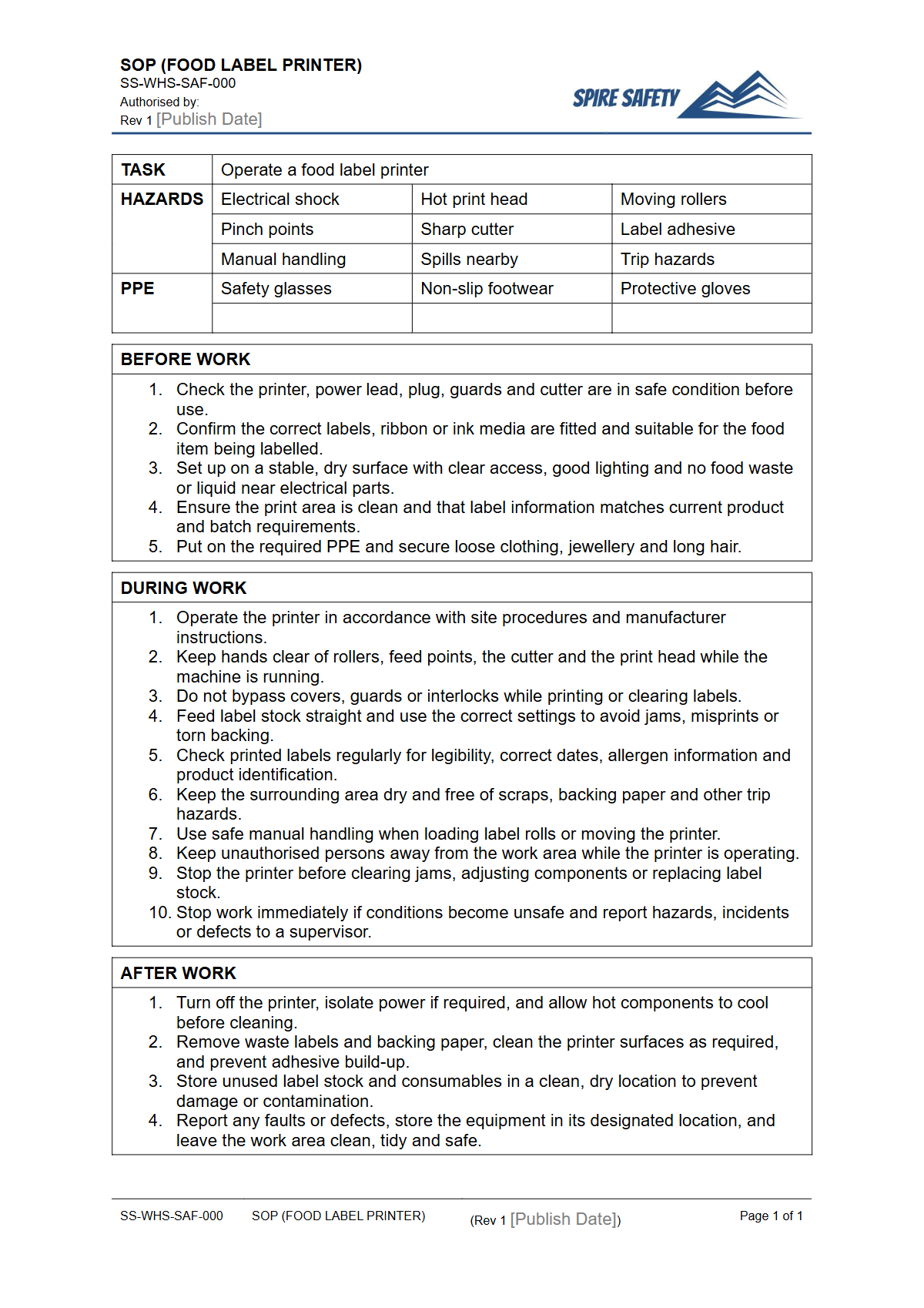
This free Safe Operating Procedure (Food Label Printer) Template provides a structured framework for documenting the safe use of thermal and direct thermal label printers in a commercial setting. Using this template helps your organisation to manage WHS risks by outlining a clear, step-by-step process for workers to follow.
It ensures that everyone operating the equipment understands the required safety precautions, potential hazards, and emergency procedures. Properly implemented, a Safe Operating Procedure (SOP) is a critical tool for worker training and demonstrating compliance with your duty of care.
A comprehensive SOP for a food label printer identifies specific hazards associated with the task, such as nip and pinch points in roller mechanisms, electrical hazards, ergonomic risks from repetitive use, and manual handling issues when replacing large label rolls. It formalises the control measures required to mitigate these risks, creating a safer work environment for everyone. Implementing clear procedures for all workplace equipment is fundamental to effective safety management, similar to the protocols outlined in our Safe Operating Procedure (Defibrillator Operation) template.
Video walkthrough
How to use the Free Safe Operating Procedure (Food Label Printer) Template
This document is a starting point designed to be adapted to your specific needs. After downloading the DOCX or PDF file, you must add details specific to your workplace, including your company name, the specific make and model of the food label printer, and the location where it is used.
Walk through the operation of the machine and identify all potential hazards unique to your environment.
Important: This document is a template and is not a completed Safe Operating Procedure. We have provided a comprehensive starting point, but you must consult with equipment operators and supervisors to identify all site-specific risks and control measures.
The finished document should be reviewed by a competent person before it is implemented. Integrating such procedures is a key part of being able to develop a comprehensive WHS management system that is both practical and effective.
When to use a Safe Operating Procedure
A Safe Operating Procedure should be used as a core part of your safety management system. It is not a document to be filed away and forgotten.
It should be introduced during the induction and training of any new worker who will be required to operate the food label printer. It serves as the official source of truth for the correct, safe method of performing the task.
The SOP should also be used for regular refresher training to prevent complacency and bad habits from forming. Furthermore, it is a vital reference document following any incident, near-miss, or the introduction of a new model of printer.
The procedure should be reviewed and updated to reflect any lessons learned or changes in the work process. Procedures for even simple tasks, like those detailed in a Step Ladder SOP, are essential for consistent safety.
Who should use this SOP
Several people within an organisation have a role related to this Safe Operating Procedure. The Person Conducting a Business or Undertaking (PCBU) has the ultimate responsibility for ensuring a safe workplace, which includes providing safe systems of work like SOPs.
WHS managers, supervisors, and team leaders are typically responsible for drafting, implementing, and reviewing the SOP, ensuring it is accurate and practical.
Most importantly, the workers who operate the food label printer are the primary end-users of the SOP. They must be trained on its contents and are expected to follow the outlined procedures to ensure their own safety and the safety of others.
The effectiveness of these procedures can be verified through regular WHS compliance audits. For workplaces with a variety of equipment, consistent documentation is key; you might also require an Air Compressor SOP (Safe Operating Procedure) Template for maintenance tasks. You can browse our complete free WHS resources library for more templates to support your safety system.
Common mistakes
Common mistakes to avoid
- Using a generic template without customising it for the specific printer model and work environment.
- Failing to adequately train workers on the content of the finalised SOP.
- Not including clear, step-by-step instructions for tasks like clearing a label jam or changing a ribbon.
- Forgetting to review and update the SOP after an incident or when equipment is changed.
Legal references
Legal considerations
The following legal requirements may be relevant to this type of work.
- Work Health and Safety Act (Harmonised) — Provides the primary duties for protecting workers and other people from work health and safety risks.
- Work Health and Safety Regulations (Harmonised) — Sets out requirements supporting the management of workplace hazards and risks.
The following codes may be relevant to this type of work.
- Managing WHS Risks Code of Practice — Provides practical guidance on identifying hazards, assessing risks and applying effective controls.
- Work Health and Safety Consultation, Cooperation and Coordination Code of Practice — Provides practical guidance on consulting workers and coordinating with other duty holders.
- Managing the Work Environment and Facilities Code of Practice — Provides practical guidance on safe work environments, workplace facilities and related controls.
Did you know
Food Labelling Laws
Under the Australia New Zealand Food Standards Code, most packaged food requires a label with specific information like ingredients and nutrition panels, making label printers critical, regulated equipment in the food industry.
Minor Machinery Risks
Even small equipment can pose significant risks. According to Safe Work Australia data, injuries from being trapped or hit by moving machinery parts are common, highlighting the need for clear procedures for all workplace equipment.
FAQ
Frequently asked questions
01What is a Safe Operating Procedure for a food label printer?
02Is this food label printer SOP template ready to use?
03Who is responsible for writing the SOP?
04How often should a Safe Operating Procedure be reviewed?
Share this resource
Free Safe Operating Procedure (Food Label Printer) Template
Browse Categories
How To Use It
- 1Download and open in Word or PDF.
- 2Replace the placeholders with your business details.
- 3Get it reviewed by a WHS specialist before rollout.
Need it customised?
Our WHS consultants can adapt this template to your site, run a gap analysis, or audit what you already have in place.
Book a Free Consultation WHS consulting servicesor call 1300 156 382
Related templates
- Free Safe Operating Procedure (Food Prep Sink Cleaning) Template
- Free Safe Operating Procedure (Food Probe Sanitising) Template
- Free Safe Operating Procedure (Food Processor) Template
- Free Safe Operating Procedure (Food Recall Isolation) Template
- Free Safe Operating Procedure (Food Scale Cleaning) Template
- Free Safe Operating Procedure (Food Smoker) Template