
Free Safe Operating Procedure (Food Cart Handling) Template
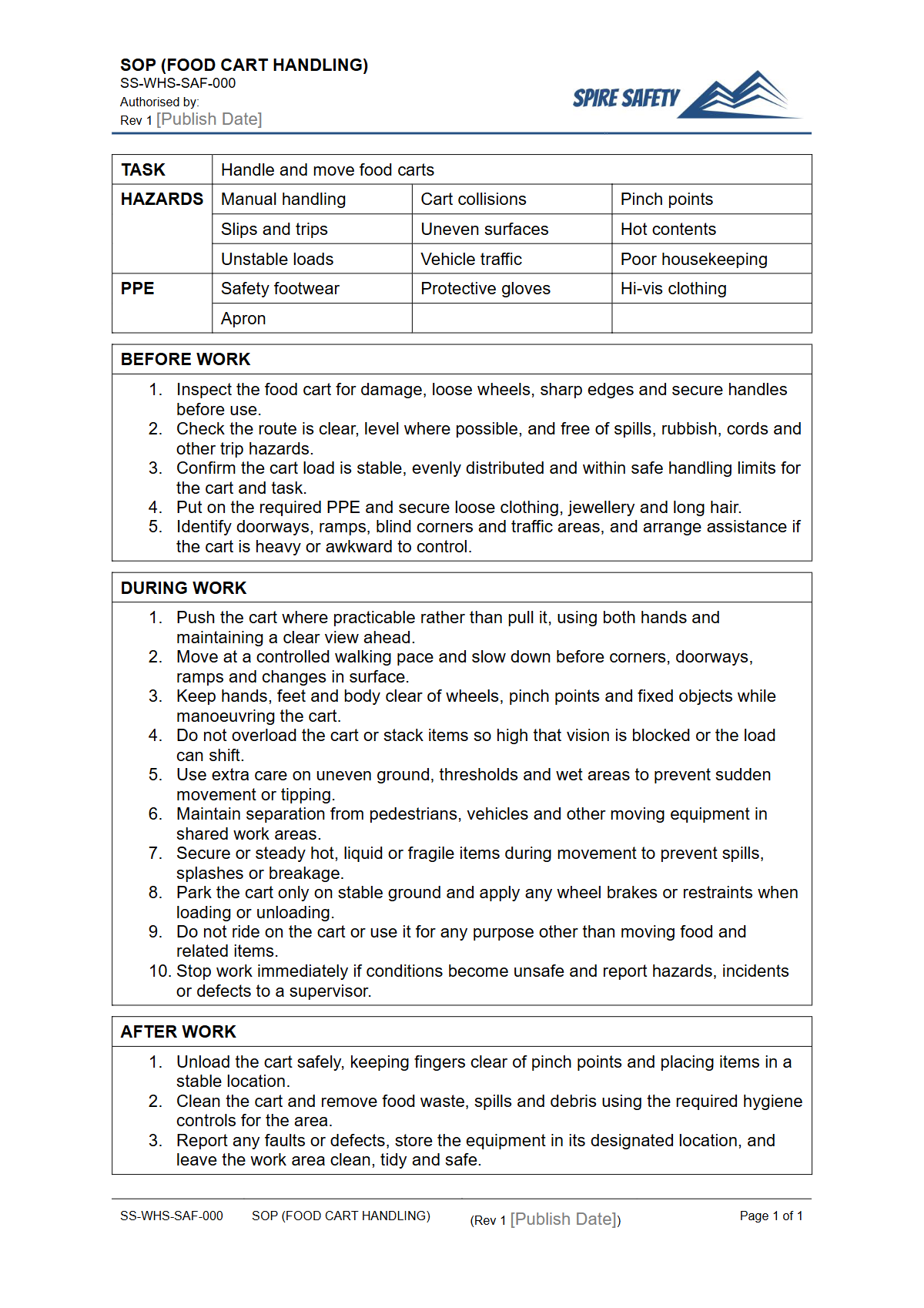
Download our free Safe Operating Procedure (Food Cart Handling) template. This DOCX & PDF resource helps you outline safe work practices for food cart use.
Free Safe Operating Procedure (Food Cart Handling) Template
DOCX • 126 KB + PDF
Updated Oct 2026
No signup required
Purpose of the Free Safe Operating Procedure (Food Cart Handling) Template
Effectively managing workplace health and safety requires clear, documented procedures for high-risk tasks. This free Safe Operating Procedure (Food Cart Handling) template provides a structured starting point for businesses to formalise their processes for using mobile food and beverage carts.
Handling food carts introduces several hazards, including musculoskeletal injuries from pushing and pulling, slips and trips from spills, and burns from hot contents. Using this SOP helps your organisation to systematically identify these risks and document the control measures required to ensure worker safety.
A well-developed SOP is a critical component of a proactive safety culture. It serves as a training tool for workers, a reference for supervisors, and evidence of your commitment to providing a safe system of work. Integrating this procedure into your broader safety framework helps formalise risk management and supports the development of comprehensive WHS management systems.
Video walkthrough
How to use the Free Safe Operating Procedure (Food Cart Handling) Template
This resource is provided as a fully editable DOCX file, with a PDF version also available for easy printing and distribution. To use the template, simply download the file and open it in your preferred word processor.
You will find placeholder text and instructional prompts to guide you in adding information specific to your operational needs.
It is essential that you customise this template to reflect the specific food carts, tasks, environment, and control measures unique to your workplace. We have included placeholder text `[COMPANY NAME]` and prompts for site-specific details that you must complete.
Your final SOP should be based on a thorough risk assessment of the task. If you require assistance with this process, Spire Safety offers expert WHS consulting support to help you meet your obligations.
When to use a Food Cart SOP
A Safe Operating Procedure for food cart handling should be developed and implemented before workers are required to perform the task. It is a vital document that should be used in several situations:
- Worker Training: Use the SOP as a primary tool for inducting new employees or training existing workers on the correct, safe methods for handling food carts.
- Risk Management: It forms part of the hazard control process, documenting the agreed-upon method for performing a task safely.
- Incident Investigation: Following an incident or near miss, the SOP can be reviewed to determine if procedures were followed and if any updates are needed.
- Refresher Training: Use the SOP as a basis for regular toolbox talks or safety meetings to reinforce safe work behaviour and discuss any new hazards.
Who should use it
This template is designed for use by any person conducting a business or undertaking (PCBU) where food carts are used. This includes a wide range of industries such as hospitality, healthcare, aged care, event management, and catering services. Key personnel who will find this document useful include:
- WHS Managers and Safety Officers: Responsible for developing and implementing safety procedures.
- Supervisors and Team Leaders: Tasked with training staff and overseeing the daily application of the SOP.
- Workers: The end-users of the SOP, who must understand and follow the procedure to perform their work safely.
Key Hazards of Food Cart Handling
A robust SOP must address the specific hazards associated with the task. When customising this template, pay close attention to the following common risks:
- Musculoskeletal Injuries: Pushing and pulling heavy or poorly maintained carts, especially over uneven surfaces or up ramps, can lead to sprains and strains. Browse our free WHS resources library for other templates that can help manage site risks.
- Slips, Trips, and Falls: Spilled liquids create a significant slip hazard. Carts can also obstruct walkways, increasing the risk of trips.
- Burns and Scalds: Carts used for hot food or beverages present a risk of burns from direct contact with hot surfaces, food, or liquids. Your first aid response for such injuries should be clear, and part of your overall emergency planning might include a Safe Operating Procedure for defibrillator operation for cardiac events.
- Food Safety and Hygiene: In addition to physical hazards, the SOP should incorporate procedures to prevent cross-contamination, ensure correct temperature control, and maintain general hygiene in line with food safety standards.
Integrating SOPs into Your Safety System
An SOP is most effective when it is part of a living safety system, not just a document filed away. Ensure your finalised Food Cart Handling SOP is accessible to all relevant workers.
It should be regularly reviewed and updated, especially when processes change or new equipment is introduced. This procedure should also complement other site-specific documents, such as an SOP for step ladder use when stocking high shelves in storage areas, to ensure a holistic approach to workplace safety.
Common mistakes
Common mistakes to avoid
- Failing to customise the template for specific workplace carts, surfaces, and environments.
- Neglecting to train workers on the finalised SOP and confirm their understanding before they perform the task.
- Overloading carts beyond their rated capacity or a safe weight for the operator and environment.
- Not inspecting cart wheels, handles, and brakes regularly, leading to unexpected movement or difficulty steering.
Legal references
Legal considerations
The following legal requirements may be relevant to this type of work.
- Work Health and Safety Act (Harmonised) — Provides the primary duties for protecting workers and other people from work health and safety risks.
- Work Health and Safety Regulations (Harmonised) — Sets out requirements supporting the management of workplace hazards and risks.
The following codes may be relevant to this type of work.
- Managing WHS Risks Code of Practice — Provides practical guidance on identifying hazards, assessing risks and applying effective controls.
- Work Health and Safety Consultation, Cooperation and Coordination Code of Practice — Provides practical guidance on consulting workers and coordinating with other duty holders.
- Managing the Work Environment and Facilities Code of Practice — Provides practical guidance on safe work environments, workplace facilities and related controls.
Did you know
Push, Don't Pull
Ergonomic studies consistently show that pushing a cart is safer than pulling it. Pushing allows you to use larger muscle groups and maintain better posture, significantly reducing the risk of back and shoulder injuries.
FAQ
Frequently asked questions
01Is a Safe Operating Procedure a legal requirement for food carts?
02What should be included in a food cart SOP?
03How often should we review our Food Cart Handling SOP?
04Can this template be used for medical or utility carts?
Share this resource
Free Safe Operating Procedure (Food Cart Handling) Template
Browse Categories
How To Use It
- 1Download and open in Word or PDF.
- 2Replace the placeholders with your business details.
- 3Get it reviewed by a WHS specialist before rollout.
Need it customised?
Our WHS consultants can adapt this template to your site, run a gap analysis, or audit what you already have in place.
Book a Free Consultation WHS consulting servicesor call 1300 156 382
Related templates
- Free Safe Operating Procedure (Food Dehydrator) Template
- Free Safe Operating Procedure (Food Display Cleaning) Template
- Free Safe Operating Procedure (Food Label Printer) Template
- Free Safe Operating Procedure (Food Prep Sink Cleaning) Template
- Free Safe Operating Procedure (Food Probe Sanitising) Template
- Free Safe Operating Procedure (Food Processor) Template