
Free Safe Operating Procedure (Flow Meter Test) Template
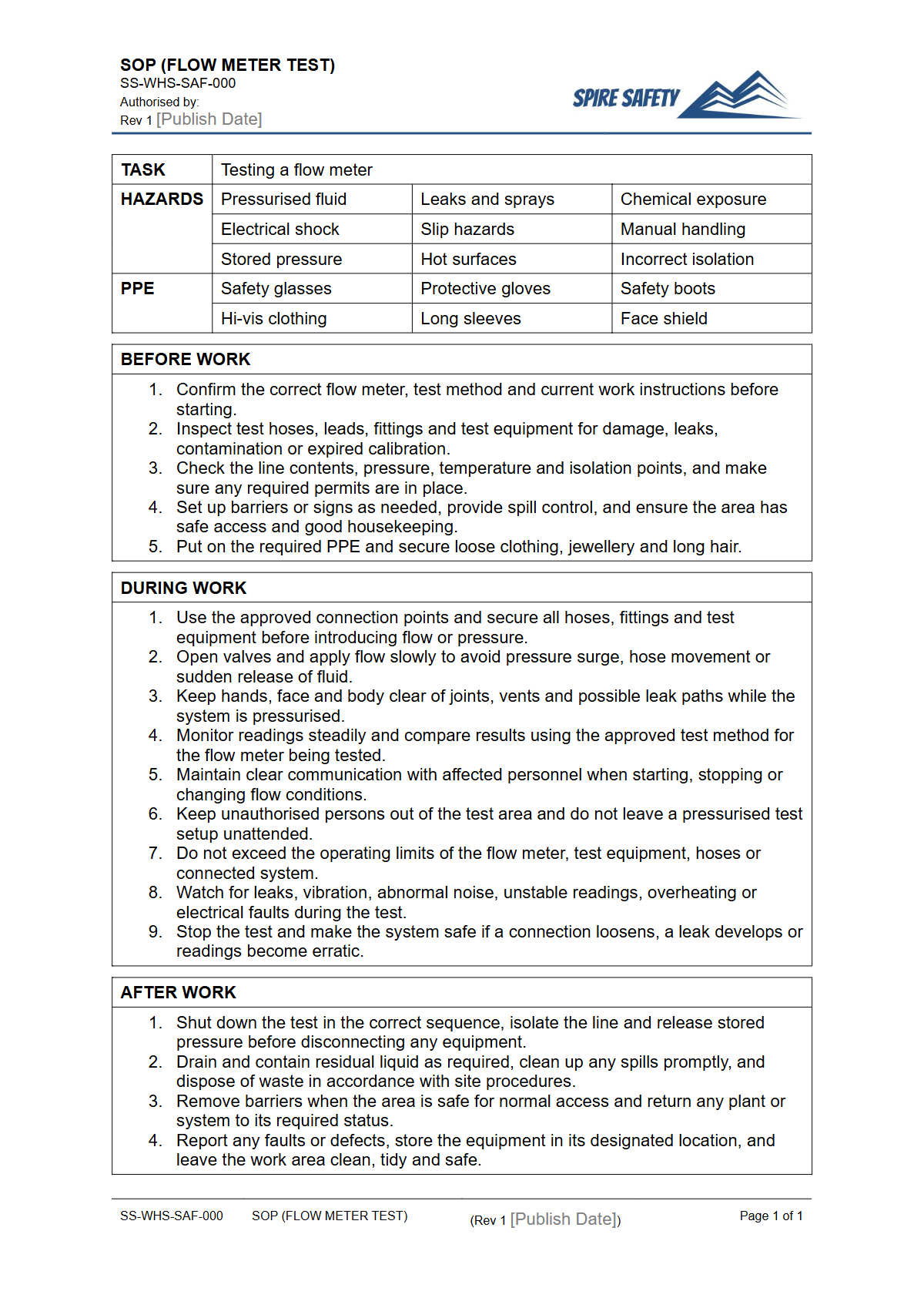
Document the process for safely testing flow meters with our structured Safe Operating Procedure template. Download your free DOCX and PDF to get started.
Free Safe Operating Procedure (Flow Meter Test) Template
DOCX • 126 KB + PDF
Updated Oct 2026
No signup required
Purpose of the Free Safe Operating Procedure (Flow Meter Test) Template
This free Safe Operating Procedure (Flow Meter Test) template provides a structured framework for documenting the steps required to safely test and calibrate flow meters in your workplace. A documented SOP ensures that the task is performed consistently and safely every time, reducing the risk of incidents and ensuring measurement accuracy.
Using a standardised procedure helps control hazards associated with pressurised systems, hazardous substances, and electrical energy. It forms a critical component of your organisation's preventative maintenance program and overall approach to workplace safety.
Key Hazards to Consider
When customising this template, you must identify and assess the specific risks present in your environment. Common hazards during flow meter testing include:
- Hazardous Substances: Potential for exposure to corrosive, toxic, or flammable liquids or gases.
- High Pressure/Temperature: Risk of injury from the uncontrolled release of stored energy in pressurised or heated systems.
- Electrical Hazards: Contact with live components if the flow meter is electrically powered or part of a larger electrical system.
- Manual Handling: Ergonomic risks from handling heavy testing equipment or working in awkward postures.
Documenting procedures for complex equipment is essential for managing risk. For example, our FREE Conveyer System SOP helps outline safety protocols for another common piece of industrial plant.
Video walkthrough
How to use the Free Safe Operating Procedure (Flow Meter Test) Template
This document is provided as a DOCX file for easy customisation and a PDF for universal access. To use it effectively, you must adapt its contents to align with your specific operational context, including the type of flow meters used, the substances they measure, and your site-specific emergency procedures.
Effective SOPs are a cornerstone of a functional safety framework, which can be developed through our WHS management systems consulting services.
Important: This is a template, not a finished document. You must consult with workers and other stakeholders to ensure it reflects the unique equipment, processes, and risks of your workplace.
We take no responsibility for the outcomes of using this document as-is. It is your responsibility to ensure it is suitable for your business needs.
When to Use This Safe Operating Procedure
A Safe Operating Procedure for flow meter testing should be used whenever the task is performed. This includes a variety of situations:
- Routine Calibration: As part of a scheduled maintenance and calibration program to ensure ongoing accuracy.
- Commissioning: When installing and verifying the performance of a new flow meter or system.
- Troubleshooting: To diagnose and resolve issues related to inaccurate flow readings or equipment malfunction.
- Post-Maintenance Verification: After repairs or modifications to the flow meter or associated pipework to confirm correct operation.
Maintaining clear records of these activities is crucial, as they are often reviewed during a WHS compliance audit to verify that safe systems of work are being implemented and followed.
Who Should Use This Safe Operating Procedure
This SOP should be used by personnel who are trained, competent, and authorised to conduct flow meter testing. This typically includes:
- Maintenance Technicians
- Instrumentation and Control Technicians
- Process Engineers
- Site Supervisors overseeing the work
All personnel involved must be familiar with the procedure, the specific equipment they are working on, and the relevant safety precautions. Competency should be verified before any individual is permitted to undertake the task independently. This principle applies to all equipment-specific procedures, such as those detailed in our Free Air Compressor SOP.
For more templates and safety resources, you can browse our complete free WHS resources library, which contains a wide range of documents to support your safety management efforts.
Common mistakes
Common mistakes to avoid
- Failing to properly isolate and de-pressurise the system before beginning work.
- Using an uncalibrated master meter or reference device for comparison, leading to inaccurate results.
- Ignoring manufacturer-specific instructions for the flow meter and testing equipment.
- Neglecting to document test results, adjustments, and any deviations from the standard procedure.
Legal references
Legal considerations
The following legal requirements may be relevant to this type of work.
- Work Health and Safety Act (Harmonised) — Provides the primary duties for protecting workers and other people from work health and safety risks.
- Work Health and Safety Regulations (Harmonised) — Sets out requirements supporting the management of workplace hazards and risks.
The following codes may be relevant to this type of work.
- Managing WHS Risks Code of Practice — Provides practical guidance on identifying hazards, assessing risks and applying effective controls.
- Work Health and Safety Consultation, Cooperation and Coordination Code of Practice — Provides practical guidance on consulting workers and coordinating with other duty holders.
- Managing the Work Environment and Facilities Code of Practice — Provides practical guidance on safe work environments, workplace facilities and related controls.
Did you know
The Coriolis Effect
Some advanced flow meters, known as Coriolis mass flow meters, use the principles of the Coriolis effect to measure mass flow rate directly, independent of fluid density, temperature, or viscosity.
FAQ
Frequently asked questions
01What are the key hazards when testing a flow meter?
02Is an SOP the same as a Safe Work Method Statement (SWMS) for flow meter testing?
03How often should a flow meter test SOP be reviewed?
04What PPE is typically required for flow meter testing?
Share this resource
Free Safe Operating Procedure (Flow Meter Test) Template
Browse Categories
How To Use It
- 1Download and open in Word or PDF.
- 2Replace the placeholders with your business details.
- 3Get it reviewed by a WHS specialist before rollout.
Need it customised?
Our WHS consultants can adapt this template to your site, run a gap analysis, or audit what you already have in place.
Book a Free Consultation WHS consulting servicesor call 1300 156 382
Related templates
- Free Safe Operating Procedure (Flow Transmitter) Template
- Free Safe Operating Procedure (Flower Bed Maintenance) Template
- Free Safe Operating Procedure (Flower Bed Weeding) Template
- Free Safe Operating Procedure (Flower Deadheading) Template
- Free Safe Operating Procedure (Flower Potting) Template
- Free Safe Operating Procedure (Fly Press) Template