
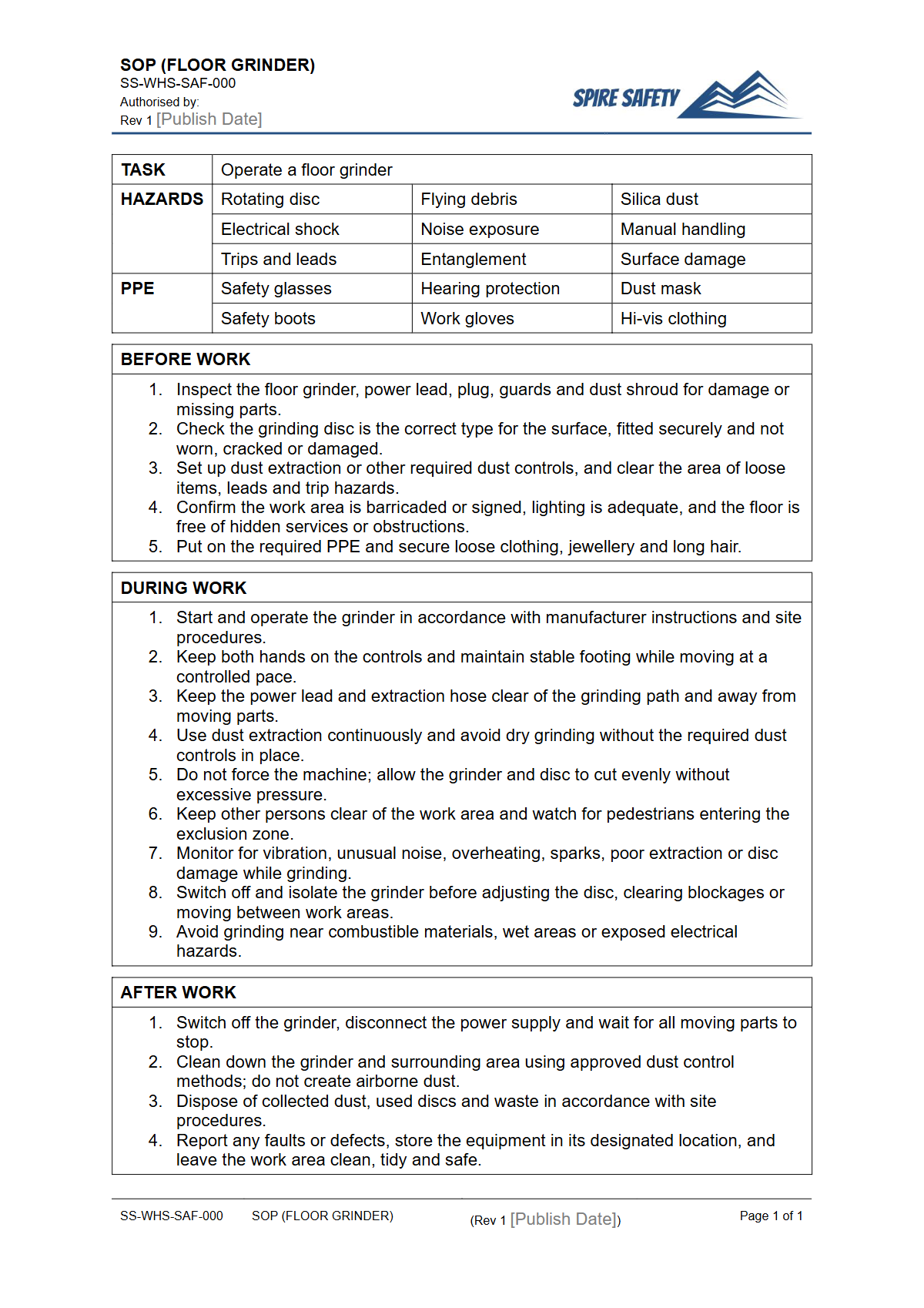
Free Safe Operating Procedure (Floor Grinder) Template
Download our free Safe Operating Procedure (Floor Grinder) template to establish clear, safe work instructions. Get your customisable DOCX and PDF now.
Free Safe Operating Procedure (Floor Grinder) Template
DOCX • 126 KB + PDF
Updated Oct 2026
No signup required
Purpose of the Free Safe Operating Procedure (Floor Grinder) Template
Operating a floor grinder, while essential for surface preparation and finishing, introduces significant workplace hazards. This Free Safe Operating Procedure (Floor Grinder) Template provides a structured framework for documenting the required steps to use this equipment safely.
A well-drafted SOP is a critical tool for managing risks such as exposure to respirable crystalline silica (silica dust), noise, hand-arm vibration, and electrical hazards. By outlining clear instructions for pre-start checks, operation, and shutdown, this document helps persons conducting a business or undertaking (PCBUs) meet their primary duty of care under Australian WHS legislation.
Implementing documented procedures like this is a fundamental part of effective WHS management systems. It transforms safety requirements from abstract rules into actionable, consistent behaviours, ensuring every operator understands the approved method for completing the task safely. This process helps minimise incidents, protect workers from long-term health effects, and provides a clear standard for training and supervision.
Video walkthrough
How to use the Free Safe Operating Procedure (Floor Grinder) Template
This template is available for immediate download in both DOCX and PDF formats. The DOCX version is fully editable, allowing you to tailor it precisely to your operational needs.
To use it effectively, you should add your company branding and fill in the site-specific details. This includes identifying the exact models of floor grinders in use, the specific tasks they are used for (e.g., concrete grinding, coating removal), and the risk control measures relevant to your work environment.
Important: This template is a starting point aligned with Australian WHS principles and is not a complete, off-the-shelf solution. We have based it on common industry practices, but every workplace is unique.
You must customise this document with your specific site details, equipment, tasks, and risk controls to ensure it is effective and suitable for your business. For instance, your procedure may need to be different from a Safe Operating Procedure for floor scrubber operation due to the different hazards involved.
When to use a Floor Grinder SOP
A Safe Operating Procedure for a floor grinder should be integrated into your daily operations and safety management processes. It must be used as a primary training document for any new worker before they are authorised to operate the equipment.
It also serves as a vital on-the-job reference for experienced operators, reinforcing correct procedures and ensuring consistency. The SOP should be readily accessible in the work area where the grinder is used.
Furthermore, the SOP is a key document during safety reviews, incident investigations, and toolbox talks. It should be formally reviewed and updated whenever a new model of grinder is introduced, when a work process changes, or following any incident or near miss involving the equipment. Regular reviews are also a core component of successful WHS compliance auditing.
Who should use it
This SOP template is designed for use by several key roles within an organisation. WHS Managers, Health and Safety Representatives (HSRs), and Site Supervisors are typically responsible for customising the template and implementing the final procedure.
They must consult with workers during this process to ensure the SOP is practical and reflects the realities of the task. Business owners and managers use the finalised SOP to demonstrate due diligence and ensure a safe system of work is in place.
The primary audience for the completed SOP is the operators themselves. Every worker tasked with using a floor grinder must be trained on the procedure and be required to follow it every time.
Just as you would have a specific Circular Saw SOP for carpenters, this procedure is for anyone involved in floor preparation.
Key Risks and Controls
When customising your SOP, pay close attention to the hierarchy of controls for the most significant risks associated with floor grinding.
- Respirable Crystalline Silica: This is a major hazard when grinding concrete, stone, or masonry. The most effective control is to eliminate or minimise dust generation at the source. This is typically achieved through wet grinding methods or by using an M- or H-class industrial vacuum cleaner connected directly to the grinder's dust shroud. Respiratory Protective Equipment (RPE) is a mandatory last line of defence.
- Noise: Floor grinders can generate noise levels well above the exposure standard, leading to permanent hearing loss. Controls include selecting quieter models where possible and ensuring all operators wear appropriate hearing protection (e.g., earplugs or earmuffs).
- Vibration: Prolonged use can lead to Hand-Arm Vibration Syndrome (HAVS). Controls involve job rotation to limit an individual's trigger time, using anti-vibration gloves, and ensuring the machine is well-maintained. The risks here are very different from those detailed in a Telehandler SOP, highlighting the need for equipment-specific procedures.
- Electrical Hazards: Ensure all electrical leads, plugs, and grinders are regularly tested and tagged. Use a residual-current device (RCD) to protect against electric shock, particularly in damp conditions.
By formalising the steps for operating equipment and managing its unique risks, you build a stronger safety culture. Explore our complete free WHS resources library for more templates to support your safety management system.
Common mistakes
Common mistakes to avoid
- Using the incorrect type of grinding disc or pads for the floor material.
- Failing to use an integrated dust extraction system (M- or H-Class vacuum) or wet methods.
- Neglecting to perform and document pre-start inspections, especially checking guards and cords.
- Wearing inadequate Personal Protective Equipment (PPE), particularly the wrong class of respiratory protection.
Legal references
Legal considerations
The following legal requirements may be relevant to this type of work.
- Work Health and Safety Act (Harmonised) — Provides the primary duties for protecting workers and other people from work health and safety risks.
- Work Health and Safety Regulations (Harmonised) — Sets out requirements supporting the management of workplace hazards and risks.
The following codes may be relevant to this type of work.
- Managing WHS Risks Code of Practice — Provides practical guidance on identifying hazards, assessing risks and applying effective controls.
- Work Health and Safety Consultation, Cooperation and Coordination Code of Practice — Provides practical guidance on consulting workers and coordinating with other duty holders.
- Managing the Work Environment and Facilities Code of Practice — Provides practical guidance on safe work environments, workplace facilities and related controls.
Did you know
Dust is the Deadliest Risk
For concrete grinders, the most severe long-term risk is not from the moving parts but from the invisible silica dust created. Uncontrolled dry grinding can generate silica dust levels hundreds of times over the legal workplace exposure standard.
Vibration Damage
Hand-Arm Vibration Syndrome (HAVS) caused by tools like floor grinders can cause permanent damage to nerves and blood vessels in the hands and arms. Early symptoms include tingling and numbness in the fingers.
FAQ
Frequently asked questions
01What are the main hazards of using a floor grinder?
02Is a Safe Operating Procedure a legal requirement for floor grinders in Australia?
03How often should an SOP for a floor grinder be reviewed?
04Can this template be used for all types of floor grinders?
Share this resource
Free Safe Operating Procedure (Floor Grinder) Template
Browse Categories
How To Use It
- 1Download and open in Word or PDF.
- 2Replace the placeholders with your business details.
- 3Get it reviewed by a WHS specialist before rollout.
Need it customised?
Our WHS consultants can adapt this template to your site, run a gap analysis, or audit what you already have in place.
Book a Free Consultation WHS consulting servicesor call 1300 156 382
Related templates
- Free Safe Operating Procedure (Floor Machine Setup) Template
- Free Safe Operating Procedure (Floor Polisher) Template
- Free Safe Operating Procedure (Floor Polishing Prep) Template
- Free Safe Operating Procedure (Floor Sander) Template
- Free Safe Operating Procedure (Floor Scarifier) Template
- Free Safe Operating Procedure (Floor Scrubber Operation) Template