
Free Safe Operating Procedure (Floor Burnishing) Template
Our Free Safe Operating Procedure for Floor Burnishing helps you define safe work methods for your team.
Free Safe Operating Procedure (Floor Burnishing) Template
DOCX • 126 KB + PDF
Updated Oct 2026
No signup required
Purpose of the Free Safe Operating Procedure (Floor Burnishing) Template
A floor burnisher, or polishing machine, is essential for maintaining high-gloss flooring in commercial and industrial settings. However, its operation involves significant risks if not managed correctly.
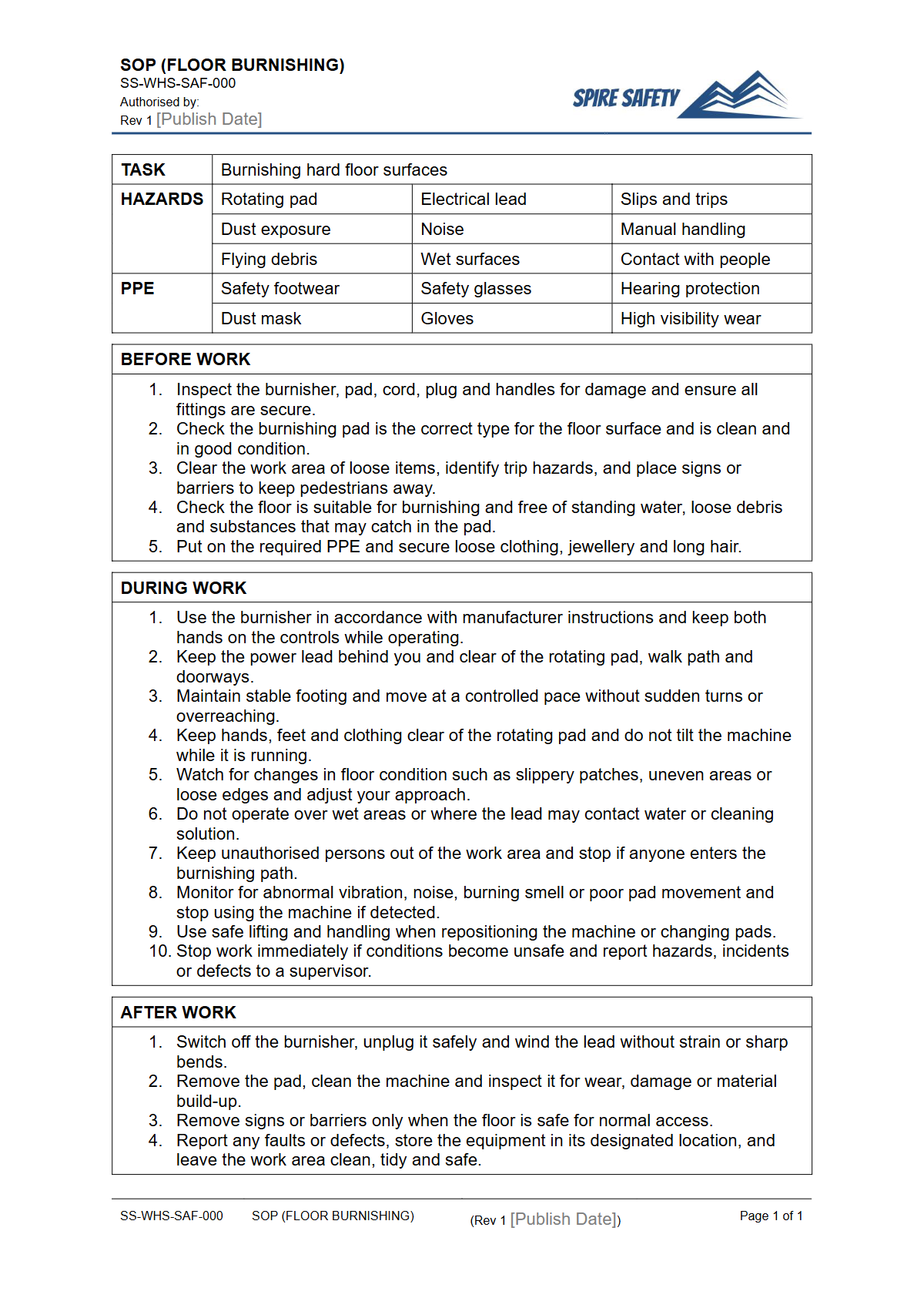
This Free Safe Operating Procedure (Floor Burnishing) Template provides a structured framework for documenting the required steps to operate the equipment safely. It helps organisations control hazards such as electric shock from faulty cords, slips and falls on wet surfaces or from trailing cables, ergonomic strain from improper handling, and respiratory exposure to dust.
By implementing a clear and detailed Safe Operating Procedure (SOP), you can standardise work practices, facilitate effective worker training, and demonstrate due diligence in meeting your work health and safety (WHS) obligations. An SOP is a fundamental tool for managing risks associated with plant and equipment.
For tailored advice on integrating such documents into your broader safety strategy, consider engaging with a specialist WHS consulting service.
Video walkthrough
How to use the Free Safe Operating Procedure (Floor Burnishing) Template
This resource is available for download as a DOCX file for easy editing or as a PDF for straightforward printing. To use the template effectively, you must adapt its contents to reflect the unique conditions of your workplace.
This includes referencing the specific make and model of your floor burnisher, the types of floor surfaces it will be used on, and the chemical products involved.
Important: This is a template only. You must customise it to align with your specific equipment, chemicals, environment, and organisational procedures.
Review the manufacturer’s operating manual and your own risk assessments to ensure all relevant hazards and controls are included. We are not liable for any incidents arising from the use of this document; its effectiveness depends on its correct customisation and implementation in a comprehensive safe system of work.
For related cleaning equipment, you might also find our Free Safe Operating Procedure (Floor Scrubber Operation) Template useful.
What This Safe Operating Procedure Template Covers
Our template provides a comprehensive starting point, with sections designed to guide you through the documentation process. Key areas covered include:
- Required Personal Protective Equipment (PPE): Specifies PPE such as non-slip, enclosed footwear, and safety glasses.
- Hazard Identification: Lists common hazards like electrical faults, moving parts, noise, and manual handling risks.
- Pre-operational Checks: Outlines a checklist for inspecting the machine before use, including the cord, plug, pad, and safety features.
- Step-by-Step Operating Instructions: A sequence for performing the task safely, from area preparation to the correct burnishing technique.
- Post-operational Tasks: Details procedures for cleaning, maintenance, and proper storage of the equipment.
Documented procedures are critical for any piece of powered equipment, not just cleaning machinery. For instance, workshops benefit from resources like our Free Circular Saw SOP Template to manage different but equally significant risks.
When to use it
A Floor Burnishing SOP should be an active document within your safety management system. It is used during worker induction and training to ensure new team members understand the correct procedures from day one.
It also serves as a practical reference tool for existing workers to reinforce safe behaviour. Furthermore, the SOP is a critical document during formal risk assessments and should be reviewed and updated whenever there is a change in equipment, processes, or after any reported incident or near-miss. Integrating such procedures is a core function of a robust WHS management system.
Who should use it
This template is designed for anyone responsible for workplace safety in environments where floor burnishers are used. This includes:
- WHS Managers and Safety Officers: To develop and implement formalised safety procedures.
- Supervisors and Team Leaders: To train their teams and monitor compliance with safe work practices.
- Business Owners and Facilities Managers: To ensure they are meeting their primary duty of care under WHS legislation.
- Workers: As a clear, accessible guide on how to perform their tasks safely.
The consistent application of SOPs is often a key point of verification during internal and external WHS compliance audits.
Enhance Your Safety Framework
Using a standardised SOP for floor burnishing is a proactive step towards creating a safer workplace. It helps prevent injuries, protects assets from damage, and builds a positive safety culture where procedures are clearly defined and understood.
By formalising your processes, you reduce ambiguity and empower workers to operate equipment correctly and confidently. Explore our complete free WHS resources library for more templates to support your safety management efforts.
Common mistakes
Common mistakes to avoid
- Using the wrong type or grade of floor pad for the surface, resulting in floor damage or a poor finish.
- Failing to place adequate warning signs (e.g., 'Wet Floor'), creating a serious slip hazard for others in the area.
- Operating the machine with a frayed, taped, or otherwise damaged electrical cord, posing a significant electrocution risk.
- Neglecting to thoroughly sweep or dust mop the floor before burnishing, which can grind dirt into the finish.
Legal references
Legal considerations
The following legal requirements may be relevant to this type of work.
- Work Health and Safety Act (Harmonised) — Provides the primary duties for protecting workers and other people from work health and safety risks.
- Work Health and Safety Regulations (Harmonised) — Sets out requirements supporting the management of workplace hazards and risks.
The following codes may be relevant to this type of work.
- Managing WHS Risks Code of Practice — Provides practical guidance on identifying hazards, assessing risks and applying effective controls.
- Work Health and Safety Consultation, Cooperation and Coordination Code of Practice — Provides practical guidance on consulting workers and coordinating with other duty holders.
- Managing the Work Environment and Facilities Code of Practice — Provides practical guidance on safe work environments, workplace facilities and related controls.
Did you know
RPM Matters
High-speed floor burnishers can spin at over 2000 RPM. This incredible speed generates the friction and heat needed to melt a microscopic layer of floor finish, creating a durable, high-gloss 'wet look'.
Dust Control
Modern burnishers often include active or passive dust control systems. These systems capture the fine particulate matter kicked up during polishing, protecting air quality and reducing respiratory risks for the operator.
FAQ
Frequently asked questions
01What are the main hazards associated with floor burnishing?
02Is a Safe Operating Procedure legally required for a floor burnisher in Australia?
03How often should an SOP for floor burnishing be reviewed?
04Can I use this template for any brand of floor burnisher?
Share this resource
Free Safe Operating Procedure (Floor Burnishing) Template
Browse Categories
How To Use It
- 1Download and open in Word or PDF.
- 2Replace the placeholders with your business details.
- 3Get it reviewed by a WHS specialist before rollout.
Need it customised?
Our WHS consultants can adapt this template to your site, run a gap analysis, or audit what you already have in place.
Book a Free Consultation WHS consulting servicesor call 1300 156 382
Related templates
- Free Safe Operating Procedure (Floor Coating) Template
- Free Safe Operating Procedure (Floor Grinder) Template
- Free Safe Operating Procedure (Floor Machine Setup) Template
- Free Safe Operating Procedure (Floor Polisher) Template
- Free Safe Operating Procedure (Floor Polishing Prep) Template
- Free Safe Operating Procedure (Floor Sander) Template