
Free Safe Operating Procedure (Flanging Machine) Template
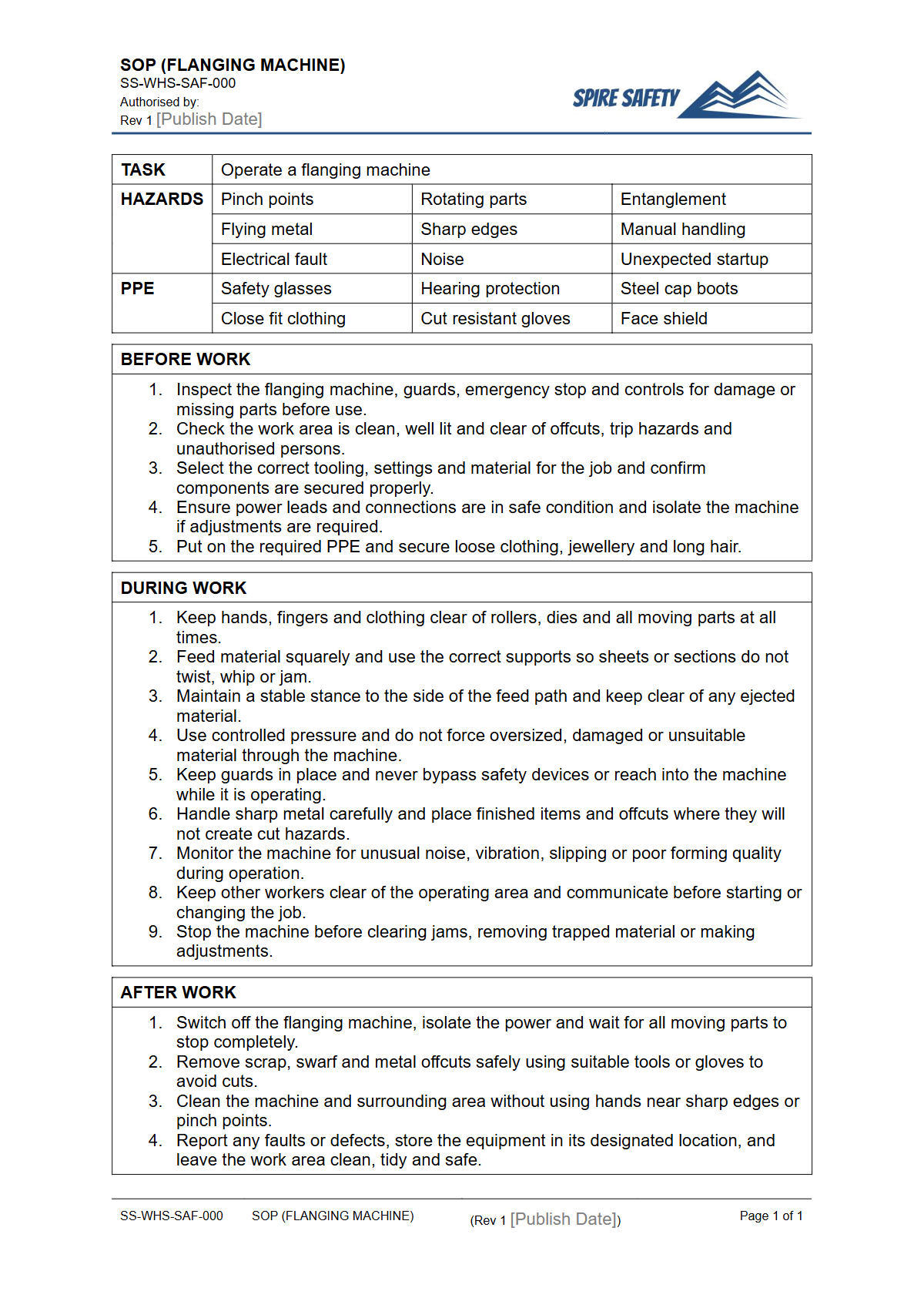
Document the correct use of flanging machines in your workplace. Download our free Safe Operating Procedure (Flanging Machine) template to get started.
Free Safe Operating Procedure (Flanging Machine) Template
DOCX • 126 KB + PDF
Updated Oct 2026
No signup required
Purpose of the Free Safe Operating Procedure (Flanging Machine) Template
Operating machinery like a flanging machine presents significant risks if not managed correctly. This free Safe Operating Procedure (Flanging Machine) template provides a structured starting point for your business to document safe work methods, identify hazards, and implement control measures.
A well-drafted SOP is a critical tool for training workers and ensuring consistent, safe operation, helping you meet your duty of care. It formalises the step-by-step process for using the equipment, from pre-start checks to shutdown procedures, minimising the risk of incidents and injuries related to entanglement, crushing, or high-pressure systems.
Developing specific procedures for each piece of plant is a cornerstone of good safety management. While this SOP focuses on flanging machines, you might also require procedures for other equipment, such as our free Air Compressor SOP, to build a comprehensive safety framework.
Video walkthrough
How to use the Free Safe Operating Procedure (Flanging Machine) Template
This resource is available for download as a DOCX file for easy editing, or as a PDF for straightforward printing and distribution. To make this document effective, you must customise it to reflect the specific model of flanging machine, the materials being used, and the unique environment of your workplace.
Generic procedures are insufficient for managing specific risks.
Important: We have provided this template to give you a head start. You must consult with the machine operators, supervisors, and other relevant personnel during the customisation process.
This collaborative approach ensures the SOP is practical, accurate, and reflects how the work is actually done. Finalised SOPs form a vital part of your overall WHS management systems.
Key Elements in the SOP Template
Our template is structured to align with Australian WHS practice and includes sections for:
- Hazard Identification: Prompts to list potential hazards like rotating parts, pinch points, noise, and electrical risks.
- Required Personal Protective Equipment (PPE): A checklist for mandatory PPE such as safety glasses, gloves, and hearing protection.
- Pre-Operational Checks: A sequence of inspections to perform before starting the machine, including checking guarding, emergency stops, and hydraulic systems.
- Step-by-Step Operating Instructions: A logical flow for performing the flanging task safely and efficiently.
- Post-Operational and Shutdown Procedures: Instructions for cleaning, maintenance, and securing the machine after use.
Each section is designed to be populated with your site-specific information. In many workshops, flanging equipment is used alongside other fabrication tools, so consider developing documentation for all high-risk plant, like a free Circular Saw SOP for your cutting tasks.
When to use a Flanging Machine SOP
A Safe Operating Procedure for a flanging machine should be used in several key situations. It is essential for inducting new employees or training existing workers on new equipment.
It serves as a practical on-the-job reference guide to reinforce correct procedures and safe behaviour. Furthermore, SOPs are invaluable during incident investigations to determine if procedural breaches occurred and are a key document reviewed during both internal and external WHS compliance audits.
In a manufacturing environment, a flanging machine may be part of a larger production line. Integrating its SOP with others, such as a Conveyer System SOP, helps create a seamless and safe workflow from one process stage to the next.
Who should use this SOP?
This template is designed for use by Persons Conducting a Business or Undertaking (PCBUs), site managers, supervisors, and WHS professionals. The primary responsibility for implementing safe work procedures lies with the PCBU.
However, supervisors are responsible for ensuring workers are trained on and adhere to the SOP. WHS advisors can use this template to guide the development and review process, ensuring it aligns with legislative requirements and best practices.
If you require assistance adapting this or other documents, our WHS consulting services can provide expert support.
By systematically documenting procedures, you create a safer work environment and a clear framework for training and supervision. Explore our complete free WHS resources library for more templates to support your safety management system.
Common mistakes
Common mistakes to avoid
- Using a generic machinery SOP without adding site-specific details for the particular flanging machine.
- Failing to consult with the experienced operators who use the equipment daily.
- Not providing practical, hands-on training on the finalised SOP to all relevant workers.
- Forgetting to schedule and conduct regular reviews, leading to an outdated and ineffective procedure.
Legal references
Legal considerations
The following legal requirements may be relevant to this type of work.
- Work Health and Safety Act (Harmonised) — Provides the primary duties for protecting workers and other people from work health and safety risks.
- Work Health and Safety Regulations (Harmonised) — Sets out requirements supporting the management of workplace hazards and risks.
The following codes may be relevant to this type of work.
- Managing WHS Risks Code of Practice — Provides practical guidance on identifying hazards, assessing risks and applying effective controls.
- Work Health and Safety Consultation, Cooperation and Coordination Code of Practice — Provides practical guidance on consulting workers and coordinating with other duty holders.
- Managing the Work Environment and Facilities Code of Practice — Provides practical guidance on safe work environments, workplace facilities and related controls.
Did you know
Entanglement Hazard
Flanging machines often use powerful rotating parts, which are a major cause of entanglement injuries. Loose clothing, unsecured long hair, and jewellery are significant risk factors that must be managed through dress codes and operator awareness.
Hierarchy of Control
An SOP is an administrative control. While essential, it should be supported by higher-level controls like fixed guarding over moving parts (engineering control) and proper machine selection for the task (substitution).
FAQ
Frequently asked questions
01What is a Safe Operating Procedure (SOP) for a flanging machine?
02Why is a specific SOP for a flanging machine necessary?
03Who is responsible for writing and implementing a Safe Operating Procedure?
04How often should a flanging machine SOP be reviewed?
Share this resource
Free Safe Operating Procedure (Flanging Machine) Template
Browse Categories
How To Use It
- 1Download and open in Word or PDF.
- 2Replace the placeholders with your business details.
- 3Get it reviewed by a WHS specialist before rollout.
Need it customised?
Our WHS consultants can adapt this template to your site, run a gap analysis, or audit what you already have in place.
Book a Free Consultation WHS consulting servicesor call 1300 156 382
Related templates
- Free Safe Operating Procedure (Flashback Arrestor Test) Template
- Free Safe Operating Procedure (Flat Top Grill) Template
- Free Safe Operating Procedure (Fleet Key Handover) Template
- Free Safe Operating Procedure (Floating Dock Access) Template
- Free Safe Operating Procedure (Floor Buffing) Template
- Free Safe Operating Procedure (Floor Burnishing) Template