
Free Safe Operating Procedure (Flashback Arrestor Test) Template
Document the critical safety checks for your oxy-fuel equipment with our free Safe Operating Procedure (Flashback Arrestor Test) Template.
Free Safe Operating Procedure (Flashback Arrestor Test) Template
DOCX • 126 KB + PDF
Updated Oct 2026
No signup required
Purpose of the Free Safe Operating Procedure (Flashback Arrestor Test) Template
Using oxy-fuel equipment for welding, cutting, or heating introduces significant fire and explosion risks. A flashback—where the flame front travels back from the torch into the hoses and potentially the gas cylinder—can have catastrophic consequences.
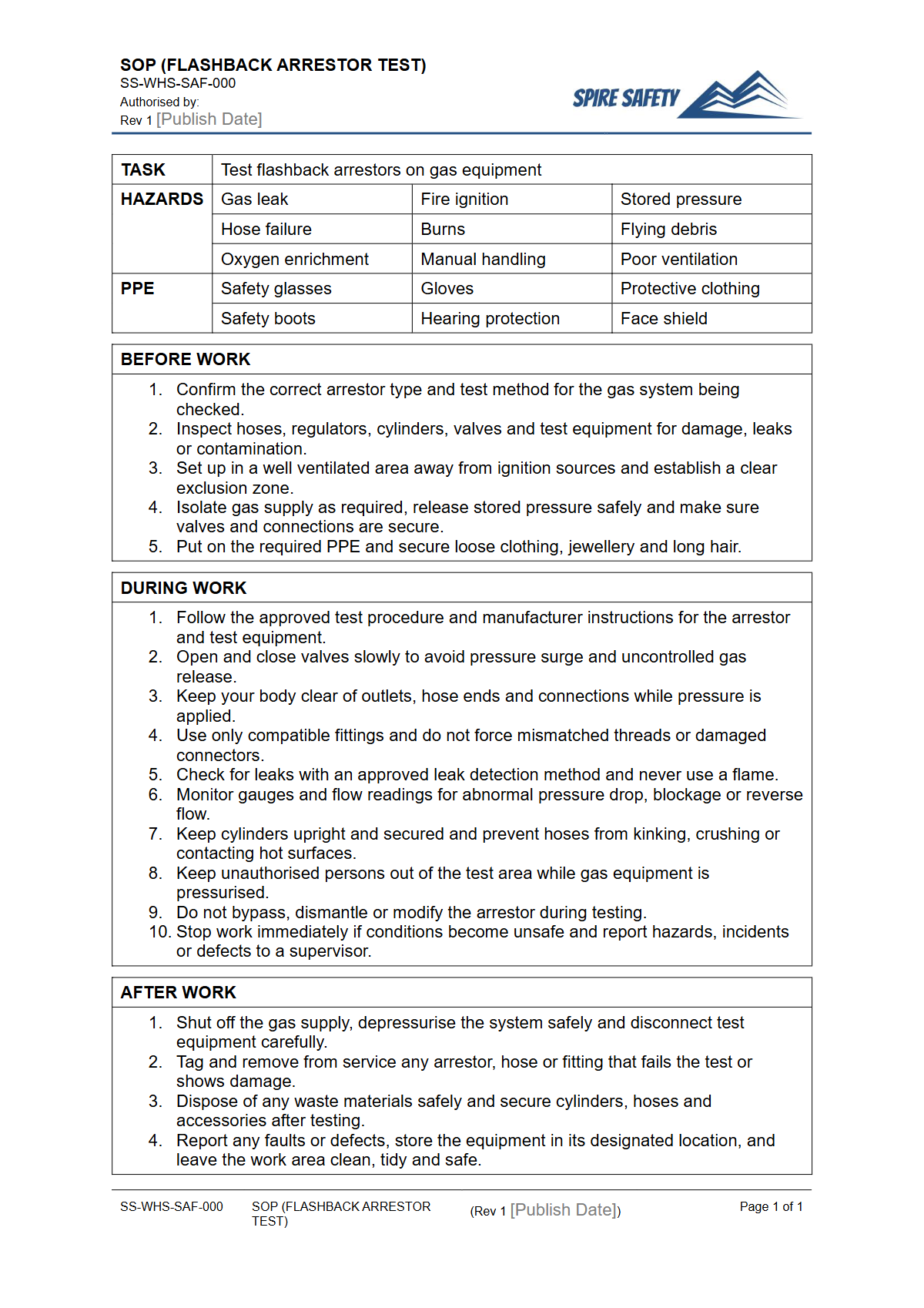
This free Safe Operating Procedure (Flashback Arrestor Test) Template provides a structured format for documenting the process your organisation uses to verify the correct function of these critical safety devices. It helps standardise testing protocols, assign responsibilities, and create auditable records to demonstrate due diligence.
A documented procedure ensures that testing is performed consistently and correctly by all competent personnel. It formalises the steps required, from visual inspection to flow and pressure drop tests, helping to prevent equipment failure.
Integrating this SOP into your operational practices is a key control measure for managing the risks associated with hot work. For other plant used in workshops, a similar procedural approach should be taken, as shown in our free Air Compressor SOP.
By implementing a formal SOP, you embed a critical safety check into your daily workflow, moving beyond ad-hoc practices. This process forms a vital component of robust WHS management systems, ensuring that controls for high-risk activities like welding and gas cutting are systematically managed, monitored, and reviewed.
It provides clear instructions for workers and a clear standard for supervisors to enforce.
Video walkthrough
How to use the Free Safe Operating Procedure (Flashback Arrestor Test) Template
This template is provided as a fully editable DOCX file and a print-ready PDF. To use it, simply download the file and adapt the contents to your specific operational context.
You should fill in details such as your company name, the specific models of flashback arrestors in use, the designated testing equipment, and the names or roles of competent persons authorised to conduct the tests. The procedure should be clear, concise, and easy for your team to follow.
Important Note: This document provides a foundational framework. We have drafted it to align with Australian WHS practice, but you must customise it to reflect the specific equipment, personnel, and environment of your workplace.
Your final SOP should be a practical tool used for training and verification, not just a generic paper exercise.
Once customised, the SOP should be communicated to all relevant workers during induction or toolbox talks. Consider it a living document; it should be reviewed and updated whenever testing equipment changes, new types of arrestors are introduced, or an incident occurs.
Having documented procedures for various equipment, like our free Circular Saw SOP, helps create a consistent approach to safety across your site.
When to Test Flashback Arrestors
The frequency and triggers for testing flashback arrestors are critical for ensuring their reliability. This SOP should be used as a guide for establishing a testing schedule based on a combination of regulatory guidance, manufacturer recommendations, and your own risk assessment. Generally, testing should be conducted:
- Before a new or repaired arrestor is placed into service for the first time.
- At regular intervals as specified by the manufacturer (e.g., annually).
- After any incident where a flashback is known or suspected to have occurred.
- As part of a scheduled preventative maintenance program for your gas welding and cutting sets.
Integrating this procedure into a broader periodic inspection schedule helps ensure it is not overlooked. The records generated from following this SOP provide essential evidence during regular WHS compliance auditing.
Who Should Use This Safe Operating Procedure
This SOP should be used by any person deemed competent to test, inspect, and maintain oxy-fuel equipment. This typically includes:
- Welders, Boilermakers, and Fabricators who use the equipment daily.
- Maintenance Fitters and Technicians responsible for equipment upkeep.
- Workshop Supervisors and Team Leaders who oversee hot work activities.
- WHS Advisors and Officers responsible for implementing and monitoring safety procedures.
A 'competent person' is someone who has acquired the necessary knowledge and skills through training, qualification, or experience to perform the task correctly and safely. Ensure that anyone assigned to test flashback arrestors has received specific training on the procedure and the testing equipment used. This focus on competency applies to all high-risk plant, as detailed in documents like our Telehandler SOP template. Explore our free WHS resources library to find more templates to support your safety management system.
Common mistakes
Common mistakes to avoid
- Using arrestors that are past their manufacturer-specified expiry date.
- Failing to immediately test an arrestor after a known or suspected flashback event.
- Neglecting to keep clear, accessible records of all tests performed.
- Assuming a brand new arrestor from the box does not require an initial test before being put into service.
Legal references
Legal considerations
The following legal requirements may be relevant to this type of work.
- Work Health and Safety Act (Harmonised) — Provides the primary duties for protecting workers and other people from work health and safety risks.
- Work Health and Safety Regulations (Harmonised) — Sets out requirements supporting the management of workplace hazards and risks.
The following codes may be relevant to this type of work.
- Managing WHS Risks Code of Practice — Provides practical guidance on identifying hazards, assessing risks and applying effective controls.
- Work Health and Safety Consultation, Cooperation and Coordination Code of Practice — Provides practical guidance on consulting workers and coordinating with other duty holders.
- Managing the Work Environment and Facilities Code of Practice — Provides practical guidance on safe work environments, workplace facilities and related controls.
Did you know
Gas Velocity is Key
Flashbacks occur when the flame front travels faster than the gas flowing out of the torch. This allows the flame to move backwards into the hoses and potentially the regulator or cylinder.
Australian Standard
Australian Standard AS 4839 specifies requirements for the safe use of portable and mobile oxy-fuel gas equipment, including guidance on the selection, inspection, and testing of flashback arrestors.
FAQ
Frequently asked questions
01What is a flashback arrestor and why is it important?
02How often should flashback arrestors be tested?
03Can I use this template for both fuel gas and oxygen line arrestors?
04Who is considered a 'competent person' to test a flashback arrestor?
Share this resource
Free Safe Operating Procedure (Flashback Arrestor Test) Template
Browse Categories
How To Use It
- 1Download and open in Word or PDF.
- 2Replace the placeholders with your business details.
- 3Get it reviewed by a WHS specialist before rollout.
Need it customised?
Our WHS consultants can adapt this template to your site, run a gap analysis, or audit what you already have in place.
Book a Free Consultation WHS consulting servicesor call 1300 156 382
Related templates
- Free Safe Operating Procedure (Flat Top Grill) Template
- Free Safe Operating Procedure (Fleet Key Handover) Template
- Free Safe Operating Procedure (Floating Dock Access) Template
- Free Safe Operating Procedure (Floor Buffing) Template
- Free Safe Operating Procedure (Floor Burnishing) Template
- Free Safe Operating Procedure (Floor Coating) Template