
Free Safe Operating Procedure (Fleet Key Handover) Template
Standardise your fleet vehicle access with our free Safe Operating Procedure (Fleet Key Handover) template. Download the customisable DOCX to get started.
Free Safe Operating Procedure (Fleet Key Handover) Template
DOCX • 126 KB + PDF
Updated Oct 2026
No signup required
Purpose of the Free Safe Operating Procedure (Fleet Key Handover) Template
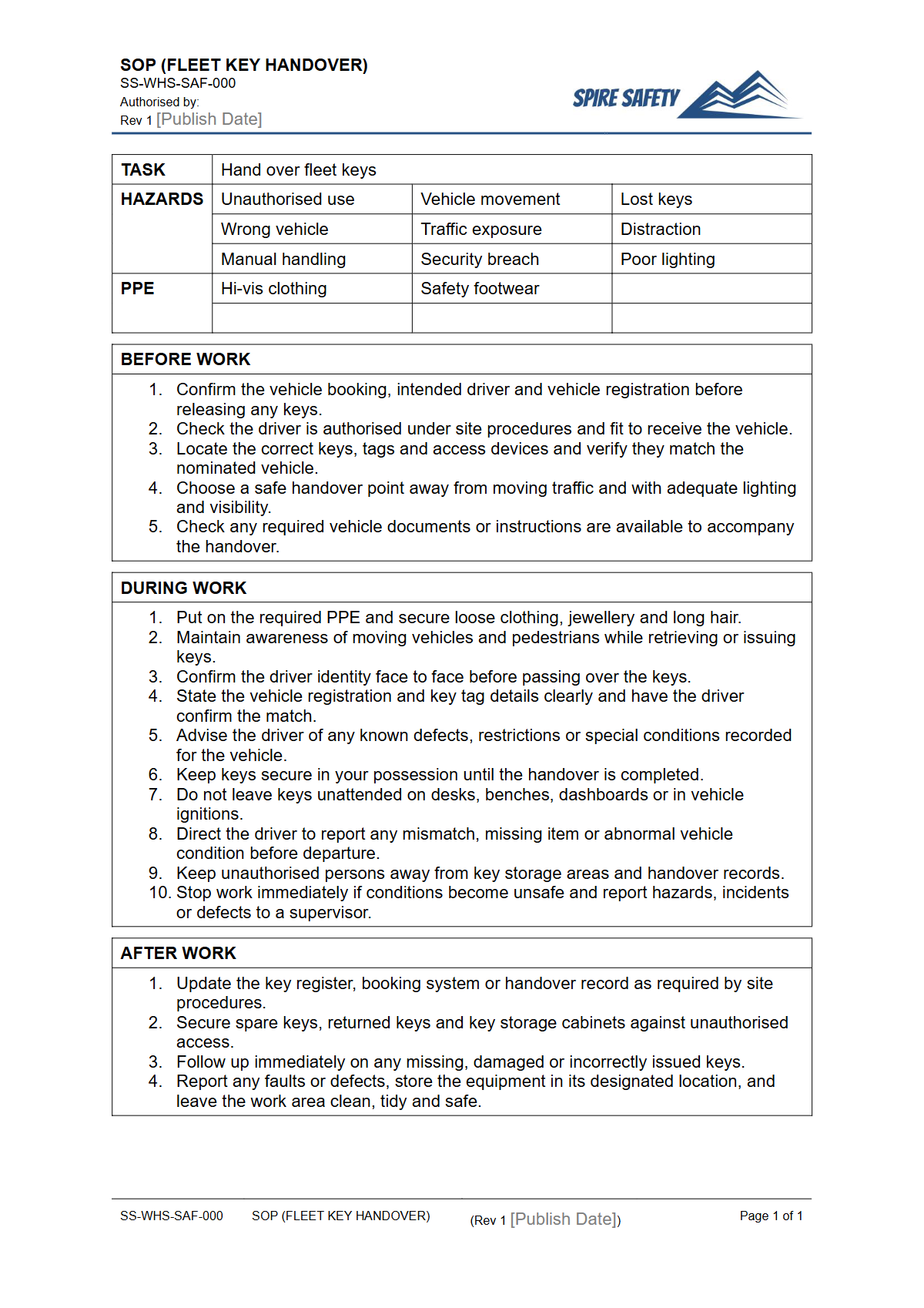
Managing a fleet of vehicles involves more than just scheduling and maintenance; it requires a systematic approach to ensure the safety of every driver and the roadworthiness of each vehicle. This Free Safe Operating Procedure (Fleet Key Handover) Template provides a structured framework for controlling the transfer of vehicles between authorised personnel.
The primary goal is to formalise the handover process, ensuring that critical safety checks are performed, driver authorisation is verified, and a clear chain of custody is maintained at all times. By implementing a formal SOP, your organisation can minimise risks associated with vehicle operation, such as those arising from unreported defects, unauthorised use, or inadequate pre-start inspections.
A documented procedure ensures consistency in how vehicles are managed, regardless of who is on shift. It helps embed safe work practices into your daily operations, forming a crucial component of your safety management system.
Using this template helps demonstrate your organisation's commitment to meeting its primary duty of care under WHS legislation by systematically managing risks related to vehicle use. This is a foundational element within comprehensive WHS management systems, reinforcing safe behaviour and accountability across the workforce.
Video walkthrough
How to use the Free Safe Operating Procedure (Fleet Key Handover) Template
This resource is available for immediate download in both DOCX and PDF formats. The DOCX file is fully editable, allowing you to tailor the procedure to the specific needs of your workplace, fleet composition, and operational risks.
It is essential that you adapt the content to reflect your unique environment.
Important: This is a template only. To be effective, you must customise it with your specific site details, vehicle types, personnel roles, and internal procedures.
We are not responsible for any incidents that may occur; the end user is solely responsible for ensuring the document is suitable for their workplace.
The template is logically structured to guide you through customisation:
- Purpose: Define the scope and objectives of the SOP.
- Responsibilities: Clearly assign duties to managers, supervisors, and workers involved in the handover process.
- Procedure: Outline the step-by-step process for vehicle handover, including pre-use checks, defect reporting, documentation, and the physical key exchange.
- Training and Competency: Specify the training required for all personnel authorised to operate fleet vehicles.
- Record Keeping: Detail the requirements for maintaining handover logs, inspection checklists, and maintenance records.
Integrating this SOP with procedures for other specific machinery, such as our FREE Telehandler SOP Template, can help create a more holistic approach to plant and equipment safety in your organisation.
When to use it
This Safe Operating Procedure should be implemented every time operational control of a company vehicle is transferred from one person to another. This includes a wide range of scenarios common in many industries.
Use it for shift changes where a vehicle is used by multiple operators throughout a 24-hour period. It is also crucial for managing pool vehicles that are available for booking by various staff members.
Furthermore, it should be a standard part of assigning a vehicle to a new employee during their induction process. Regular use ensures that no vehicle is operated without a pre-start check and formal handover, significantly reducing the chance of an incident caused by a pre-existing fault.
The documented trail created by following this SOP is also invaluable during incident investigations or safety audits. It provides clear evidence of the vehicle's condition and the operator responsible at any given time.
Regularly reviewing these procedures is a key part of the continuous improvement cycle, often assessed during WHS compliance auditing activities.
Who should use it
This SOP is designed for use by multiple roles within an organisation. WHS Managers and Fleet Managers are primarily responsible for developing, implementing, and reviewing the procedure to ensure it aligns with legal obligations and operational needs.
Supervisors and Team Leaders are responsible for enforcing the procedure on the ground, ensuring workers follow the steps correctly and that all documentation is completed accurately. Most importantly, all workers who operate company vehicles—from sales representatives in company cars to operators of light trucks or specialised equipment—must be trained on and adhere to this SOP.
It clarifies their responsibilities for vehicle safety and empowers them to refuse an unsafe vehicle.
By involving all levels of the organisation, the SOP moves from being just a document to a living part of your safety culture. This broad application is similar to other task-specific procedures, like our FREE Grader SOP (Safe Operating Procedure) Template, which also require clear roles for both management and operators.
You can find more examples across our entire free WHS resources library to support various operational tasks.
Integrating Key Handover into Your Safety System
A Safe Operating Procedure for fleet key handover does not exist in isolation. For it to be truly effective, it must be integrated into your organisation's broader safety framework.
This means linking it to your risk management processes, including the initial risk assessment for vehicle use. The SOP should be a direct output of the control measures identified in that assessment.
It should also be a core component of your worker training and induction programs, ensuring every authorised driver understands their obligations from day one.
Furthermore, the records generated from the SOP—such as completed checklists and defect reports—should feed directly into your maintenance and repair system. This creates a closed loop where hazards are identified, reported, and rectified in a timely manner.
If your organisation struggles to connect these different safety elements, engaging in specialist WHS consulting can help you build a more cohesive and effective system. This holistic view ensures that administrative controls like this SOP work in harmony with other measures to create a truly safe working environment. This principle applies to all equipment, whether it's a company ute or machinery covered by our FREE Trencher SOP Template.
Common mistakes
Common mistakes to avoid
- Failing to conduct and document thorough pre-start vehicle checks before every use.
- Assuming the previous driver has reported all existing faults or damage.
- Neglecting to verify that the incoming driver is authorised and fit for duty (e.g., not fatigued).
- Incomplete or 'pencil-whipped' handover logs that fail to create a clear record of responsibility.
Legal references
Legal considerations
The following legal requirements may be relevant to this type of work.
- Work Health and Safety Act (Harmonised) — Provides the primary duties for protecting workers and other people from work health and safety risks.
- Work Health and Safety Regulations (Harmonised) — Sets out requirements supporting the management of workplace hazards and risks.
The following codes may be relevant to this type of work.
- Managing WHS Risks Code of Practice — Provides practical guidance on identifying hazards, assessing risks and applying effective controls.
- Work Health and Safety Consultation, Cooperation and Coordination Code of Practice — Provides practical guidance on consulting workers and coordinating with other duty holders.
- Managing the Work Environment and Facilities Code of Practice — Provides practical guidance on safe work environments, workplace facilities and related controls.
Did you know
Vehicle Incidents
According to Safe Work Australia, vehicle collisions are consistently a leading cause of traumatic worker fatalities in Australia. Implementing robust vehicle safety procedures is a critical control measure to prevent these incidents.
Chain of Responsibility
Under the Heavy Vehicle National Law (HVNL), Chain of Responsibility (CoR) provisions extend legal liability for safety breaches beyond the driver to every party in the supply chain, including managers and schedulers. A formal handover process helps demonstrate due diligence.
FAQ
Frequently asked questions
01What should be included in a fleet key handover procedure?
02Is this fleet key handover SOP suitable for heavy vehicles?
03How does an SOP for key handover help with WHS compliance?
04Who is responsible for completing the key handover checklist?
Share this resource
Free Safe Operating Procedure (Fleet Key Handover) Template
Browse Categories
How To Use It
- 1Download and open in Word or PDF.
- 2Replace the placeholders with your business details.
- 3Get it reviewed by a WHS specialist before rollout.
Need it customised?
Our WHS consultants can adapt this template to your site, run a gap analysis, or audit what you already have in place.
Book a Free Consultation WHS consulting servicesor call 1300 156 382
Related templates
- Free Safe Operating Procedure (Floating Dock Access) Template
- Free Safe Operating Procedure (Floor Buffing) Template
- Free Safe Operating Procedure (Floor Burnishing) Template
- Free Safe Operating Procedure (Floor Coating) Template
- Free Safe Operating Procedure (Floor Grinder) Template
- Free Safe Operating Procedure (Floor Machine Setup) Template