
Free Safe Operating Procedure (Fitness Equipment Setup) Template
Establish clear safety protocols for assembling and installing gym equipment with our customisable template. Download your free SOP to get started today.
Free Safe Operating Procedure (Fitness Equipment Setup) Template
DOCX • 126 KB + PDF
Updated Oct 2026
No signup required
Purpose of the Free Safe Operating Procedure (Fitness Equipment Setup) Template
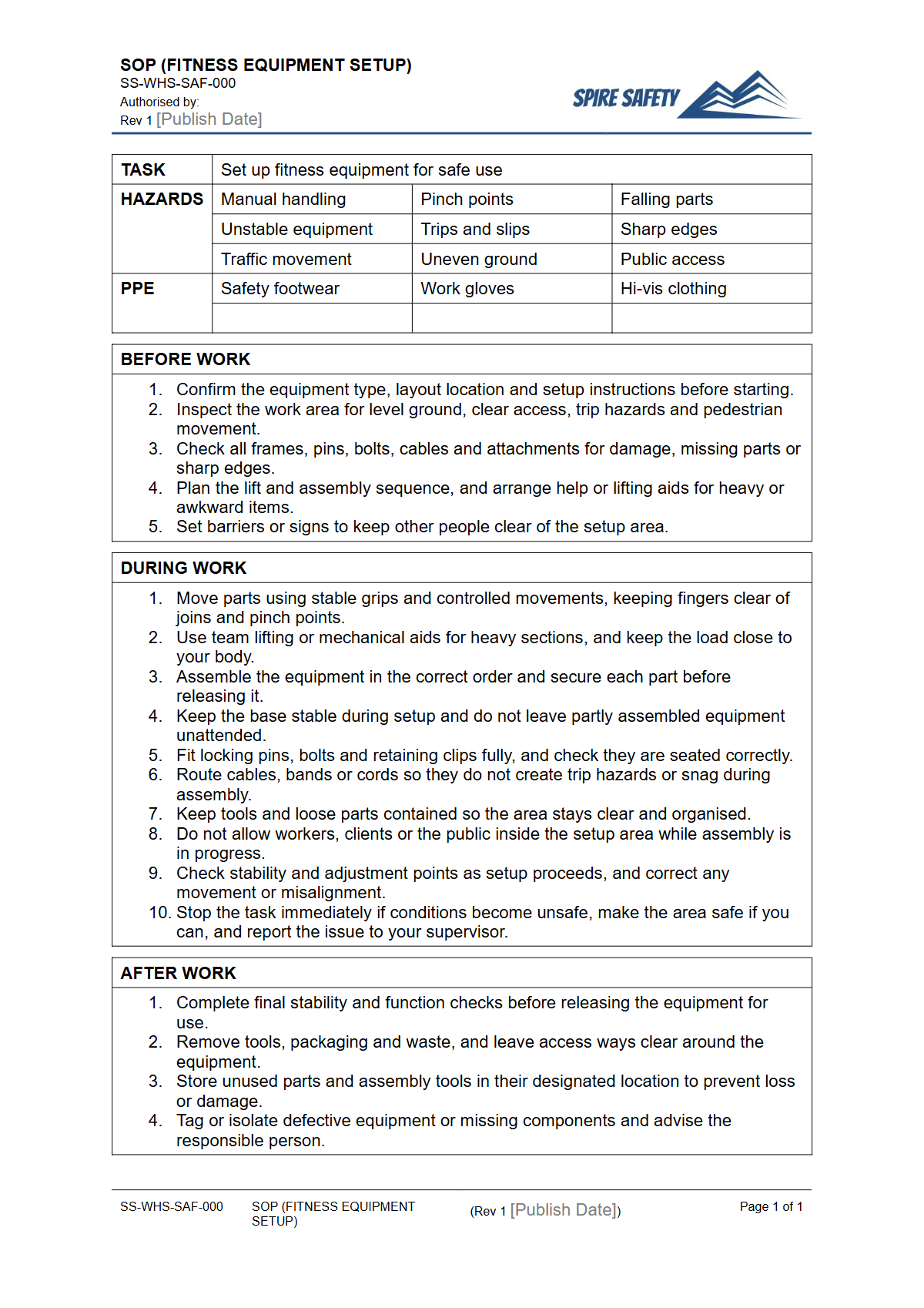
Establishing a clear and consistent process for assembling and installing fitness equipment is crucial for preventing injuries and ensuring operational safety. This Free Safe Operating Procedure (Fitness Equipment Setup) Template provides a structured framework for documenting the required steps, hazards, and controls associated with the task.
Using a standardised procedure helps minimise risks such as musculoskeletal injuries from manual handling, crush injuries from unstable parts, or structural failure from incorrect assembly. It ensures that every installation is performed to the same high safety standard, regardless of who performs the task.
Implementing documented procedures like this Safe Operating Procedure is a fundamental part of demonstrating due diligence and creating a proactive safety culture. It serves as a key document within broader WHS management systems, providing clear instructions to workers and evidence of risk management practices.
By formalising the setup process, organisations can reduce incidents, protect their staff, and ensure the long-term safety of the equipment for gym members and users.
Video walkthrough
How to use the Free Safe Operating Procedure (Fitness Equipment Setup) Template
This document is provided in both DOCX and PDF formats for your convenience. The DOCX file is fully editable, allowing you to tailor the content to the specific requirements of your workplace, the types of fitness equipment you use, and the unique environmental conditions of your facility.
It provides a solid starting point aligned with Australian WHS principles, but it is not a complete, out-of-the-box solution.
Important: We have created this template as a guide. You must customise it to reflect the specific hazards and control measures relevant to your business and the particular make and model of equipment being installed.
This includes incorporating details from the manufacturer’s installation manual, conducting a site-specific risk assessment, and consulting with the workers who will be performing the task. If you require assistance with risk assessments or customising safety documentation, our WHS consulting services can provide expert support.
Key Sections to Customise
- Personal Protective Equipment (PPE): Specify the exact PPE required, such as steel-capped boots, gloves for grip and hand protection, or safety glasses if there is a risk of flying debris.
- Pre-Setup Checks: Detail the steps for preparing the area, including ensuring adequate space, proper lighting, and clearing trip hazards. This section should also include checking that all parts and tools are present and in good condition as per the manufacturer's inventory list.
- Step-by-Step Procedure: Break down the assembly process into logical, sequential steps. Reference the manufacturer's manual explicitly. Include safe manual handling techniques for lifting heavy components.
- Post-Setup Verification: Outline the crucial checks to be performed after assembly. This includes testing for stability, ensuring all bolts are tightened to the correct torque, verifying that safety features (like emergency stops on treadmills) are functional, and removing all tools and packaging from the area.
When to use it
A Safe Operating Procedure for fitness equipment setup should be used every time new equipment is assembled or existing equipment is moved and reinstalled. It is not a one-off document but a critical tool for maintaining safety standards.
It should be used as a checklist by the person performing the installation to ensure no steps are missed. Furthermore, it serves as a primary training document for new employees or contractors tasked with equipment assembly.
The SOP also plays a vital role in scheduled safety reviews and continuous improvement processes. It should be referenced during incident investigations related to equipment setup and can be a key piece of evidence reviewed during a WHS compliance audit to demonstrate that formalised, safe systems of work are in place.
Review and update the SOP whenever a new model of equipment is introduced or if a risk assessment identifies a change in the process.
Who should use it
This template is designed for a range of personnel within the fitness, wellness, and recreation industries. Key users include:
- Business Owners and Facility Managers: To ensure they are meeting their duty of care under WHS law by providing safe work procedures.
- WHS/OHS Officers: As a tool to implement and monitor safety standards and integrate them into the overall safety management system.
- Maintenance Staff and Technicians: As a practical, step-by-step guide to follow during the physical installation process, ensuring their own safety and the safety of the final assembly.
- Team Leaders and Supervisors: To train their staff and verify that setup procedures are being followed correctly.
For organisations looking to achieve higher standards of safety management, having documented procedures is essential. This methodical approach to operational tasks aligns with the principles underpinning internationally recognised standards, and our ISO 45001 consulting team can guide you on integrating such documents into a certified framework.
You can also explore our free WHS resources library for other templates to support your safety goals.
Common mistakes
Common mistakes to avoid
- Not customising the template for specific equipment models and workplace conditions.
- Failing to consult with the workers who will be performing the setup.
- Using the SOP as a one-time document instead of a live training and reference tool.
- Overlooking post-setup verification checks to ensure equipment is stable and safe for use.
Legal references
Legal considerations
The following legal requirements may be relevant to this type of work.
- Work Health and Safety Act (Harmonised) — Provides the primary duties for protecting workers and other people from work health and safety risks.
- Work Health and Safety Regulations (Harmonised) — Sets out requirements supporting the management of workplace hazards and risks.
The following codes may be relevant to this type of work.
- Managing WHS Risks Code of Practice — Provides practical guidance on identifying hazards, assessing risks and applying effective controls.
- Work Health and Safety Consultation, Cooperation and Coordination Code of Practice — Provides practical guidance on consulting workers and coordinating with other duty holders.
- Managing the Work Environment and Facilities Code of Practice — Provides practical guidance on safe work environments, workplace facilities and related controls.
Did you know
Manual Handling Risk
Musculoskeletal disorders from hazardous manual tasks are a leading cause of serious workers' compensation claims in Australia. A clear SOP helps control these risks during equipment assembly.
Manufacturer's Instructions
Failing to follow the manufacturer's assembly instructions can not only create a significant safety hazard but may also void the equipment's warranty. An SOP ensures these critical instructions are systematically followed.
FAQ
Frequently asked questions
01What should be included in a Safe Operating Procedure for fitness equipment setup?
02Is this template suitable for all types of gym equipment?
03Who is responsible for creating the SOP in a gym or fitness centre?
04How often should an SOP for equipment setup be reviewed?
Share this resource
Free Safe Operating Procedure (Fitness Equipment Setup) Template
Browse Categories
How To Use It
- 1Download and open in Word or PDF.
- 2Replace the placeholders with your business details.
- 3Get it reviewed by a WHS specialist before rollout.
Need it customised?
Our WHS consultants can adapt this template to your site, run a gap analysis, or audit what you already have in place.
Book a Free Consultation WHS consulting servicesor call 1300 156 382
Related templates
- Free Safe Operating Procedure (Fitness Mat Cleaning) Template
- Free Safe Operating Procedure (Fitness Room Cleaning) Template
- Free Safe Operating Procedure (Flange Alignment Tool) Template
- Free Safe Operating Procedure (Flange Spreader) Template
- Free Safe Operating Procedure (Flanging Machine) Template
- Free Safe Operating Procedure (Flashback Arrestor Test) Template