
Free Safe Operating Procedure (Fitness Room Cleaning) Template
Ensure a safe and hygienic environment with our structured template for fitness room cleaning tasks. Download your free Safe Operating Procedure to get started.
Free Safe Operating Procedure (Fitness Room Cleaning) Template
DOCX • 126 KB + PDF
Updated Oct 2026
No signup required
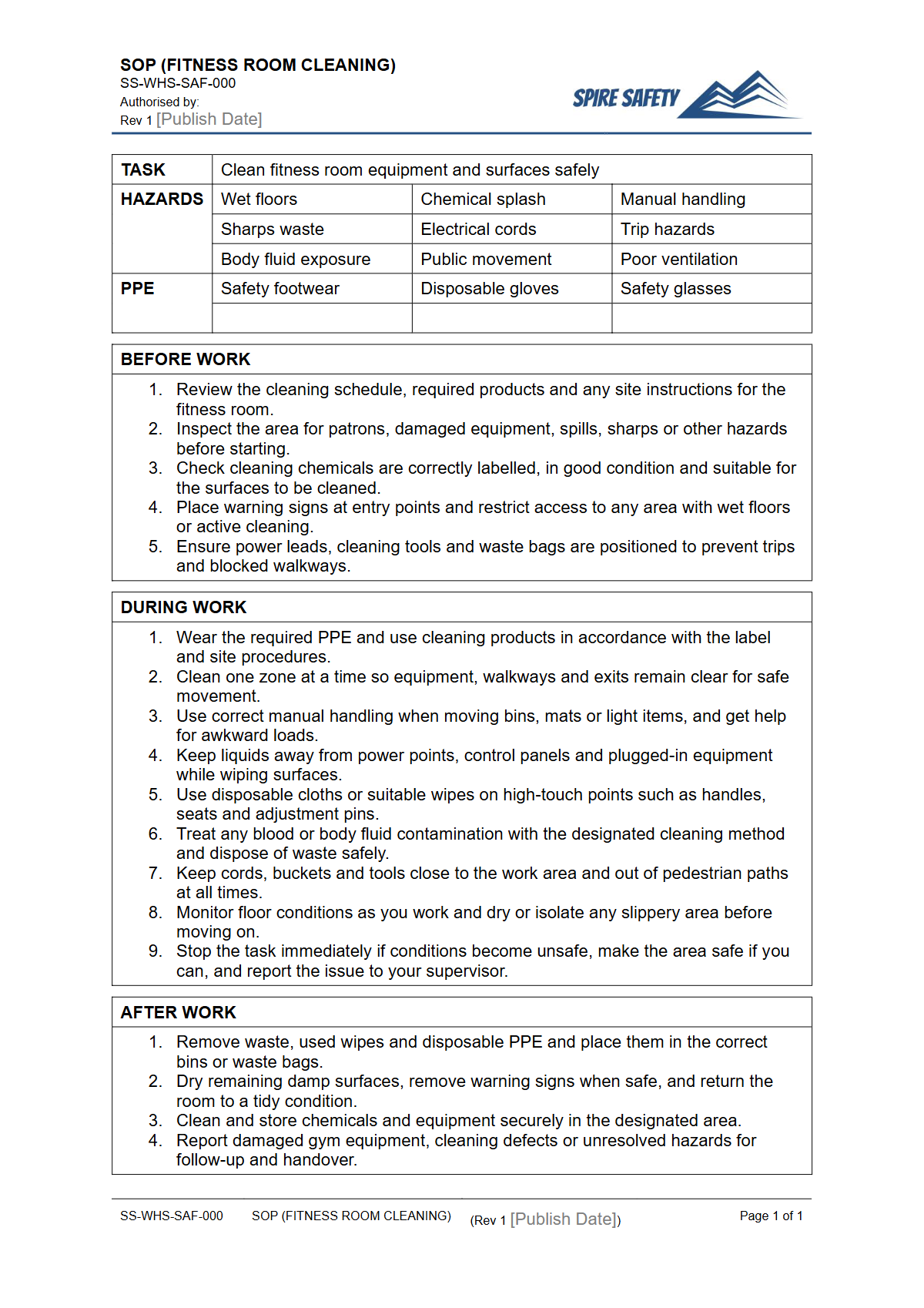
Purpose of the Free Safe Operating Procedure (Fitness Room Cleaning) Template
Maintaining a clean and hygienic fitness centre is crucial for member satisfaction and safety. This Free Safe Operating Procedure (Fitness Room Cleaning) Template provides a structured framework for documenting the required steps to clean gym floors, equipment, and amenities safely and effectively.
Using a standardised procedure helps ensure consistency, reduces the risk of injury or illness, and demonstrates a commitment to workplace health and safety. It forms a critical part of your overall safety documentation and supports the development of robust WHS management systems.
The primary goal of this Safe Operating Procedure, often called an SOP, is to identify and control hazards associated with cleaning tasks. These can include exposure to hazardous chemicals, ergonomic risks from manual handling, slip and trip hazards from wet floors, and contact with biological agents.
By clearly outlining pre-operational checks, step-by-step cleaning processes, and post-cleaning tasks, you create a clear and repeatable system of work that minimises risk for cleaning staff and gym patrons alike.
Video walkthrough
How to use the Free Safe Operating Procedure (Fitness Room Cleaning) Template
This template is available for download as a DOCX file for easy editing or as a PDF for quick reference. The document is designed as a starting point, pre-filled with common sections found in a Safe Operating Procedure for fitness room cleaning, such as required Personal Protective Equipment (PPE), chemical handling, equipment cleaning, and waste disposal.
To make it effective, you must review and adapt every section to suit your specific operational environment.
Please note: this document is a template and must be customised to reflect the specific equipment, chemicals, layouts, and processes used in your workplace. We cannot guarantee its suitability for your specific circumstances without thorough site-specific customisation in consultation with your workers.
After customising the content, the SOP should be used to train all relevant personnel. Ensure every worker involved in cleaning activities reads, understands, and signs off on the procedure before undertaking the tasks.
Keep the document in a location that is easily accessible to all staff for reference. For an example of how procedures are tailored to a very different task, you can review our Safe Operating Procedure for deep fryer operation.
When to use it
A Safe Operating Procedure for cleaning should be an integral part of your daily operations. It is not a document to be filed away and forgotten. Use it as a primary reference tool for:
- Daily and routine cleaning tasks: To guide staff in the correct, safe method for cleaning equipment, floors, and change rooms every single time.
- Training new employees: As a foundational training document to ensure new starters learn the safe and correct procedures from day one.
- Refresher training: For periodic retraining sessions to reinforce safe work practices and introduce any updates to the procedure.
- Incident investigations: As a benchmark to determine if a deviation from the established procedure contributed to a near miss or injury.
- Risk assessments: The SOP can be reviewed and updated as part of your regular hazard identification and risk assessment process. Formalising this review can be achieved through periodic WHS compliance auditing.
Who should use it
This Safe Operating Procedure template is designed for use by multiple roles within a fitness organisation. Primarily, it is for the workers who perform the cleaning tasks, providing them with clear, unambiguous instructions to keep them safe. However, its use extends further:
- Gym Managers and Supervisors: To train staff, monitor compliance with safe work practices, and ensure a consistently safe and clean environment for members.
- WHS Officers and Representatives: To assist in risk assessments, develop safety documentation, and facilitate consultation with workers about cleaning-related hazards.
- Business Owners (PCBUs): To help meet their primary duty of care under WHS legislation by providing and maintaining a safe system of work. For businesses needing support in establishing these systems, engaging expert WHS consulting can provide valuable guidance and oversight.
This document is one of many tools available to help you build a safer workplace. You can explore our complete free WHS resources library for more templates, checklists, and guides to support your safety management efforts.
Common mistakes
Common mistakes to avoid
- Using the template 'as-is' without customising it for the specific chemicals and equipment in use.
- Failing to provide practical, hands-on training to staff on the procedures outlined in the SOP.
- Not making the SOP easily accessible to cleaning staff during their shifts.
- Forgetting to include emergency procedures for chemical spills or accidental exposure.
Legal references
Legal considerations
The following legal requirements may be relevant to this type of work.
- Work Health and Safety Act (Harmonised) — Provides the primary duties for protecting workers and other people from work health and safety risks.
- Work Health and Safety Regulations (Harmonised) — Sets out requirements supporting the management of workplace hazards and risks.
The following codes may be relevant to this type of work.
- Managing WHS Risks Code of Practice — Provides practical guidance on identifying hazards, assessing risks and applying effective controls.
- Work Health and Safety Consultation, Cooperation and Coordination Code of Practice — Provides practical guidance on consulting workers and coordinating with other duty holders.
- Managing the Work Environment and Facilities Code of Practice — Provides practical guidance on safe work environments, workplace facilities and related controls.
Did you know
Slips, Trips and Falls
Slips, trips and falls are a leading cause of workplace injury in Australia. Maintaining dry, clear floors, as outlined in a cleaning SOP, is a critical control measure to prevent these common incidents.
Chemical Exposure
Incorrectly mixing cleaning chemicals, such as bleach and ammonia, can create toxic chloramine gas, which can cause severe respiratory issues. An SOP ensures staff use and store chemicals correctly.
FAQ
Frequently asked questions
01What are the key hazards in fitness room cleaning?
02How often should a fitness room cleaning SOP be reviewed?
03Is a Safe Operating Procedure a legal requirement for cleaning?
04Can I use this template for other cleaning tasks outside of a gym?
Share this resource
Free Safe Operating Procedure (Fitness Room Cleaning) Template
Browse Categories
How To Use It
- 1Download and open in Word or PDF.
- 2Replace the placeholders with your business details.
- 3Get it reviewed by a WHS specialist before rollout.
Need it customised?
Our WHS consultants can adapt this template to your site, run a gap analysis, or audit what you already have in place.
Book a Free Consultation WHS consulting servicesor call 1300 156 382
Related templates
- Free Safe Operating Procedure (Flange Alignment Tool) Template
- Free Safe Operating Procedure (Flange Spreader) Template
- Free Safe Operating Procedure (Flanging Machine) Template
- Free Safe Operating Procedure (Flashback Arrestor Test) Template
- Free Safe Operating Procedure (Flat Top Grill) Template
- Free Safe Operating Procedure (Fleet Key Handover) Template