
Free Safe Operating Procedure (Fish Scaling) Template
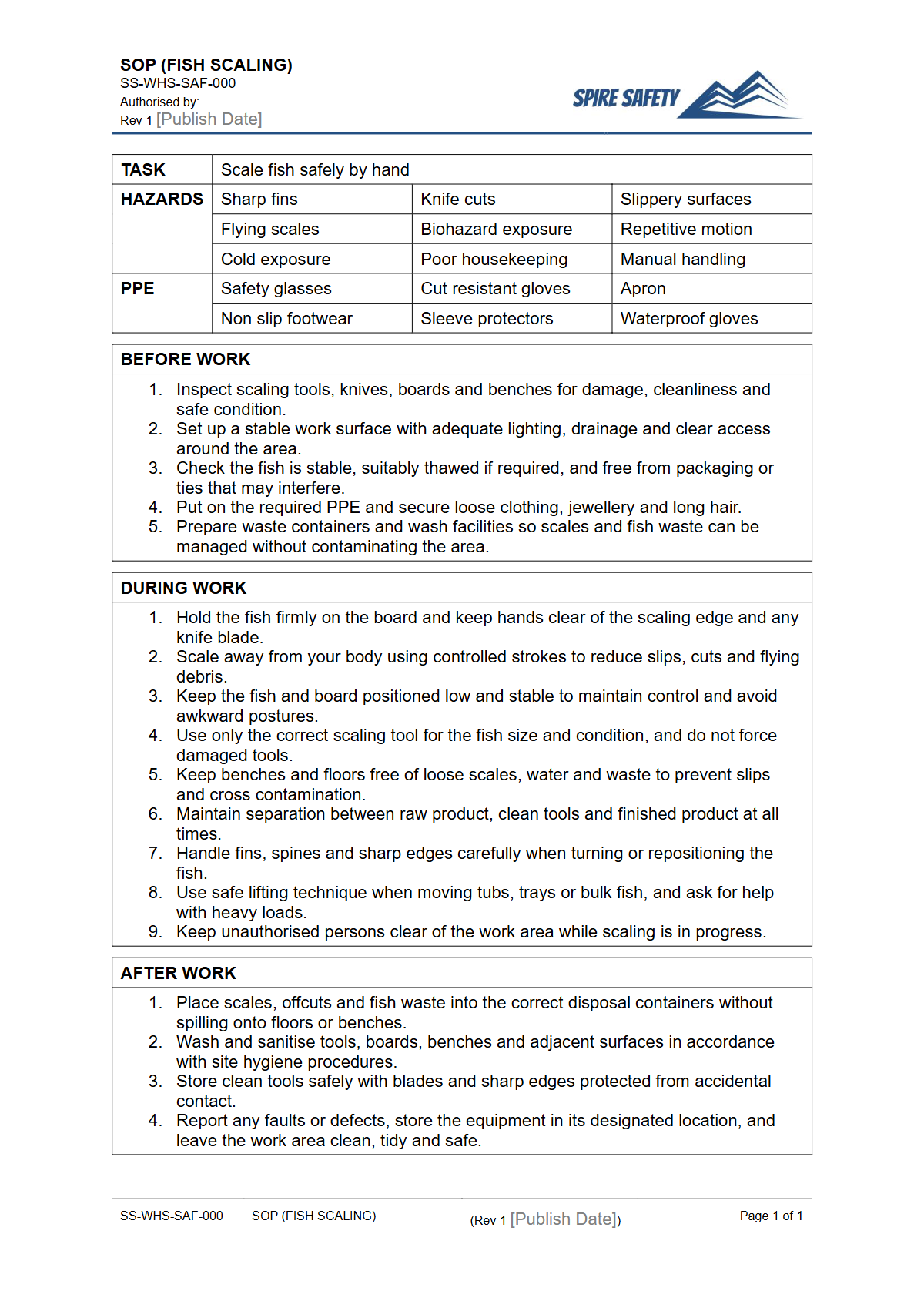
Download our free Safe Operating Procedure (Fish Scaling) Template to formalise safety protocols for kitchen staff. This customisable document helps you start.
Free Safe Operating Procedure (Fish Scaling) Template
DOCX • 126 KB + PDF
Updated Oct 2026
No signup required
Purpose of the Free Safe Operating Procedure (Fish Scaling) Template
Fish scaling, whether done manually or with an electric scaler, presents distinct workplace hazards. This free Safe Operating Procedure (Fish Scaling) Template provides a structured framework for documenting the safest method to perform this common task in commercial kitchens, seafood processing plants, and hospitality venues.
A documented SOP standardises your process, ensuring every worker understands the risks and the required control measures. It serves as a vital tool for worker training, induction, and supervision.
By formalising procedures, you create a clear, repeatable process that minimises the risk of cuts, slips, and ergonomic injuries. This document is a foundational component of effective WHS management systems, demonstrating a commitment to proactive risk management and helping to meet your duty of care obligations under Australian WHS legislation.
Video walkthrough
How to use the Free Safe Operating Procedure (Fish Scaling) Template
This template is provided in both DOCX and PDF formats for your convenience. The DOCX file is fully editable, allowing you to tailor it to the specific equipment, environment, and processes used in your workplace.
To implement it effectively, you should consult with the workers who actually perform the task. Their direct experience is invaluable for identifying all potential hazards and practical control measures.
Important: This is a template only. You must customise it to reflect the specific hazards and control measures relevant to your workplace.
We are not responsible for the outcomes of any actions taken based on this document. After customising the SOP, ensure it is reviewed and approved by a competent person, and that all relevant workers are trained on the final procedure.
It should integrate with other kitchen safety documents, such as a Safe Operating Procedure for a Deep Fryer, to build a comprehensive safety framework.
Key Hazards in Fish Scaling
A thorough risk assessment is necessary before finalising your SOP. Common hazards associated with fish scaling include:
Mechanical and Physical Hazards
- Lacerations: Sharp edges on scaling tools, fish fins, and gills can cause deep cuts. Electric scalers introduce additional risks of abrasion or entanglement if not handled correctly.
- Slips, Trips, and Falls: Water, ice, and fish scales can create extremely slippery floor surfaces, a leading cause of injury in food preparation areas.
- Eye Injuries: Dislodged scales can fly into a worker's eyes, causing irritation or injury.
Managing risks from powered equipment is critical. The principles used to control hazards in an SOP for a circular saw, such as machine guarding, proper handling techniques, and electrical safety checks, can be adapted for electric fish scalers.
Ergonomic and Biological Hazards
- Repetitive Strain Injuries (RSI): The repetitive motion of manual scaling can lead to musculoskeletal disorders in the hands, wrists, and arms over time.
- Biological Contamination: Handling raw seafood exposes workers to potential bacteria like Vibrio and Salmonella. Proper hand hygiene and sanitation are crucial to prevent illness and cross-contamination.
When to use the Safe Operating Procedure
An SOP for fish scaling should be used as a primary reference document in several situations. It is essential for training new employees or for workers who are new to the task, ensuring they learn the correct, safe method from the beginning.
It should be readily available in the work area for quick reference by any team member. The SOP also serves as a benchmark document during safety observations, toolbox talks, and formal WHS compliance auditing to verify that established procedures are being followed consistently.
Who should use it
This procedure is designed for any person required to scale fish as part of their job. This includes kitchen hands, apprentices, chefs, and seafood process workers.
Supervisors and managers should also be familiar with the SOP to ensure they can adequately supervise work and enforce safety standards. In larger food processing facilities, the principles in this SOP can be integrated with procedures for related equipment, such as a Conveyer System SOP that might transport fish to and from the scaling station.
Ultimately, anyone involved in the task, its supervision, or its safety oversight should use and understand this document.
Common mistakes
Common mistakes to avoid
- Using a generic template without customising it for the specific tools and environment.
- Failing to consult with workers who actually perform the task when drafting the procedure.
- Not providing or maintaining the Personal Protective Equipment (PPE) specified in the SOP, such as cut-resistant gloves and safety glasses.
- Ignoring ergonomic risks associated with repetitive manual scaling, leading to long-term strain injuries.
Legal references
Legal considerations
The following legal requirements may be relevant to this type of work.
- Work Health and Safety Act (Harmonised) — Provides the primary duties for protecting workers and other people from work health and safety risks.
- Work Health and Safety Regulations (Harmonised) — Sets out requirements supporting the management of workplace hazards and risks.
The following codes may be relevant to this type of work.
- Managing WHS Risks Code of Practice — Provides practical guidance on identifying hazards, assessing risks and applying effective controls.
- Work Health and Safety Consultation, Cooperation and Coordination Code of Practice — Provides practical guidance on consulting workers and coordinating with other duty holders.
- Managing the Work Environment and Facilities Code of Practice — Provides practical guidance on safe work environments, workplace facilities and related controls.
Did you know
Kitchen Injury Stats
According to Safe Work Australia, the food and beverage services industry has one of the highest rates of serious workers' compensation claims, with cuts and slips being among the most common causes of injury.
Fish Scale Armour
The structure of fish scales is so effective at providing flexible protection that materials scientists have studied them to develop advanced body armour for humans.
FAQ
Frequently asked questions
01What are the main hazards when scaling fish?
02Is an SOP legally required for fish scaling in Australia?
03How often should an SOP for fish scaling be reviewed?
04Can I use this template for both manual and machine fish scaling?
Share this resource
Free Safe Operating Procedure (Fish Scaling) Template
Browse Categories
How To Use It
- 1Download and open in Word or PDF.
- 2Replace the placeholders with your business details.
- 3Get it reviewed by a WHS specialist before rollout.
Need it customised?
Our WHS consultants can adapt this template to your site, run a gap analysis, or audit what you already have in place.
Book a Free Consultation WHS consulting servicesor call 1300 156 382
Related templates
- Free Safe Operating Procedure (Fitness Equipment Setup) Template
- Free Safe Operating Procedure (Fitness Mat Cleaning) Template
- Free Safe Operating Procedure (Fitness Room Cleaning) Template
- Free Safe Operating Procedure (Flange Alignment Tool) Template
- Free Safe Operating Procedure (Flange Spreader) Template
- Free Safe Operating Procedure (Flanging Machine) Template