
Free Safe Operating Procedure (Fire Pump Test) Template
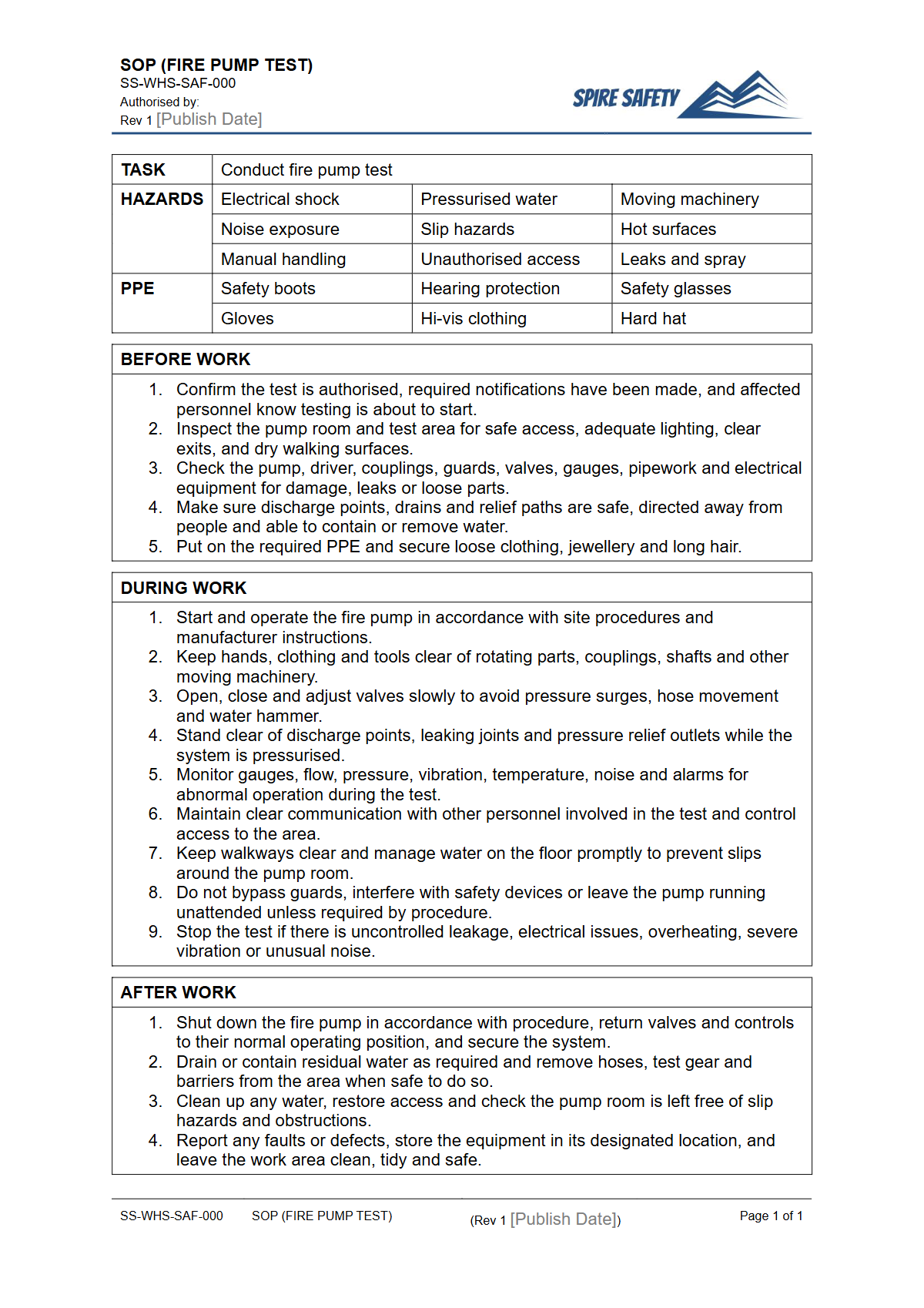
Download our free Safe Operating Procedure (Fire Pump Test) template to formalise safety steps for routine inspections and testing of fire pump sets.
Free Safe Operating Procedure (Fire Pump Test) Template
DOCX • 126 KB + PDF
Updated Oct 2026
No signup required
Purpose of the Free Safe Operating Procedure (Fire Pump Test) Template
Fire pump sets are a cornerstone of a building's fire suppression system, designed to provide critical water pressure when it's needed most. Ensuring their operational readiness through regular testing is a fundamental WHS and compliance requirement.
This Free Safe Operating Procedure (Fire Pump Test) Template provides a structured framework for documenting the steps, hazards, and controls necessary to conduct these tests safely and effectively. Using a standardised procedure helps to eliminate guesswork, reduce the risk of injury to personnel or damage to equipment, and ensure that every test is performed consistently.
A documented Safe Operating Procedure (SOP) serves as an essential training tool for new team members and a reliable reference for experienced technicians. It outlines pre-start checks, the specific sequence of operations, performance metrics to record, and shutdown procedures.
Formalising this process helps build a reliable maintenance history, aids in fault diagnosis, and demonstrates due diligence in managing critical safety equipment. Integrating such procedures into your safety framework is a key part of building robust comprehensive WHS management systems.
Video walkthrough
How to use the Free Safe Operating Procedure (Fire Pump Test) Template
This template is a starting point designed to align with Australian WHS principles. It must be customised to reflect the specific circumstances of your workplace.
Fire pump systems vary significantly, with different configurations for diesel and electric motors, jockey pumps, controllers, and valve layouts. Your finalised SOP must account for the unique make, model, and installation at your site.
To adapt this document effectively, we recommend a competent person reviews and amends the content. This involves:
- Conducting a specific risk assessment for the fire pump testing task at your location.
- Incorporating manufacturer's operating instructions and maintenance recommendations.
- Referencing relevant standards, such as AS 1851 for routine servicing and AS 2941 for pumpset systems.
- Clearly listing the names or roles of authorised personnel responsible for the task.
- Detailing site-specific isolation points for energy sources (electrical, fuel) and notification procedures for monitoring companies or building occupants.
If you require assistance in adapting this template or conducting the necessary risk assessments, engaging specialist WHS consulting can provide expert guidance and ensure your procedures are thorough.
When to use it
This Safe Operating Procedure should be used every time a fire pump test is conducted, regardless of its scope. This creates a consistent and safe work method for all personnel involved. Key scenarios for its use include:
- Routine Scheduled Tests: For weekly, monthly, quarterly, and annual tests as stipulated by Australian Standard AS 1851 and your site's maintenance schedule.
- Post-Maintenance Verification: After any repairs or part replacements, the SOP guides a verification test to ensure the system is functioning correctly and is ready for automatic operation.
- New Personnel Training: As a practical guide for inducting and training new maintenance staff or contractors on the correct and safe procedure for testing the pumpset.
- Commissioning: While more detailed commissioning documents are often used, this SOP can form part of the documentation package to establish a baseline for future operational tests.
Documenting maintenance for fixed plant is a crucial safety function, much like having a detailed Air Compressor SOP for managing pressurised air systems.
Who should use it
The operation and testing of fire pump systems should only be performed by 'competent persons'. A competent person is someone who has the required training, skills, and experience to carry out the task safely, identify potential hazards, and understand the system's operational parameters. This typically includes:
- Authorised Maintenance Staff
- Qualified Electricians or Mechanics
- Facilities Managers
- Specialist Fire Service Technicians
- WHS Officers overseeing the testing process
Unauthorised or untrained personnel must not be permitted to operate or test fire pumps. The high pressures, significant electrical energy (or flammable fuel), and critical nature of the equipment present serious risks if handled incorrectly.
The principles of using trained operators for high-risk equipment are universal, whether you are documenting a test procedure or developing a safe operating procedure for a boom pump. Explore our entire free WHS resources library for more templates to help you manage workplace safety.
Common mistakes
Common mistakes to avoid
- Forgetting to notify the fire alarm monitoring company or building occupants before a test, causing false alarms.
- Failing to check fuel levels and battery condition (diesel pumps) or main power supply (electric pumps) before starting.
- Not accurately recording key performance data like suction/discharge pressures and flow rates during the test.
- Neglecting to properly reset the pump controller to automatic standby mode after the test is complete.
Legal references
Legal considerations
The following legal requirements may be relevant to this type of work.
- Work Health and Safety Act (Harmonised) — Provides the primary duties for protecting workers and other people from work health and safety risks.
- Work Health and Safety Regulations (Harmonised) — Sets out requirements supporting the management of workplace hazards and risks.
The following codes may be relevant to this type of work.
- Managing WHS Risks Code of Practice — Provides practical guidance on identifying hazards, assessing risks and applying effective controls.
- Work Health and Safety Consultation, Cooperation and Coordination Code of Practice — Provides practical guidance on consulting workers and coordinating with other duty holders.
- Managing the Work Environment and Facilities Code of Practice — Provides practical guidance on safe work environments, workplace facilities and related controls.
Did you know
Australian Standard for Servicing
In Australia, the routine servicing of fire protection systems, including fire pumps, is primarily governed by Australian Standard AS 1851:2012.
Churn Pressure
'Churn pressure' is the water pressure a pump produces when it's running with the discharge valves closed (no water flowing). This is a critical baseline measurement taken during a routine test.
FAQ
Frequently asked questions
01What should be included in a fire pump test Safe Operating Procedure?
02How often should fire pump sets be tested in Australia?
03Who is a 'competent person' to perform a fire pump test?
04Can this template be used for both diesel and electric fire pumps?
Share this resource
Free Safe Operating Procedure (Fire Pump Test) Template
Browse Categories
How To Use It
- 1Download and open in Word or PDF.
- 2Replace the placeholders with your business details.
- 3Get it reviewed by a WHS specialist before rollout.
Need it customised?
Our WHS consultants can adapt this template to your site, run a gap analysis, or audit what you already have in place.
Book a Free Consultation WHS consulting servicesor call 1300 156 382
Related templates
- Free Safe Operating Procedure (Fire Stair Cleaning) Template
- Free Safe Operating Procedure (Firewood Processor) Template
- Free Safe Operating Procedure (Fish Filleting) Template
- Free Safe Operating Procedure (Fish Scaling) Template
- Free Safe Operating Procedure (Fitness Equipment Setup) Template
- Free Safe Operating Procedure (Fitness Mat Cleaning) Template