
Free Safe Operating Procedure (Fire Panel Isolation) Template
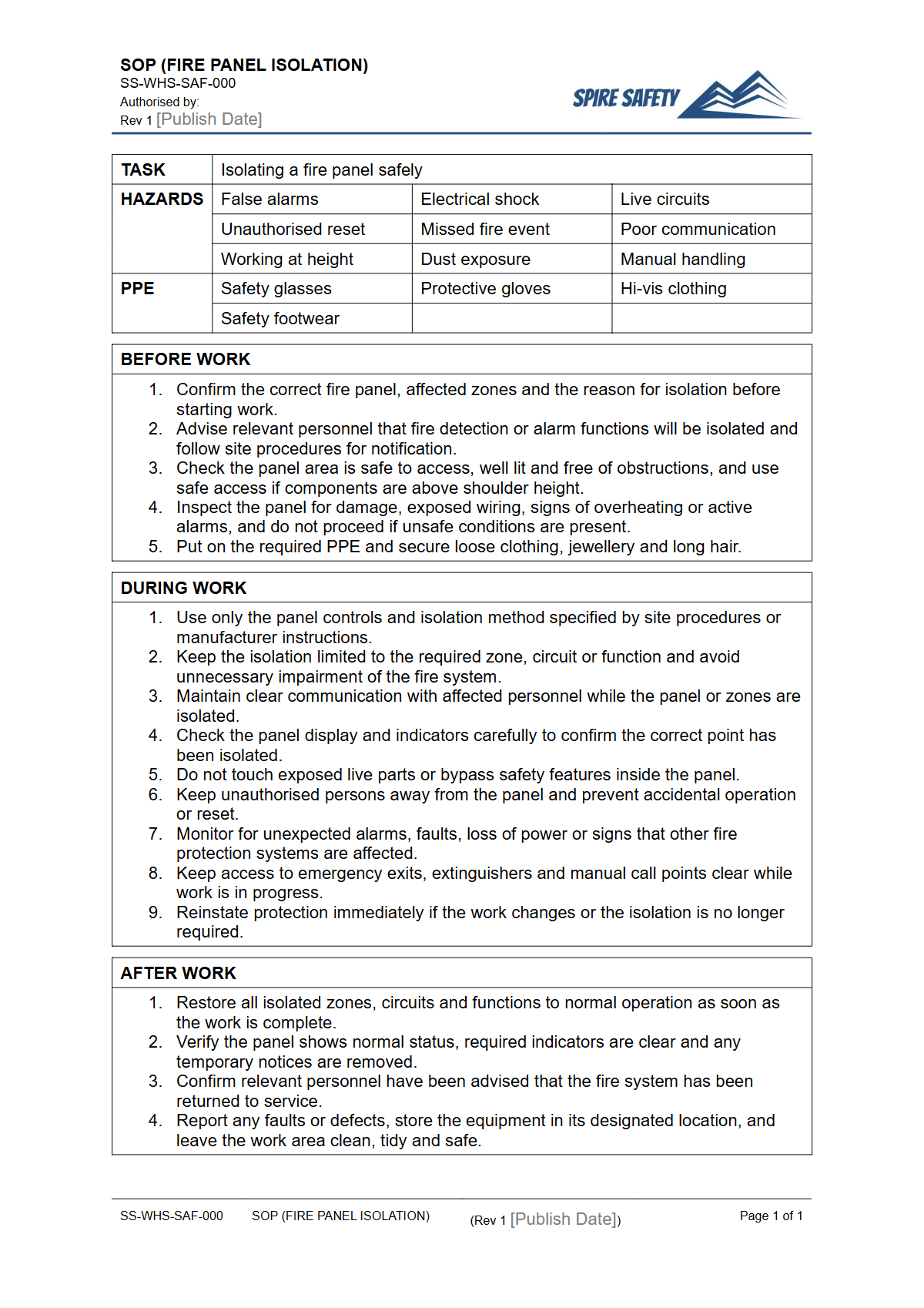
Document the steps for safely isolating a fire indicator panel for maintenance or testing. Download our free Safe Operating Procedure template to get started.
Free Safe Operating Procedure (Fire Panel Isolation) Template
DOCX • 126 KB + PDF
Updated Oct 2026
No signup required
Purpose of the Free Safe Operating Procedure (Fire Panel Isolation) Template
Effectively managing a building’s fire safety system is a critical responsibility. This Free Safe Operating Procedure (Fire Panel Isolation) Template provides a structured framework for documenting the steps to safely isolate and de-isolate a fire indicator panel (FIP).
Isolating a panel is necessary during maintenance, testing, or nearby construction work to prevent false alarms, which can lead to costly fire brigade call-outs, business disruption, and alarm fatigue among occupants. A documented SOP ensures the task is performed consistently and safely, minimising the risk of leaving a building unprotected.
This procedure is not just about preventing nuisance alarms; it is a vital administrative control measure. It forms part of your risk management process by ensuring only trained and authorised personnel interact with life-saving equipment.
Using a standardised procedure helps demonstrate due diligence and a commitment to maintaining a safe work environment for everyone. The principle of isolating energy sources is fundamental in WHS, and this SOP applies that principle to fire systems, much like our Free Air Compressor SOP Template also includes steps for isolation and lock-out.
Video walkthrough
How to use the Free Safe Operating Procedure (Fire Panel Isolation) Template
This document serves as a comprehensive starting point aligned with Australian WHS principles. To make it effective for your workplace, you must customise it with site-specific information.
Download the DOCX version and edit it to include details such as the specific make and model of your fire panel, its location, the contact information for your fire monitoring company, and the names or roles of authorised personnel. Integrate it into your broader WHS management system for maximum effectiveness.
Important: This is a template only. We have populated it with common steps and considerations, but every workplace and fire system is unique.
You must review, edit, and adapt the content to reflect the specific hazards, equipment, and legal requirements of your site and state or territory. Ensure the final document is reviewed and approved by a competent person, such as a qualified fire technician or facilities manager.
When to use this Safe Operating Procedure
A fire panel isolation SOP should be used whenever there is a need to temporarily disable the notification or alarm functions of a fire system. This prevents false activations while ensuring the work can be carried out efficiently. The procedure should be initiated before starting any of the following activities:
- Scheduled testing and maintenance of the fire panel or its connected detectors and alarms, as mandated by Australian Standard AS 1851.
- Construction, renovation, or demolition work in the vicinity that could generate dust, fumes, steam, or vibrations capable of triggering detectors (e.g., cutting concrete, welding, grinding).
- Fault-finding or repair work on the fire detection and alarm system itself.
- Planned drills or system tests that require disabling external notifications to monitoring services or emergency services.
Implementing this procedure systematically ensures that all necessary preconditions, notifications, and post-work checks are completed every time. This robust process should be supported by regular WHS compliance auditing to verify it is being followed correctly.
Who should use this SOP
The isolation of a fire panel is a high-risk task that must only be performed by personnel who are competent, trained, and authorised to do so. The specific qualifications may be mandated by state or territory regulations and Australian Standards. Typically, the individuals using this SOP would include:
- Licensed Fire Technicians: Professionals contracted to service, test, and maintain the fire system.
- Qualified Electricians: Electricians with specific training and experience with fire alarm systems.
- Authorised Facilities or Maintenance Staff: On-site personnel who have received specific training from the equipment manufacturer or a qualified provider on the building's fire panel.
Competency for this task is not just about knowing which buttons to press. It involves understanding the consequences of incorrect isolation, the procedure for notifying all stakeholders (including building management and monitoring companies), and the critical importance of correctly re-instating the system upon completion of works.
Consider this SOP as one part of a suite of safety documents, like a FREE Circular Saw SOP (Safe Operating Procedure) Template, that defines safe work methods for specific tasks. For broader safety system guidance, our WHS consulting team can assist.
A structured approach helps ensure consistency, similar to how our FREE Telehandler SOP Template guides operators through complex machinery use. Explore our complete free WHS resources library for more templates to support your safety management system.
Common mistakes
Common mistakes to avoid
- Failing to notify the building management, occupants, and the alarm monitoring company before isolation.
- Forgetting to de-isolate the panel and test its normal function after work is completed.
- Isolating the incorrect zone or device, leaving the work area unprotected from fire hazards.
- Performing isolation without being formally trained and authorised by the person conducting a business or undertaking (PCBU).
Legal references
Legal considerations
The following legal requirements may be relevant to this type of work.
- Work Health and Safety Act (Harmonised) — Provides the primary duties for protecting workers and other people from work health and safety risks.
- Work Health and Safety Regulations (Harmonised) — Sets out requirements supporting the management of workplace hazards and risks.
The following codes may be relevant to this type of work.
- Managing WHS Risks Code of Practice — Provides practical guidance on identifying hazards, assessing risks and applying effective controls.
- Work Health and Safety Consultation, Cooperation and Coordination Code of Practice — Provides practical guidance on consulting workers and coordinating with other duty holders.
- Managing the Work Environment and Facilities Code of Practice — Provides practical guidance on safe work environments, workplace facilities and related controls.
Did you know
A Costly Nuisance
Australian fire services respond to tens of thousands of avoidable false alarms each year, tying up critical emergency resources. Proper fire panel isolation during maintenance is a key strategy to prevent these costly and disruptive events.
The Guiding Standard
Australian Standard AS 1851 'Routine service of fire protection systems and equipment' is the primary document guiding the frequency and procedures for testing and maintaining fire panels, detectors, and alarm systems across the country.
FAQ
Frequently asked questions
01Do I need a special licence to isolate a fire panel in Australia?
02What is the difference between isolating a zone and isolating the whole panel?
03What happens if I forget to de-isolate the panel after work?
04Why can't I just switch the power off at the fire panel?
Share this resource
Free Safe Operating Procedure (Fire Panel Isolation) Template
Browse Categories
How To Use It
- 1Download and open in Word or PDF.
- 2Replace the placeholders with your business details.
- 3Get it reviewed by a WHS specialist before rollout.
Need it customised?
Our WHS consultants can adapt this template to your site, run a gap analysis, or audit what you already have in place.
Book a Free Consultation WHS consulting servicesor call 1300 156 382
Related templates
- Free Safe Operating Procedure (Fire Pump Test) Template
- Free Safe Operating Procedure (Fire Stair Cleaning) Template
- Free Safe Operating Procedure (Firewood Processor) Template
- Free Safe Operating Procedure (Fish Filleting) Template
- Free Safe Operating Procedure (Fish Scaling) Template
- Free Safe Operating Procedure (Fitness Equipment Setup) Template