
Free Safe Operating Procedure (Fire Hose Testing) Template
Ensure your fire hose testing is conducted safely and systematically with our free template. Download this customisable Safe Operating Procedure to get started.
Free Safe Operating Procedure (Fire Hose Testing) Template
DOCX • 126 KB + PDF
Updated Oct 2026
No signup required
Purpose of the Free Safe Operating Procedure (Fire Hose Testing) Template
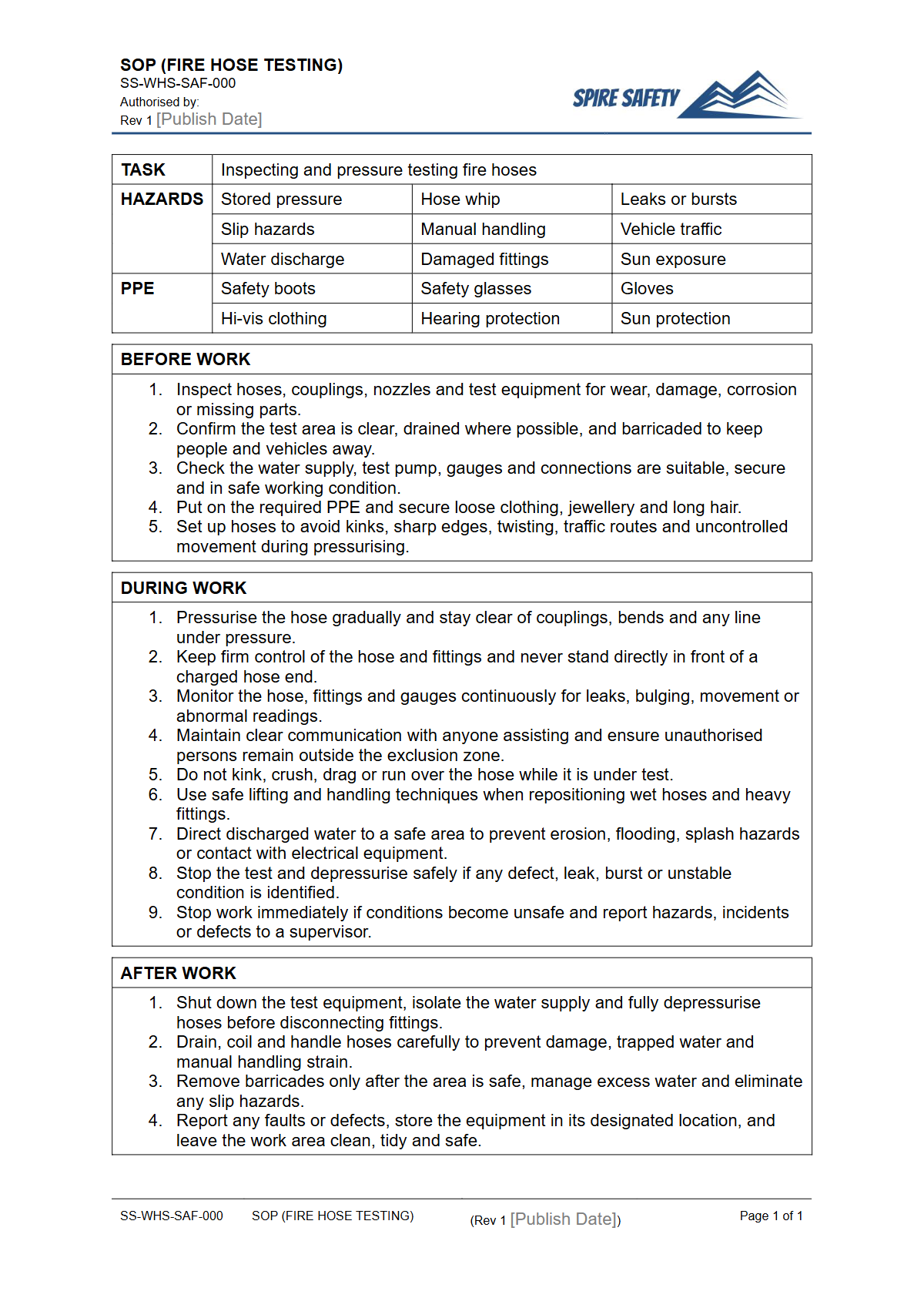
This Free Safe Operating Procedure (Fire Hose Testing) Template provides a structured framework for safely conducting routine inspections and pressure tests on fire hoses and their associated reels. Documenting this process is critical for ensuring that fire safety equipment remains in a constant state of readiness and will function as intended in an emergency.
A clear, step-by-step procedure minimises the risk of injury to personnel performing the test and reduces the likelihood of equipment damage.
Using a standardised SOP helps demonstrate a commitment to proactive safety management. It forms a key part of your overall WHS management systems, providing consistency in how tasks are performed, regardless of who is undertaking them.
This procedure helps outline the required personal protective equipment (PPE), pre-start checks, testing sequence, and post-test actions needed for a safe and effective outcome.
Video walkthrough
How to use the Free Safe Operating Procedure (Fire Hose Testing) Template
To get started, download the template in your preferred format (DOCX or PDF). This document is a comprehensive starting point, not a finished procedure.
It is essential that you customise the content to reflect the specific types of fire hoses used at your workplace, the unique environmental conditions, and the relevant state or territory WHS regulations. We strongly advise that you conduct a site-specific risk assessment to identify all potential hazards associated with the task and incorporate appropriate controls into the SOP.
Your documented safety procedures should be consistent and clear for all types of workplace equipment. Just as you would formalise the steps for using a circular saw, this SOP ensures the critical task of fire hose testing is not left to chance.
When customising, involve workers who will perform the task to ensure the procedure is practical and easy to follow. Ensure the final document is approved by a competent person before being issued for use.
The principles of managing pressurised systems are common across various types of equipment. For guidance on a related task, you may find our Free Air Compressor SOP useful for comparison.
Once finalised, your fire hose testing SOP should be regularly reviewed and updated, especially if there are changes to equipment, processes, or regulations.
When to use this Safe Operating Procedure
This SOP should be used every time a fire hose or fire hose reel requires routine inspection or testing. The frequency of these tests is dictated by Australian Standard AS 1851, which typically requires inspections at six-monthly intervals and hydrostatic pressure testing at five-yearly intervals.
However, more frequent checks may be necessary depending on the environment (e.g., corrosive or high-damage areas) or your internal maintenance schedule.
The procedure should also be followed for any non-routine testing, such as after a hose has been used in a fire or for training purposes. Integrating this SOP into your scheduled maintenance program ensures consistency and accountability.
For organisations seeking to verify their maintenance and compliance schedules align with legislative requirements, a formal WHS compliance auditing process can provide valuable assurance and identify areas for improvement.
Who should use this template
This Safe Operating Procedure is intended for use by competent personnel who have been trained and authorised to inspect and test fire safety equipment. This typically includes facilities maintenance staff, dedicated fire safety technicians, or third-party service contractors.
It is also a valuable resource for WHS managers, safety officers, and supervisors responsible for overseeing the site's fire safety program.
Ensuring that only trained individuals perform these tasks is a critical safety control. The SOP serves as both a guide for the operator and a training tool for new team members.
For a wider selection of safety documentation, you can browse our complete free WHS resources library to find templates for other high-risk tasks and equipment.
Common mistakes
Common mistakes to avoid
- Failing to properly isolate and depressurise the system before and after testing.
- Using incorrect test pressures, which can either damage the hose or fail to identify weaknesses.
- Neglecting to thoroughly inspect couplings, nozzles, and the hose reel for damage or corrosion.
- Poor or incomplete record-keeping, making it difficult to track maintenance history and prove compliance.
Legal references
Legal considerations
The following legal requirements may be relevant to this type of work.
- Work Health and Safety Act (Harmonised) — Provides the primary duties for protecting workers and other people from work health and safety risks.
- Work Health and Safety Regulations (Harmonised) — Sets out requirements supporting the management of workplace hazards and risks.
The following codes may be relevant to this type of work.
- Managing WHS Risks Code of Practice — Provides practical guidance on identifying hazards, assessing risks and applying effective controls.
- Work Health and Safety Consultation, Cooperation and Coordination Code of Practice — Provides practical guidance on consulting workers and coordinating with other duty holders.
- Managing the Work Environment and Facilities Code of Practice — Provides practical guidance on safe work environments, workplace facilities and related controls.
Did you know
The Standard
Routine servicing of fire hoses in Australia is primarily governed by Australian Standard AS 1851, which sets out the minimum requirements for the inspection, testing, and maintenance of fire protection systems.
Hydrostatic Testing
The five-yearly service often involves hydrostatic testing, where the hose is filled with water and pressurised to a level significantly higher than its normal operating pressure to ensure its integrity.
FAQ
Frequently asked questions
01What should be included in a fire hose testing SOP?
02How often do fire hoses need to be tested in Australia?
03Who is qualified to perform fire hose testing?
04What happens if a fire hose fails a test?
Share this resource
Free Safe Operating Procedure (Fire Hose Testing) Template
Browse Categories
How To Use It
- 1Download and open in Word or PDF.
- 2Replace the placeholders with your business details.
- 3Get it reviewed by a WHS specialist before rollout.
Need it customised?
Our WHS consultants can adapt this template to your site, run a gap analysis, or audit what you already have in place.
Book a Free Consultation WHS consulting servicesor call 1300 156 382
Related templates
- Free Safe Operating Procedure (Fire Panel Isolation) Template
- Free Safe Operating Procedure (Fire Pump Test) Template
- Free Safe Operating Procedure (Fire Stair Cleaning) Template
- Free Safe Operating Procedure (Firewood Processor) Template
- Free Safe Operating Procedure (Fish Filleting) Template
- Free Safe Operating Procedure (Fish Scaling) Template