
Free Safe Operating Procedure (Fire Extinguisher Use) Template
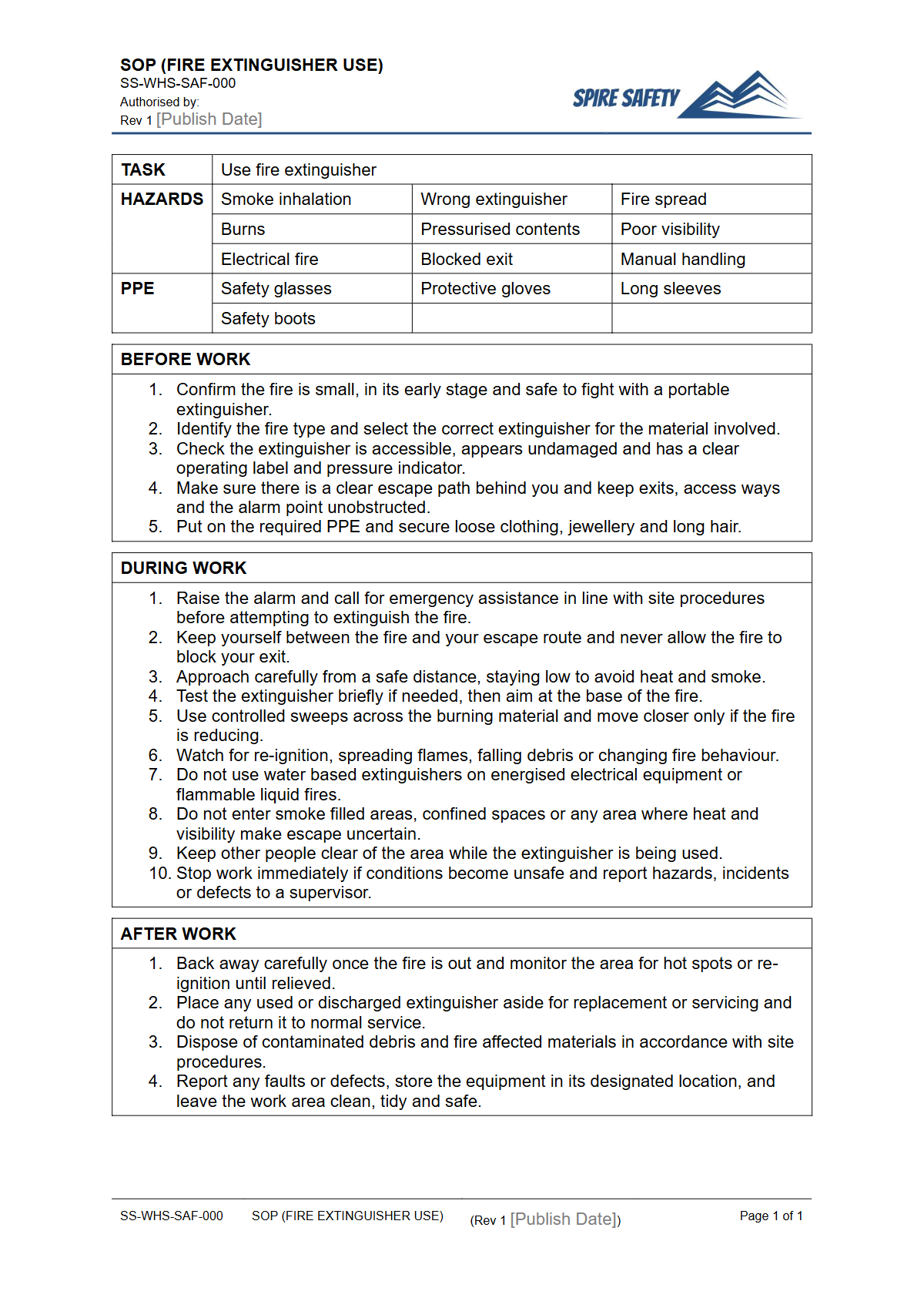
Download our free Safe Operating Procedure for fire extinguisher use. This customisable template helps you outline clear, safe steps for workers. Get your copy.
Free Safe Operating Procedure (Fire Extinguisher Use) Template
DOCX • 126 KB + PDF
Updated Oct 2026
No signup required
Purpose of the Free Safe Operating Procedure (Fire Extinguisher Use) Template
Effectively responding to a small fire requires clear, pre-established steps. Our free Safe Operating Procedure (Fire Extinguisher Use) Template provides a structured foundation for documenting the correct procedures for your workplace.
This resource helps ensure workers know when and how to safely operate a fire extinguisher, minimising risk and potential harm.
A Safe Operating Procedure (SOP) for fire extinguisher use is a critical document that formalises your organisation's approach to first-response fire fighting. Its purpose is to clearly define the steps for safely assessing a fire, selecting the appropriate extinguisher, and using it correctly on small, incipient-stage fires.
This template guides you through documenting potential hazards, required personal protective equipment (PPE), and the specific actions to take before, during, and after use. Integrating such procedures is a fundamental part of creating and maintaining comprehensive WHS management systems, demonstrating a proactive approach to emergency preparedness.
Video walkthrough
How to use the Free Safe Operating Procedure (Fire Extinguisher Use) Template
To use this template, simply download the DOCX file and open it in your preferred word processor. The document is structured with sections for you to complete, including task descriptions, potential hazards, and control measures.
It provides a logical framework aligned with Australian WHS practice for you to build upon.
Note: It is crucial to adapt this template to your specific workplace. We've provided a solid framework, but you must add details relevant to your site's specific fire risks, the types and locations of extinguishers available, and your unique emergency evacuation procedures. For example, a kitchen environment would require different considerations than a workshop, much like those detailed in our free Safe Operating Procedure for deep fryer operation.
When to Use This Safe Operating Procedure
This Safe Operating Procedure should not be read for the first time during an emergency. Its primary use is as a training and reference tool.
It should be a key document during employee inductions, regular safety training, and toolbox talks to familiarise workers with procedures before an incident occurs. The SOP should detail the universally recognised PASS technique: Pull the pin, Aim the nozzle at the base of the fire, Squeeze the lever, and Sweep from side to side.
The procedure should be reviewed periodically as part of your safety management schedule, often prompted by regular WHS compliance audits to ensure it remains current and effective.
Who Should Use It
This template is designed for use by Persons Conducting a Business or Undertaking (PCBUs), WHS managers, and supervisors responsible for developing and implementing workplace safety procedures. They must customise the content to reflect the site-specific environment.
Once finalised, the SOP is for all workers and contractors who may need to operate a fire extinguisher. It's vital to remember that only trained and competent individuals should attempt to fight a fire, and only when it is clearly safe to do so.
The priority must always be life safety and evacuation. If you need assistance developing site-specific emergency plans or training programs, consider seeking expert WHS consulting support to ensure your approach is robust.
A well-documented procedure is the first step towards a prepared and confident team. By customising this template, you create a clear, actionable guide that enhances safety and clarifies responsibilities during a critical event.
You can find more templates and checklists like this one in our complete free WHS resources library to help build out your safety documentation.
Common mistakes
Common mistakes to avoid
- Using the wrong type of extinguisher for the fire class (e.g., water on an electrical fire).
- Failing to assess the situation and trying to fight a fire that is too large or spreading rapidly.
- Not maintaining a clear and accessible escape route while attempting to use an extinguisher.
- Neglecting regular inspection and maintenance, leading to a malfunctioning unit in an emergency.
Legal references
Legal considerations
The following legal requirements may be relevant to this type of work.
- Work Health and Safety Act (Harmonised) — Provides the primary duties for protecting workers and other people from work health and safety risks.
- Work Health and Safety Regulations (Harmonised) — Sets out requirements supporting the management of workplace hazards and risks.
The following codes may be relevant to this type of work.
- Managing WHS Risks Code of Practice — Provides practical guidance on identifying hazards, assessing risks and applying effective controls.
- Work Health and Safety Consultation, Cooperation and Coordination Code of Practice — Provides practical guidance on consulting workers and coordinating with other duty holders.
- Managing the Work Environment and Facilities Code of Practice — Provides practical guidance on safe work environments, workplace facilities and related controls.
Did you know
Standardised Colours
In Australia, fire extinguisher bodies are painted red with a coloured band indicating the contents. This standardisation was introduced in 1997 to allow for quick identification in an emergency.
Limited Discharge Time
A standard 9.0kg ABE dry powder extinguisher, one of the most common types, has a discharge time of only about 15-25 seconds. This highlights the importance of using them only on small, incipient-stage fires.
FAQ
Frequently asked questions
01What is the PASS technique for using a fire extinguisher?
02Should I fight every fire with an extinguisher?
03How often do fire extinguishers need to be inspected in Australia?
04What are the different classes of fire in Australia?
Share this resource
Free Safe Operating Procedure (Fire Extinguisher Use) Template
Browse Categories
How To Use It
- 1Download and open in Word or PDF.
- 2Replace the placeholders with your business details.
- 3Get it reviewed by a WHS specialist before rollout.
Need it customised?
Our WHS consultants can adapt this template to your site, run a gap analysis, or audit what you already have in place.
Book a Free Consultation WHS consulting servicesor call 1300 156 382
Related templates
- Free Safe Operating Procedure (Fire Hose Reel) Template
- Free Safe Operating Procedure (Fire Hose Testing) Template
- Free Safe Operating Procedure (Fire Panel Isolation) Template
- Free Safe Operating Procedure (Fire Pump Test) Template
- Free Safe Operating Procedure (Fire Stair Cleaning) Template
- Free Safe Operating Procedure (Firewood Processor) Template