
Free Safe Operating Procedure (Fire Door Adjustment) Template
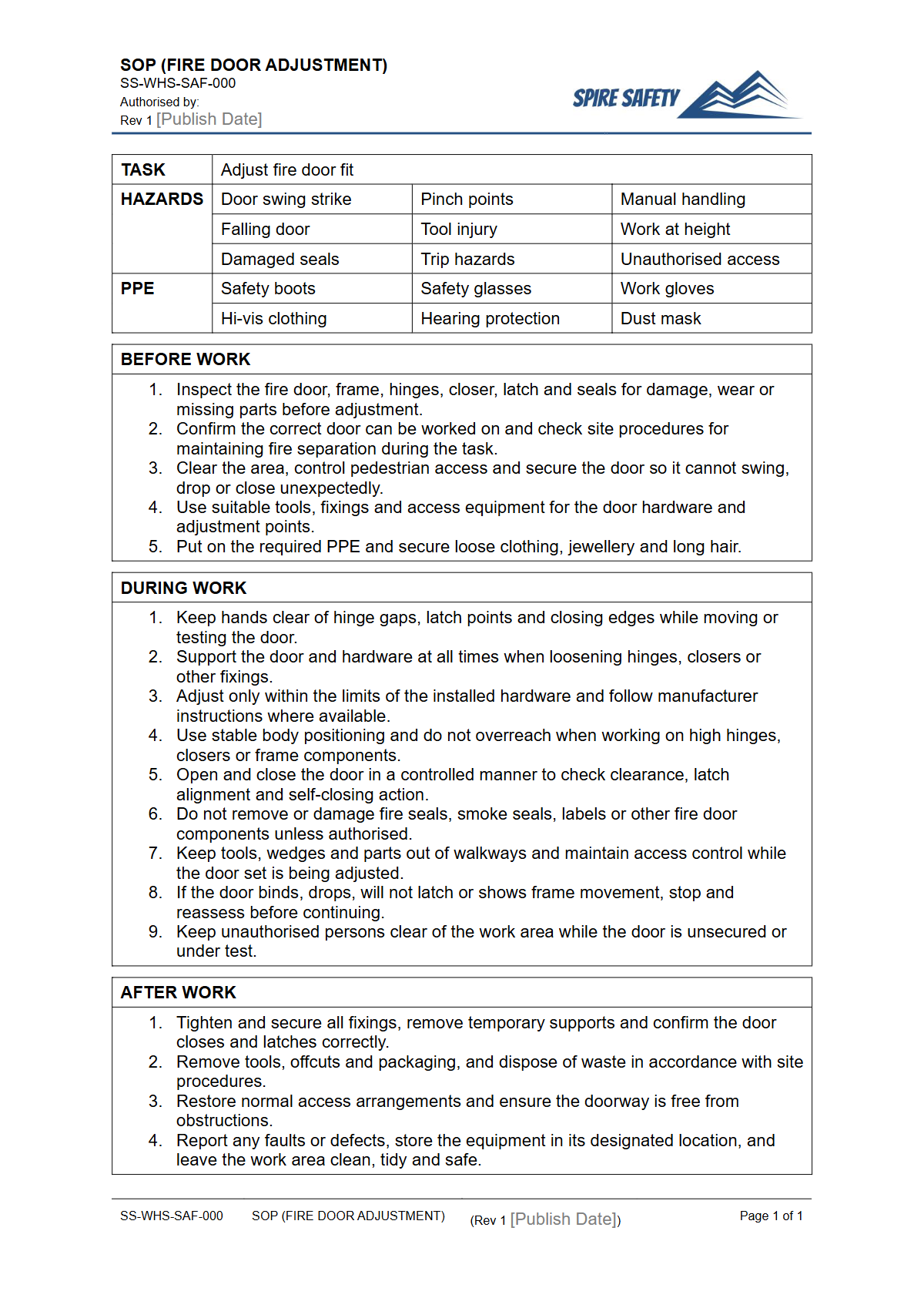
Download our free Safe Operating Procedure (Fire Door Adjustment) Template. This resource helps you document the steps for safely adjusting fire doors.
Free Safe Operating Procedure (Fire Door Adjustment) Template
DOCX • 126 KB + PDF
Updated Oct 2026
No signup required
Purpose of the Free Safe Operating Procedure (Fire Door Adjustment) Template
Fire doors are a critical life-saving component of a building's passive fire protection system. Correct adjustment is essential to ensure they function as designed during an emergency.
This free Safe Operating Procedure (Fire Door Adjustment) Template provides a structured starting point for organisations to document the specific steps, hazards, and controls associated with this vital maintenance task. Using a formal SOP helps ensure that adjustments are performed consistently and safely by competent personnel, maintaining the integrity of the fire door assembly and protecting occupants.
A well-defined SOP minimises the risk of improper adjustments that could compromise the door's fire-resistance rating. It outlines pre-work checks, the adjustment process itself, and post-work verification steps.
Documenting this process is a key part of demonstrating due diligence and forms an important record within your broader comprehensive WHS management systems. This template helps standardise the procedure across your facility, reducing variability and improving safety outcomes.
Video walkthrough
How to use the Free Safe Operating Procedure (Fire Door Adjustment) Template
This document is a template and must be customised to your specific workplace. After downloading the DOCX file, you should consult with workers and other stakeholders to identify the unique hazards and controls applicable to your environment, tools, and types of fire doors.
We recommend a competent person reviews and approves the final document before it is implemented.
- Review and Customise: Add your company name, logo, and other relevant details.
- Detail Specifics: Update the procedure with the exact tools used (e.g., specific wrenches, gauges), door hardware types, and any site-specific environmental hazards.
- Identify Hazards and Controls: Use the risk assessment section to detail potential hazards like manual handling, working in live environments, or dust exposure. Document the corresponding control measures.
- Consult and Train: Discuss the draft SOP with the maintenance team who will be using it. Once finalised, provide training to all relevant personnel to ensure they understand and follow the procedure correctly.
- Schedule Reviews: Set a regular review date (e.g., annually) to ensure the SOP remains current and effective. Regular reviews may also be triggered by incidents or changes in legislation.
Integrating this SOP with procedures for other common maintenance tasks helps build a robust safety framework. For instance, if door frame repairs involve cutting, you should also have a free Circular Saw SOP available for your team.
When to use a Fire Door Adjustment SOP
This Safe Operating Procedure should be used whenever a fire door requires adjustment to ensure it meets operational and compliance standards. It is not for major repairs or replacement, which require different procedures and often specialist, certified contractors. Key times to use this SOP include:
- Routine Maintenance: As part of a scheduled building maintenance program, in line with AS 1851 inspection requirements. Regular checks ensure doors self-close and latch correctly without fail.
- Following Inspections: After a fire safety audit or inspection identifies a non-compliant door (e.g., incorrect gaps, latch not engaging, closing speed too fast or slow).
- After Building Movement: Buildings can settle or shift over time, affecting door alignment. Adjustments may be needed to restore correct function.
- Post-Incident: If a door is damaged or found to be malfunctioning, this SOP guides the initial assessment and adjustment process.
Regularly assessing the effectiveness of these procedures is a critical activity. The findings from this work can be a key input for periodic WHS compliance auditing to verify that safety processes are being correctly implemented on-site.
Who should use this SOP?
The adjustment of fire doors should only be undertaken by personnel who are competent to do so. This typically includes:
- Qualified Maintenance Staff: Technicians or carpenters with demonstrated experience and training in door hardware and fire door assembly requirements.
- Facilities Management Personnel: Individuals responsible for building upkeep who have received specific training on the function and requirements of fire-rated doorsets.
- Supervisors and Managers: To oversee the work, ensure the procedure is followed correctly, and sign off on its completion. They must understand the critical importance of correct fire door function.
It is crucial that anyone performing this task understands the strict tolerances for gaps, the importance of using only manufacturer-approved or fire-rated hardware, and the consequences of incorrect adjustment. For complex issues beyond simple adjustment, it is always best to engage specialist WHS consulting or a certified fire door technician.
You can find other templates for specialised tasks in our free WHS resources library to support your teams.
Common mistakes
Common mistakes to avoid
- Painting over intumescent seals or hardware, which can inhibit their function.
- Using non-rated hardware (like hinges, closers, or latches) for repairs or replacement.
- Propping fire doors open, which completely negates their purpose.
- Ignoring incorrect gaps between the door and the frame, which must be within strict tolerances.
Legal references
Legal considerations
The following legal requirements may be relevant to this type of work.
- Work Health and Safety Act (Harmonised) — Provides the primary duties for protecting workers and other people from work health and safety risks.
- Work Health and Safety Regulations (Harmonised) — Sets out requirements supporting the management of workplace hazards and risks.
The following codes may be relevant to this type of work.
- Managing WHS Risks Code of Practice — Provides practical guidance on identifying hazards, assessing risks and applying effective controls.
- Work Health and Safety Consultation, Cooperation and Coordination Code of Practice — Provides practical guidance on consulting workers and coordinating with other duty holders.
- Managing the Work Environment and Facilities Code of Practice — Provides practical guidance on safe work environments, workplace facilities and related controls.
Did you know
The Role of Intumescent Seals
Many fire doors are fitted with intumescent seals that expand when exposed to heat. This expansion seals the gap between the door and the frame, preventing the passage of smoke and hot gases.
Australian Standard AS 1905.1
In Australia, the performance and installation of fire-resistant doorsets are primarily governed by Australian Standard AS 1905.1. This standard specifies requirements for everything from door construction to the size of gaps around the installed door.
FAQ
Frequently asked questions
01Why is a specific SOP needed for fire door adjustment?
02What key information should be included in a fire door adjustment SOP?
03How often should fire doors be inspected and adjusted?
04Can any maintenance worker adjust a fire door?
Share this resource
Free Safe Operating Procedure (Fire Door Adjustment) Template
Browse Categories
How To Use It
- 1Download and open in Word or PDF.
- 2Replace the placeholders with your business details.
- 3Get it reviewed by a WHS specialist before rollout.
Need it customised?
Our WHS consultants can adapt this template to your site, run a gap analysis, or audit what you already have in place.
Book a Free Consultation WHS consulting servicesor call 1300 156 382
Related templates
- Free Safe Operating Procedure (Fire Extinguisher Use) Template
- Free Safe Operating Procedure (Fire Hose Reel) Template
- Free Safe Operating Procedure (Fire Hose Testing) Template
- Free Safe Operating Procedure (Fire Panel Isolation) Template
- Free Safe Operating Procedure (Fire Pump Test) Template
- Free Safe Operating Procedure (Fire Stair Cleaning) Template