
Free Safe Operating Procedure (Fire Damper Test) Template
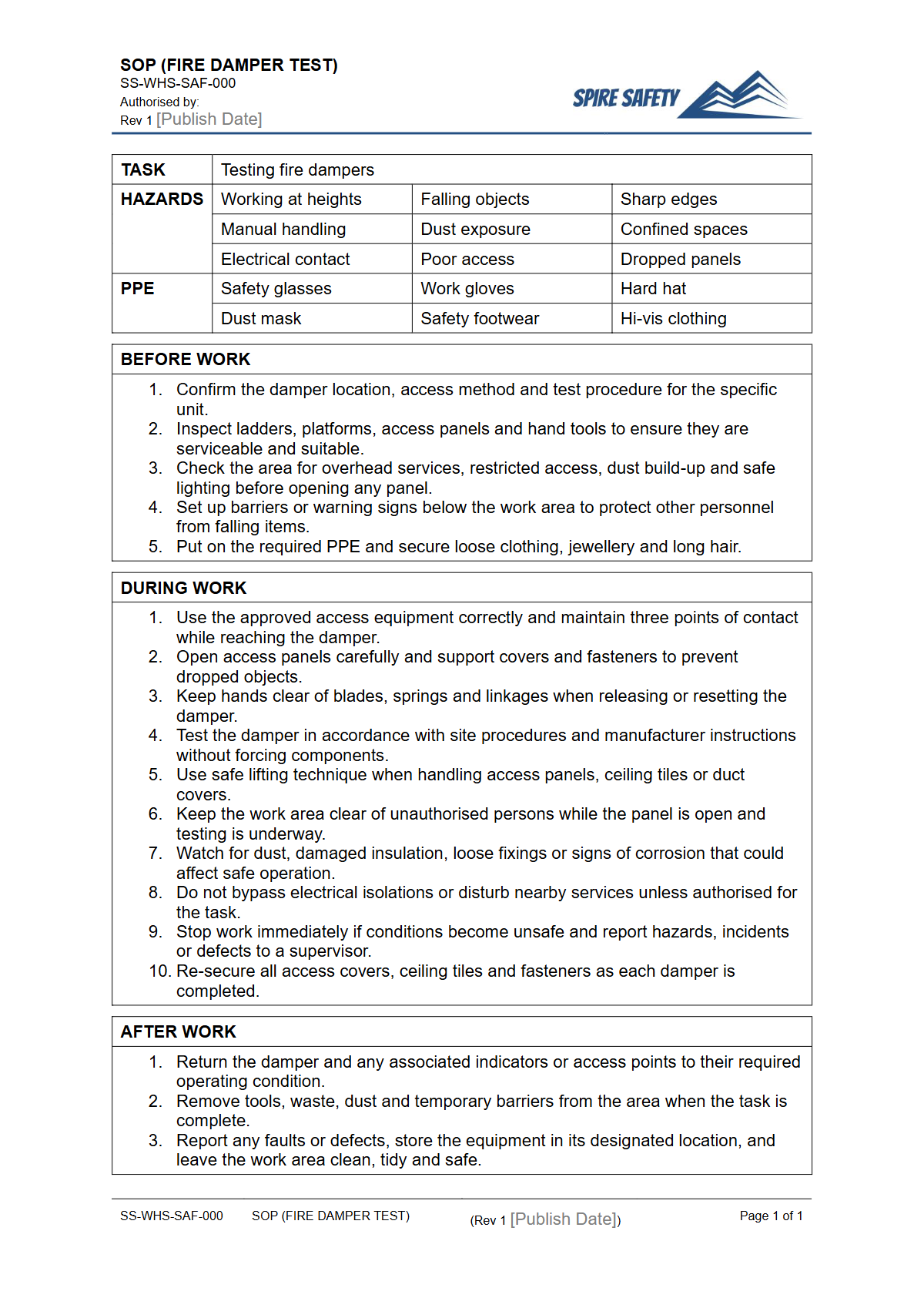
Download our free Safe Operating Procedure for fire damper testing. This customisable template helps you outline safe work steps for your team.
Free Safe Operating Procedure (Fire Damper Test) Template
DOCX • 126 KB + PDF
Updated Oct 2026
No signup required
Purpose of the Free Safe Operating Procedure (Fire Damper Test) Template
Our Free Safe Operating Procedure (Fire Damper Test) Template is designed to help you create a structured process for maintaining these critical fire safety assets. Fire dampers are passive fire protection devices within ventilation ductwork that close automatically upon detection of heat, preventing the spread of fire and smoke through a building's HVAC system.
This Safe Operating Procedure (SOP) provides a clear framework for conducting fire damper tests safely and consistently. Its primary purpose is to outline the step-by-step process, identify potential hazards like working at heights or dealing with energised equipment, and specify the control measures needed to mitigate risks.
Using a standardised procedure helps ensure that all tests are thorough, results are accurately recorded, and your organisation meets its obligations for maintaining building fire safety integrity. A robust SOP is a cornerstone of any effective WHS management system.
Video walkthrough
How to use the Free Safe Operating Procedure (Fire Damper Test) Template
Download the template in your preferred format—DOCX for easy editing or PDF for stable viewing. This document is a foundational guide, not a completed procedure.
You must systematically work through each section and adapt the content to reflect the specific types of fire dampers, tools, access methods, and personnel at your site. For example, the process for testing a pneumatic damper may require different steps than a simple fusible link type, much like the safe operation of an air compressor has unique requirements detailed in our Free Air Compressor SOP.
IMPORTANT: We have developed this template to get you started. You must customise this document to the specific equipment, hazards, and control measures relevant to your workplace.
The final responsibility for creating a safe and effective procedure rests with the PCBU (Person Conducting a Business or Undertaking).
When to use this Safe Operating Procedure
A Safe Operating Procedure for fire damper testing should be used whenever this maintenance task is performed. Australian Standard AS 1851 outlines the minimum frequencies for routine service, which typically involves functional tests at specified intervals (e.g., annually for most types).
This SOP should also be referenced during the initial commissioning of a building's HVAC system, following any repairs or modifications to the dampers or ductwork, and as part of scheduled preventative maintenance programs. Regular WHS compliance auditing will often verify that such testing and documentation are being completed correctly.
Who should use this SOP
This template is designed for use by competent personnel responsible for building maintenance and fire safety. This includes Facilities Managers, Building Maintenance Officers, qualified HVAC Technicians, and specialist fire safety contractors.
WHS Managers and Safety Officers will also find it a valuable tool for ensuring that a formal, risk-assessed process is in place for this high-risk maintenance task. While the principles of managing fire risk are universal, the specifics vary by application, whether it's a mechanical system or managing ignition sources as detailed in our Safe Operating Procedure for deep fryer use.
Developing clear SOPs for all critical tasks is a key part of workplace safety. By standardising procedures, you reduce the chance of error and create a safer environment for everyone.
Similar principles apply to operating complex machinery, as demonstrated in our FREE Conveyer System SOP. You can explore our complete range of templates in our free WHS resources library to build a comprehensive safety documentation suite for your business.
Common mistakes
Common mistakes to avoid
- Forgetting to reset the damper and re-secure the fusible link after a successful test.
- Failing to adequately clean dust, debris, and obstructions from the damper blades and frame.
- Incomplete or inaccurate record-keeping, making it impossible to prove compliance during an audit.
- Neglecting to notify building occupants or disable alarms, leading to false fire alarms during testing.
Legal references
Legal considerations
The following legal requirements may be relevant to this type of work.
- Work Health and Safety Act (Harmonised) — Provides the primary duties for protecting workers and other people from work health and safety risks.
- Work Health and Safety Regulations (Harmonised) — Sets out requirements supporting the management of workplace hazards and risks.
The following codes may be relevant to this type of work.
- Managing WHS Risks Code of Practice — Provides practical guidance on identifying hazards, assessing risks and applying effective controls.
- Work Health and Safety Consultation, Cooperation and Coordination Code of Practice — Provides practical guidance on consulting workers and coordinating with other duty holders.
- Managing the Work Environment and Facilities Code of Practice — Provides practical guidance on safe work environments, workplace facilities and related controls.
Did you know
Fusible Links
The fusible link in a traditional fire damper is designed to melt at a specific temperature, typically around 74°C (165°F), causing the damper to slam shut under spring tension.
A Hidden Network
A large commercial high-rise building can contain hundreds or even thousands of fire dampers, forming a critical but often unseen network of passive fire protection.
FAQ
Frequently asked questions
01How often do fire dampers need to be tested in Australia?
02What is the difference between a fire damper and a smoke damper?
03Do I need to be licensed to test fire dampers?
04Can I use this SOP template for all types of fire dampers?
Share this resource
Free Safe Operating Procedure (Fire Damper Test) Template
Browse Categories
How To Use It
- 1Download and open in Word or PDF.
- 2Replace the placeholders with your business details.
- 3Get it reviewed by a WHS specialist before rollout.
Need it customised?
Our WHS consultants can adapt this template to your site, run a gap analysis, or audit what you already have in place.
Book a Free Consultation WHS consulting servicesor call 1300 156 382
Related templates
- Free Safe Operating Procedure (Fire Door Adjustment) Template
- Free Safe Operating Procedure (Fire Extinguisher Use) Template
- Free Safe Operating Procedure (Fire Hose Reel) Template
- Free Safe Operating Procedure (Fire Hose Testing) Template
- Free Safe Operating Procedure (Fire Panel Isolation) Template
- Free Safe Operating Procedure (Fire Pump Test) Template