
Free Safe Operating Procedure (Fire Alarm Panel) Template
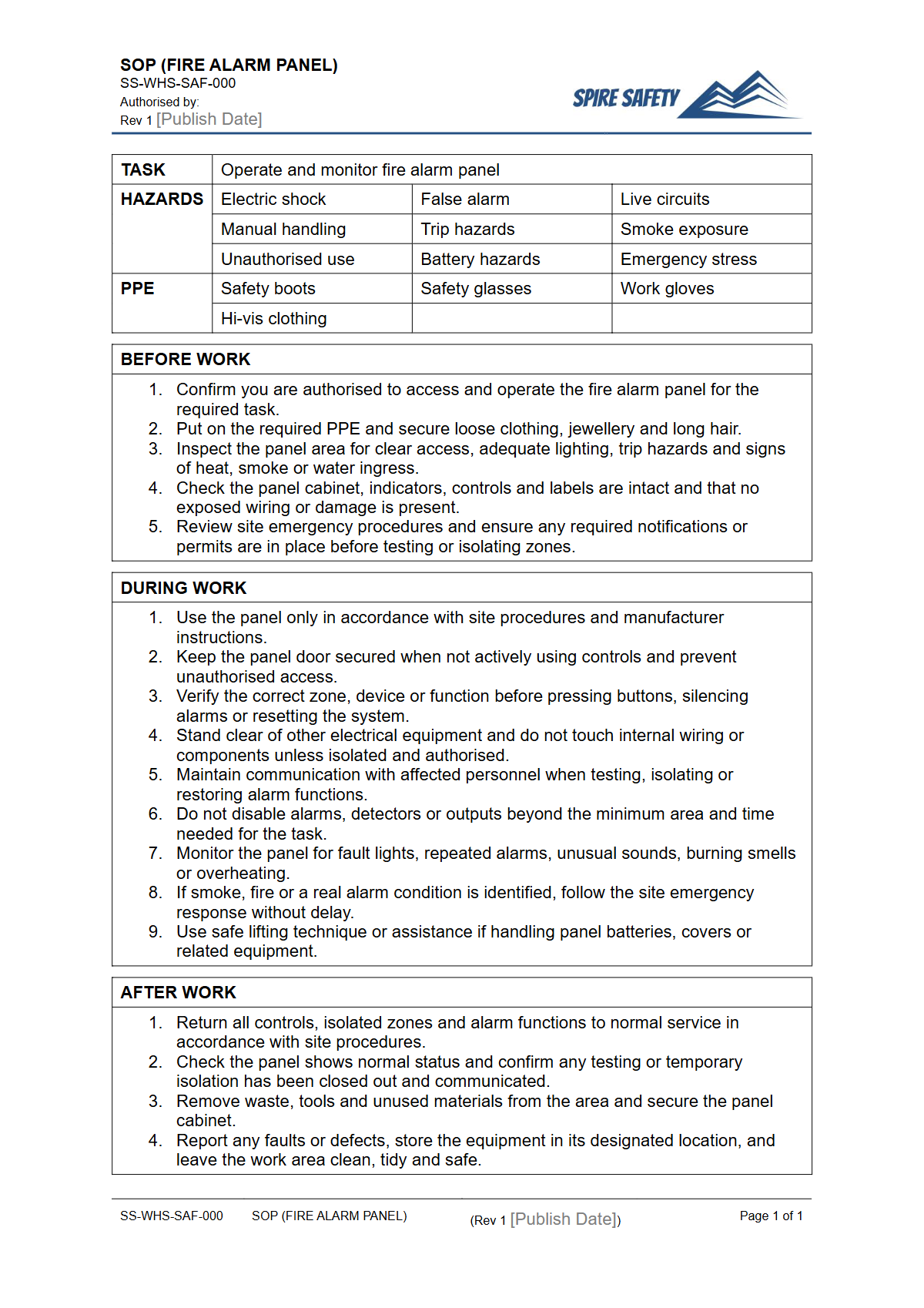
Establish clear instructions for operating and testing fire alarm panels in your workplace. Download our free Safe Operating Procedure template to get started.
Free Safe Operating Procedure (Fire Alarm Panel) Template
DOCX • 126 KB + PDF
Updated Oct 2026
No signup required
Purpose of the Free Safe Operating Procedure (Fire Alarm Panel) Template
A fire alarm panel is the central hub of your building's fire detection and emergency warning system. Incorrect operation can lead to delayed emergency responses, unnecessary evacuations due to false alarms, or failure to detect a genuine fire.
This free Safe Operating Procedure (Fire Alarm Panel) template provides a structured framework for documenting the correct steps for interacting with your specific fire alarm system.
A documented SOP serves several critical functions. It acts as a primary training tool for new staff, ensuring everyone understands their role and responsibilities.
It provides a clear, repeatable process for routine testing, isolation, and reset procedures, reducing the risk of human error. For a business, having a formal SOP is a key part of demonstrating proactive risk management and is a foundational document within broader WHS management systems.
Using this template helps ensure that actions taken at the fire alarm panel are consistent, deliberate, and aligned with both the manufacturer's guidelines and your site's specific emergency plan. This procedural clarity is vital for maintaining the operational readiness of your life-saving equipment.
Video walkthrough
How to use the Free Safe Operating Procedure (Fire Alarm Panel) Template
This document is a starting point designed to be adapted to your unique workplace. Download the DOCX file and customise it with the specific details of your fire alarm panel model, building layout, and internal procedures.
The PDF version is provided as a clean reference.
Important: You must customise this template to reflect your specific equipment and workplace risks. We are not familiar with your individual site, so you must add site-specific details, including the make and model of the panel, its exact location, and contact details for your fire maintenance contractor and monitoring company.
Consult the manufacturer's operating manual and your emergency response plan during customisation.
Ensure the procedure covers all common interactions, such as weekly testing, isolating detection zones for maintenance work, acknowledging and silencing alarms, and resetting the system after an event. The same disciplined approach to procedural safety is vital for other key equipment, as outlined in our free Air Compressor SOP.
Integrating with Emergency Procedures
Your Fire Alarm Panel SOP is not a standalone document; it must integrate seamlessly with your site's overall Emergency Plan. The SOP should detail the 'how' of operating the panel, while the Emergency Plan dictates the 'who, what, and when' of the overall response.
For example, the SOP explains how to silence the warning sounder, but the Emergency Plan states who is authorised to do so and under what circumstances (e.g., after the emergency services have arrived and given clearance).
When to use a Fire Alarm Panel SOP
A Safe Operating Procedure for a fire alarm panel is a living document used in multiple scenarios. It should be a core part of the induction process for any personnel who may be required to interact with the panel, including facility managers, security staff, and designated emergency wardens.
It serves as the basis for regular refresher training and practical drills to maintain competency and confidence.
The SOP should be readily accessible near the fire alarm panel itself for quick reference during an actual event. It is also the go-to document before conducting any maintenance or construction work that could generate dust or fumes, guiding workers on how to properly isolate specific detector zones to prevent false alarms.
Finally, the SOP should be reviewed and updated after any system upgrades, changes to the building layout, or as a corrective action following a fire-related incident or significant false alarm. The effectiveness of these procedures is often a focus during a formal WHS compliance auditing program.
Who should use this Safe Operating Procedure
This SOP is intended for all personnel authorised to operate or perform routine tests on the fire alarm panel. The specific roles will vary between organisations but typically include:
- WHS Managers and Safety Officers
- Facilities and Building Managers
- Chief Wardens, Floor Wardens, and other Emergency Control Organisation (ECO) members
- Security personnel responsible for first response
- Maintenance staff and qualified technicians
It is crucial that access and operation are restricted to trained and competent individuals. Unauthorised interaction can compromise the entire fire safety system.
For complex plant, defining user roles is equally important, a principle seen in procedures like a conveyer system SOP. This ensures that only those with the correct knowledge perform specific tasks, safeguarding both the equipment and personnel. Explore our full free WHS resources library for more templates to support your safety management system.
Common mistakes
Common mistakes to avoid
- Failing to customise the template with the specific make, model, and location of the panel.
- Not providing practical, hands-on training to all authorised users.
- Forgetting to update the SOP after system modifications or changes to building layout.
- Storing the procedure in an office, far away from the fire alarm panel where it's needed most.
Legal references
Legal considerations
The following legal requirements may be relevant to this type of work.
- Work Health and Safety Act (Harmonised) — Provides the primary duties for protecting workers and other people from work health and safety risks.
- Work Health and Safety Regulations (Harmonised) — Sets out requirements supporting the management of workplace hazards and risks.
The following codes may be relevant to this type of work.
- Managing WHS Risks Code of Practice — Provides practical guidance on identifying hazards, assessing risks and applying effective controls.
- Work Health and Safety Consultation, Cooperation and Coordination Code of Practice — Provides practical guidance on consulting workers and coordinating with other duty holders.
- Managing the Work Environment and Facilities Code of Practice — Provides practical guidance on safe work environments, workplace facilities and related controls.
Did you know
The Cost of False Alarms
Fire and Rescue NSW reports that they attend over 46,000 false alarms each year. A robust SOP for isolating detectors during maintenance can significantly reduce these costly and disruptive callouts.
Early Warning Systems
The first automated electric fire alarm system was patented in 1890 by Francis Robbins Upton, an associate of Thomas Edison. Modern systems build on this century-old principle of automated detection and warning.
FAQ
Frequently asked questions
01What information should be included in a Fire Alarm Panel SOP?
02How often should staff be trained on the Fire Alarm Panel SOP?
03Is this template compliant with Australian Standards for fire safety?
04What is the difference between an SOP and an Emergency Plan?
Share this resource
Free Safe Operating Procedure (Fire Alarm Panel) Template
Browse Categories
How To Use It
- 1Download and open in Word or PDF.
- 2Replace the placeholders with your business details.
- 3Get it reviewed by a WHS specialist before rollout.
Need it customised?
Our WHS consultants can adapt this template to your site, run a gap analysis, or audit what you already have in place.
Book a Free Consultation WHS consulting servicesor call 1300 156 382
Related templates
- Free Safe Operating Procedure (Fire Blanket Use) Template
- Free Safe Operating Procedure (Fire Damper Test) Template
- Free Safe Operating Procedure (Fire Door Adjustment) Template
- Free Safe Operating Procedure (Fire Extinguisher Use) Template
- Free Safe Operating Procedure (Fire Hose Reel) Template
- Free Safe Operating Procedure (Fire Hose Testing) Template