
Free Safe Operating Procedure (Field Bin Handling) Template
Formalise your agricultural safety protocols with our free Safe Operating Procedure for field bin handling. Download the customisable DOCX template today.
Free Safe Operating Procedure (Field Bin Handling) Template
DOCX • 126 KB + PDF
Updated Oct 2026
No signup required
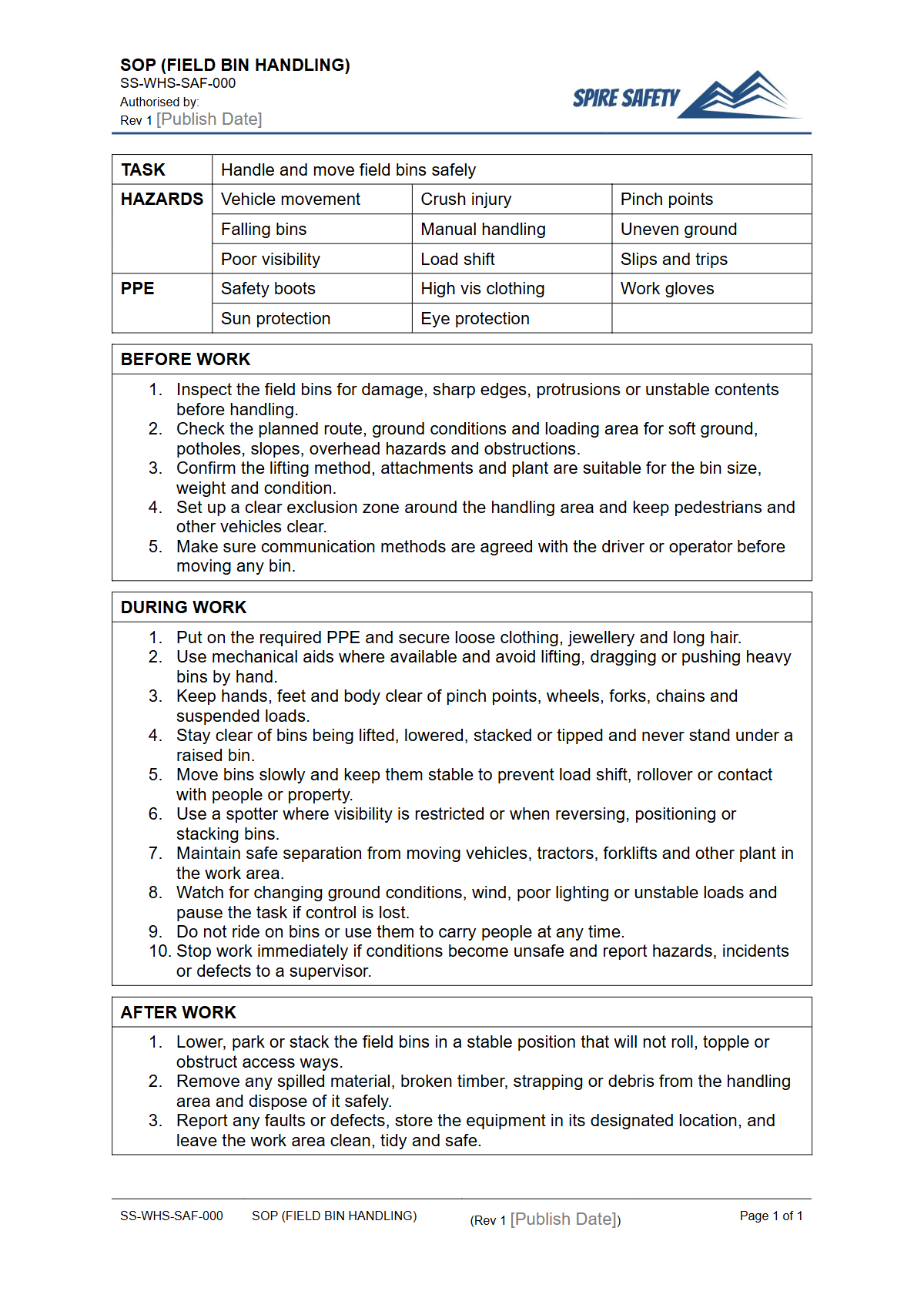
Purpose of the Free Safe Operating Procedure (Field Bin Handling) Template
Operating and moving field bins, chaser bins, and mother bins are routine but high-risk tasks in many agricultural settings. This Free Safe Operating Procedure (Field Bin Handling) Template provides a structured framework for documenting the required safety controls for these activities.
It helps Persons Conducting a Business or Undertaking (PCBUs) fulfil their duty of care by outlining a clear, step-by-step process for workers, minimising risks such as crushing, entanglement in augers, vehicle collisions, and instability on uneven ground.
A documented SOP is a critical tool for standardising work methods and ensuring every person involved understands the hazards and control measures. Using this template as a foundation helps create a safer working environment, reduces the likelihood of incidents, and demonstrates a commitment to systematic safety management.
It covers key stages including pre-operational checks, safe towing and positioning, operation of augers, and shutdown procedures.
Video walkthrough
How to use the Free Safe Operating Procedure (Field Bin Handling) Template
This document is a starting point designed for customisation. After downloading the DOCX file, you must adapt it to reflect the specific field bins, vehicles, and conditions at your workplace.
A generic procedure is not sufficient for managing your unique risks. The SOP should be developed in consultation with the workers who actually perform the task, as they have direct knowledge of the equipment and operational challenges.
To effectively implement this Safe Operating Procedure:
- Review and Customise: Go through each section and modify the content to match your specific bin models (e.g., auger types, hydraulic systems, braking mechanisms), towing vehicles, and typical site terrain.
- Consult Your Team: Involve operators and farmhands in the review process. Their input is invaluable for creating a practical and effective procedure that will be used correctly.
- Train All Users: Once finalised, use the SOP as a training document for all new and existing workers. Ensure they understand every step and have demonstrated their competence.
- Display and Access: Make the finalised SOP readily accessible in relevant work areas, such as machinery sheds or vehicle cabins.
Procedures for related equipment, such as those outlined in our free Telehandler SOP template, should also be reviewed to ensure consistent safety protocols across interconnected tasks.
A Note on Customisation
This template provides a general structure based on common WHS principles. We have not been to your site, and we cannot know your specific machinery, environment, or operational context. It is your responsibility as the PCBU to ensure the final document is tailored to your workplace and provides a safe system of work.
When to use it
An SOP for field bin handling should be used consistently as part of daily operations. It is not a document to be filed away and forgotten.
It should be actively referenced during worker training and induction, for pre-start meetings before harvest or seeding, and as a guide for refresher training sessions. It is also an essential document to review during incident investigations or after a near miss to identify any procedural gaps that need to be addressed.
Integrating this SOP into your broader safety framework is key. Documented procedures are a core component of comprehensive WHS management systems, helping to embed safe work practices into your organisation's culture.
Regular reviews, ideally annually or when changes occur, ensure the procedure remains relevant and effective.
Who should use it
This Safe Operating Procedure is intended for use by anyone involved in the management and operation of field bins. This includes:
- Farm Owners and Managers (PCBUs): To establish and authorise a formal safe system of work.
- Supervisors and Leading Hands: To supervise work, conduct training, and enforce the documented procedure.
- Workers and Operators: As a direct guide for performing the task safely and for conducting pre-operational checks.
- WHS Officers and Consultants: As a tool for risk assessments, training development, and conducting workplace inspections.
The process is often linked to other machinery, and it's beneficial to have consistent documentation across all high-risk plant. For example, the procedure for filling the bin from a harvester might involve a FREE Conveyer System SOP (Safe Operating Procedure) Template, ensuring safety at every transfer point. Having clear procedures for all stages of grain handling, including planting, is also crucial, which can be supported by documents like our free grain drill SOP template.
Ultimately, a robust SOP helps ensure that everyone, from management to the operator in the paddock, shares the same understanding of how to manage the risks. Periodic reviews, sometimes facilitated by external WHS compliance auditing services, can help verify that the procedures are being followed correctly and remain effective.
Find more templates in our free WHS resources library to build out your safety documentation.
Common mistakes
Common mistakes to avoid
- Using the generic template without customising it for specific bin models and site conditions.
- Failing to consult with and train the actual operators of the equipment on the finalised SOP.
- Neglecting to conduct and document the required pre-operational safety checks before each use.
- Not reviewing and updating the SOP after a near miss, incident, or change in equipment.
Legal references
Legal considerations
The following legal requirements may be relevant to this type of work.
- Work Health and Safety Act (Harmonised) — Provides the primary duties for protecting workers and other people from work health and safety risks.
- Work Health and Safety Regulations (Harmonised) — Sets out requirements supporting the management of workplace hazards and risks.
The following codes may be relevant to this type of work.
- Managing WHS Risks Code of Practice — Provides practical guidance on identifying hazards, assessing risks and applying effective controls.
- Work Health and Safety Consultation, Cooperation and Coordination Code of Practice — Provides practical guidance on consulting workers and coordinating with other duty holders.
- Managing the Work Environment and Facilities Code of Practice — Provides practical guidance on safe work environments, workplace facilities and related controls.
Did you know
A Heavy Toll
According to Safe Work Australia, agriculture is one of the highest-risk industries for worker fatalities, with machinery-related incidents being a major cause. A full field bin can weigh over 30 tonnes, creating immense stored energy and crush risks.
Centre of Gravity
The stability of a field bin changes dramatically as it is filled and emptied. A partially filled bin can have a higher centre of gravity and be more prone to tipping on slopes or during transport than a full or empty one.
FAQ
Frequently asked questions
01What are the main hazards of handling field bins?
02Does this SOP cover all types of field bins, like chaser bins and mother bins?
03Who is responsible for developing a Safe Operating Procedure for field bin handling?
04How often should an SOP for field bin handling be reviewed?
Share this resource
Free Safe Operating Procedure (Field Bin Handling) Template
Browse Categories
How To Use It
- 1Download and open in Word or PDF.
- 2Replace the placeholders with your business details.
- 3Get it reviewed by a WHS specialist before rollout.
Need it customised?
Our WHS consultants can adapt this template to your site, run a gap analysis, or audit what you already have in place.
Book a Free Consultation WHS consulting servicesor call 1300 156 382
Related templates
- Free Safe Operating Procedure (Field Boundary Marking) Template
- Free Safe Operating Procedure (Field Drain Clearing) Template
- Free Safe Operating Procedure (Field Gate Maintenance) Template
- Free Safe Operating Procedure (Filling Machine) Template
- Free Safe Operating Procedure (Filter Replacement) Template
- Free Safe Operating Procedure (Fire Alarm Panel) Template