
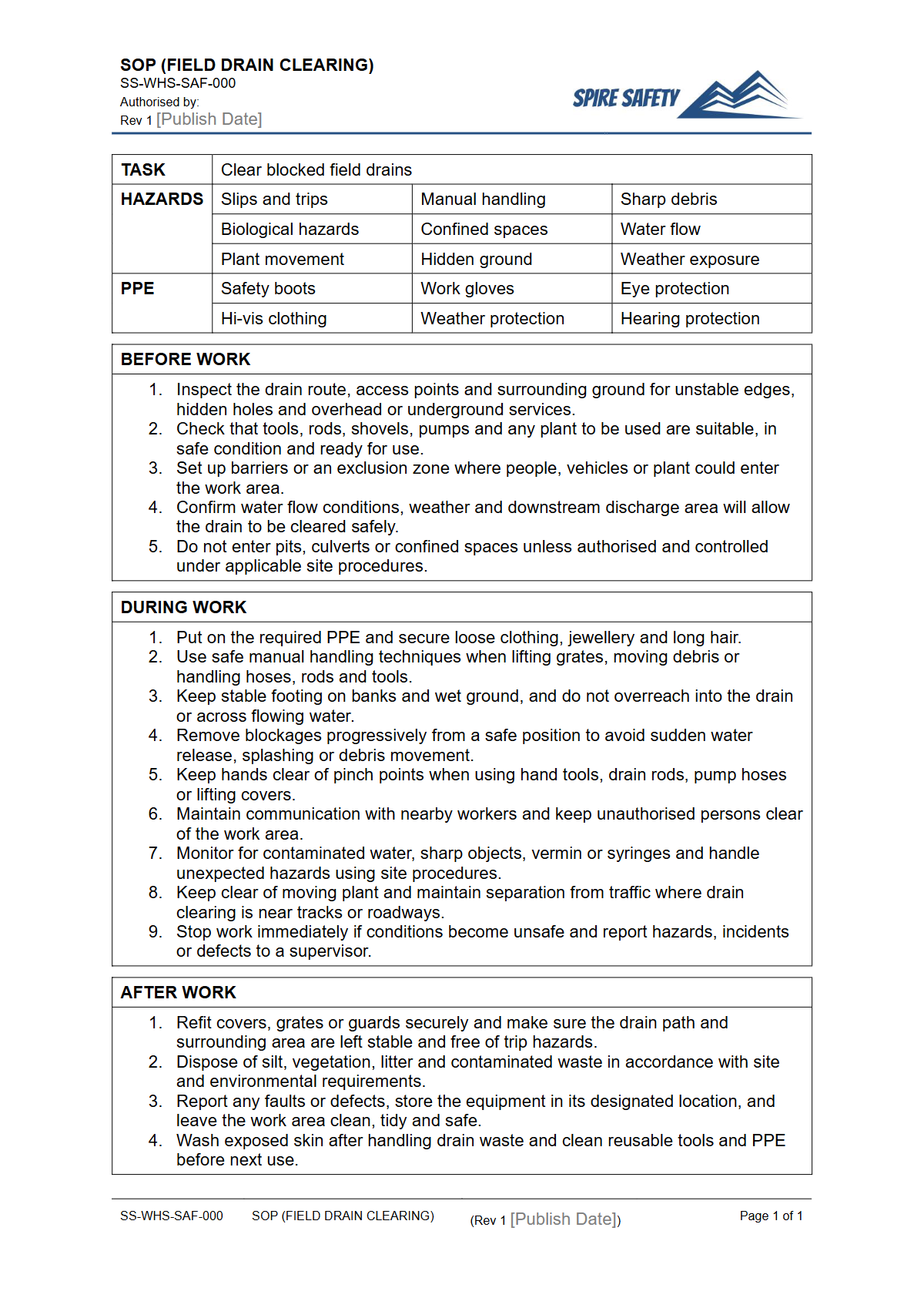
Free Safe Operating Procedure (Field Drain Clearing) Template
Download our free Safe Operating Procedure (Field Drain Clearing) Template to formalise safety protocols for this agricultural and civil task.
Free Safe Operating Procedure (Field Drain Clearing) Template
DOCX • 126 KB + PDF
Updated Oct 2026
No signup required
Purpose of the Free Safe Operating Procedure (Field Drain Clearing) Template
Field drain clearing is a critical task in agriculture and land management, but it carries significant risks, including equipment rollovers, engulfment, and exposure to contaminants. This free Safe Operating Procedure (Field Drain Clearing) Template provides a structured starting point for your business to document a safe system of work for this activity.
An SOP is a fundamental tool for risk management, outlining step-by-step instructions to help workers perform their duties safely and consistently. By formalising your process, you can reduce the likelihood of incidents, improve operational efficiency, and demonstrate a commitment to workplace health and safety.
Using this template helps you identify potential hazards, establish robust control measures, and specify the correct personal protective equipment (PPE) for the job. A well-drafted SOP is a key component of effective training and induction programs, ensuring all personnel, including new or temporary workers, understand the expected safety standards and operational protocols. It also serves as a crucial reference document during safety meetings, incident investigations, and audits of your WHS management systems.
Video walkthrough
How to use the Free Safe Operating Procedure (Field Drain Clearing) Template
This document is a template and must be customised to suit the specific context of your workplace. To use the Safe Operating Procedure (Field Drain Clearing) Template effectively, begin by conducting a site-specific risk assessment.
Identify the unique machinery, ground conditions, potential underground services (like pipes or cables), and environmental factors relevant to your operations. Download the DOCX file and update the content to reflect your findings, detailing your organisation's specific procedures, equipment models, and emergency plans.
We recommend involving the workers who actually perform the task in the customisation process. Their hands-on experience is invaluable for identifying practical risks and effective controls that might be overlooked in a purely theoretical assessment.
Once finalised, the SOP should be formally approved by management, communicated to all relevant personnel, and made easily accessible at the worksite. Regularly review and update the document, especially after an incident or when new equipment or techniques are introduced. This process is similar for other task-specific documents, like our FREE Trencher SOP Template.
When to use it
A Safe Operating Procedure for field drain clearing should be used as a primary reference tool before and during the task. It is essential for several key activities:
- Task Planning: Consult the SOP during the planning phase to ensure all necessary safety measures, equipment checks, and permits are in place before work commences.
- Worker Training and Induction: Use the SOP as a core training document for new operators and as a refresher for experienced staff to ensure consistent, safe work practices.
- Pre-start Meetings: Review the SOP in pre-start or toolbox talks to remind the team of the critical safety steps, hazards, and controls for the day's work.
- Supervision and Monitoring: Supervisors can use the SOP as a benchmark to monitor work performance and confirm that procedures are being followed correctly.
- Incident Investigation: In the event of an accident or near-miss, the SOP provides a baseline to help investigators determine if procedures were followed and where they might need improvement. For broader system checks, consider engaging external help for WHS compliance auditing.
Who should use it
This SOP is intended for a range of personnel within an organisation to ensure a shared understanding of safety requirements. Key users include:
- Equipment Operators: The primary users of the SOP, who must follow the step-by-step instructions to perform their work safely.
- Supervisors and Farm Managers: Responsible for ensuring the SOP is implemented, understood, and followed by their teams. They also play a role in reviewing and updating the document. Similar machinery, like that covered in our FREE Scraper SOP (Safe Operating Procedure) Template, requires the same level of oversight.
- Work Health and Safety (WHS) Officers: Use the SOP as part of the overall safety management system, for auditing purposes, and to assist in risk assessments and training development.
- Maintenance Personnel: Refer to the SOP to understand the operational context and safety requirements related to equipment inspection and maintenance, ensuring machinery remains fit for purpose.
- Business Owners / Persons Conducting a Business or Undertaking (PCBUs): Accountable for providing a safe system of work; the SOP is a key document that helps them fulfil this duty. They can explore our entire free WHS resources library for more templates to support their safety obligations.
By ensuring all these roles are familiar with the SOP, you create a more cohesive and safety-conscious culture. Many agricultural and civil tasks involve similar principles, such as those outlined in our FREE Grader SOP (Safe Operating Procedure) Template, reinforcing the importance of standardised procedures across all operations.
Common mistakes
Common mistakes to avoid
- Failing to identify and locate underground services before starting any excavation.
- Using equipment that is not suited for the ground conditions, leading to bogging or rollovers.
- Neglecting to wear appropriate PPE, especially waterproof boots and gloves.
- Working alone in remote areas without a reliable communication method or emergency plan.
Legal references
Legal considerations
The following legal requirements may be relevant to this type of work.
- Work Health and Safety Act (Harmonised) — Provides the primary duties for protecting workers and other people from work health and safety risks.
- Work Health and Safety Regulations (Harmonised) — Sets out requirements supporting the management of workplace hazards and risks.
The following codes may be relevant to this type of work.
- Managing WHS Risks Code of Practice — Provides practical guidance on identifying hazards, assessing risks and applying effective controls.
- Work Health and Safety Consultation, Cooperation and Coordination Code of Practice — Provides practical guidance on consulting workers and coordinating with other duty holders.
- Managing the Work Environment and Facilities Code of Practice — Provides practical guidance on safe work environments, workplace facilities and related controls.
Did you know
Hidden Dangers in Soil
Disturbed soil and stagnant water in drains can harbour harmful bacteria, such as Legionella and Leptospira, which can cause serious illness if inhaled or absorbed through cuts in the skin.
Drainage and Crop Yield
Poorly drained fields can reduce crop yields by up to 60% due to waterlogged roots, nutrient loss, and increased soil compaction, highlighting the economic importance of proper drain maintenance.
FAQ
Frequently asked questions
01What are the main hazards when clearing field drains?
02How often should an SOP for field drain clearing be reviewed?
03Is worker training required after creating this SOP?
04What PPE is typically required for field drain clearing?
Share this resource
Free Safe Operating Procedure (Field Drain Clearing) Template
Browse Categories
How To Use It
- 1Download and open in Word or PDF.
- 2Replace the placeholders with your business details.
- 3Get it reviewed by a WHS specialist before rollout.
Need it customised?
Our WHS consultants can adapt this template to your site, run a gap analysis, or audit what you already have in place.
Book a Free Consultation WHS consulting servicesor call 1300 156 382
Related templates
- Free Safe Operating Procedure (Field Gate Maintenance) Template
- Free Safe Operating Procedure (Filling Machine) Template
- Free Safe Operating Procedure (Filter Replacement) Template
- Free Safe Operating Procedure (Fire Alarm Panel) Template
- Free Safe Operating Procedure (Fire Blanket Use) Template
- Free Safe Operating Procedure (Fire Damper Test) Template