
Free Safe Operating Procedure (Filling Machine) Template
Formalise safety protocols for your automated or manual filling equipment with our structured template.
Free Safe Operating Procedure (Filling Machine) Template
DOCX • 126 KB + PDF
Updated Oct 2026
No signup required
Purpose of the Free Safe Operating Procedure (Filling Machine) Template
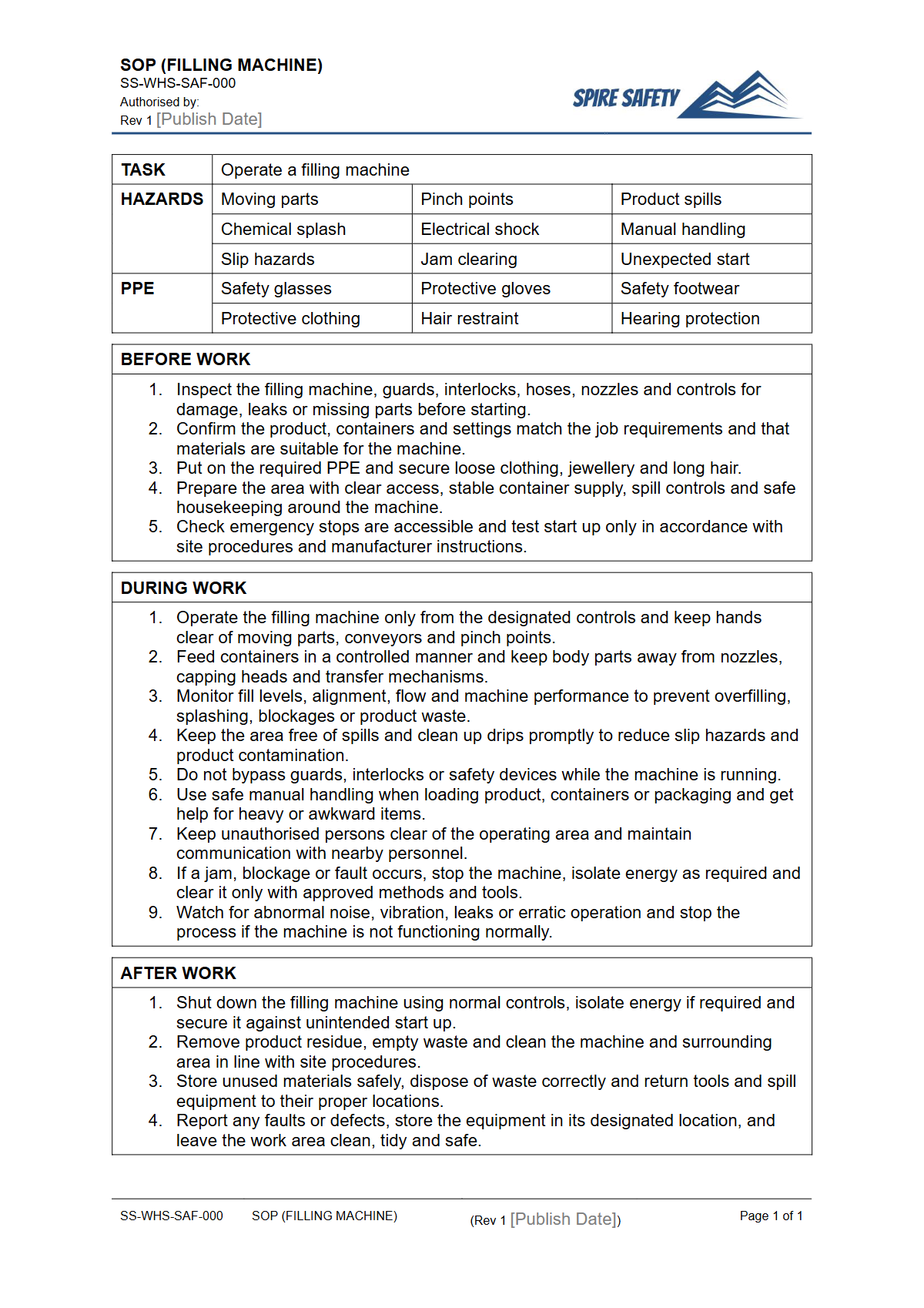
This Free Safe Operating Procedure (Filling Machine) Template provides a structured framework for documenting the safe use of various types of filling machines, whether they handle liquids, powders, granules, or other products. Its purpose is to clearly outline the step-by-step process required to operate the equipment safely, minimising risks to workers.
By formalising procedures, you establish a clear standard for operation, training, and supervision. A well-drafted Safe Operating Procedure (SOP) helps identify hazards such as mechanical entanglement, crushing, chemical exposure, ergonomic strains, and electrical risks before they cause an incident.
Implementing machine-specific SOPs is a fundamental part of demonstrating due diligence and forms a critical component of broader robust WHS management systems. This document serves as a key training tool for new operators and a reference for experienced staff, ensuring consistent and safe work practices are maintained across all shifts. It also provides a baseline for incident investigations and continuous improvement of your safety processes.
What is a Safe Operating Procedure?
A Safe Operating Procedure is a written document that provides detailed, sequential instructions on how to perform a specific task safely and efficiently. It goes beyond a simple checklist by integrating hazard identification, risk controls, and emergency responses directly into the workflow.
For plant like a filling machine, an SOP typically covers pre-operational checks, safe operation steps, cleaning, shutdown procedures, and what to do if something goes wrong.
Video walkthrough
How to use the Free Safe Operating Procedure (Filling Machine) Template
To effectively use the Free Safe Operating Procedure (Filling Machine) Template, you should begin by downloading the DOCX file and customising it to reflect the specific equipment and processes in your workplace. This template is a comprehensive starting point, but it is not a finished document.
You must adapt it with details specific to your machine's make and model, the products it handles, and your unique operational environment. This includes adding specific details about safety features, isolation points, and the required personal protective equipment (PPE).
We strongly recommend a consultation process involving the machine operators, supervisors, and health and safety representatives who will be using the document. Their direct experience is invaluable for ensuring the SOP is practical, accurate, and comprehensive.
Consider how the filling machine interacts with other equipment; for example, you may need to integrate this procedure with your free Conveyer System SOP if the two are part of a connected production line.
When to use this Safe Operating Procedure
A Safe Operating Procedure for a filling machine should be used as the primary reference document for any interaction with the equipment. It is not just for routine operation.
Its application extends to several key stages, including initial worker training and induction, ongoing competency assessments, and refresher training sessions. Supervisors should use it as a tool for observing work practices and confirming that procedures are being followed correctly.
The SOP should also be consulted before undertaking non-routine tasks such as clearing blockages, performing minor adjustments, or conducting cleaning and sanitation. Furthermore, it serves as a critical reference point during incident investigations and when conducting risk assessments, especially after a near miss or when a process is modified.
The procedures for associated plant, such as those detailed in our Free Air Compressor SOP, should be similarly integrated into daily use.
Who should use this document
This Safe Operating Procedure is intended for several key roles within an organisation. The primary users are the machine operators themselves, who must understand and follow the outlined steps to ensure their own safety and that of their colleagues.
Supervisors and team leaders also have a critical role in enforcing the SOP, using it to guide training, monitor performance, and correct unsafe behaviour. Their sign-off on the document confirms their responsibility for its implementation.
WHS managers and personnel will use the SOP as a key piece of documentation within the overall safety management system. It provides auditable evidence that risks have been assessed and controlled.
The effectiveness of this and other procedures can be verified through routine WHS compliance auditing. Finally, maintenance and engineering staff should refer to the SOP to understand operational hazards before they perform servicing or repairs, ensuring their work does not introduce new risks. The principles in this document are applicable across many types of plant, similar to our Safe Operating Procedure for a Deep Fryer.
Developing a comprehensive SOP requires a thorough understanding of the plant's risks. If your team lacks the specific expertise for complex machinery, engaging external WHS consulting services can provide the necessary guidance to ensure all hazards are identified and controlled. For more templates and safety documents, browse our complete library of free WHS resources.
Common mistakes
Common mistakes to avoid
- Using a generic SOP template without customising it for the specific make, model, and workplace conditions.
- Failing to involve the actual machine operators in the drafting and review process, leading to impractical or incomplete procedures.
- Neglecting to include clear instructions for non-routine tasks like clearing jams, cleaning, and emergency shutdowns.
- Not providing adequate training on the SOP or failing to verify that workers understand and can apply the procedures correctly.
Legal references
Legal considerations
The following legal requirements may be relevant to this type of work.
- Work Health and Safety Act (Harmonised) — Provides the primary duties for protecting workers and other people from work health and safety risks.
- Work Health and Safety Regulations (Harmonised) — Sets out requirements supporting the management of workplace hazards and risks.
The following codes may be relevant to this type of work.
- Managing WHS Risks Code of Practice — Provides practical guidance on identifying hazards, assessing risks and applying effective controls.
- Work Health and Safety Consultation, Cooperation and Coordination Code of Practice — Provides practical guidance on consulting workers and coordinating with other duty holders.
- Managing the Work Environment and Facilities Code of Practice — Provides practical guidance on safe work environments, workplace facilities and related controls.
Did you know
Machine Guarding is Critical
According to Safe Work Australia, a significant percentage of machinery-related injuries are due to inadequate guarding. An effective SOP will always include checks to ensure all guards are in place and functioning correctly before operation.
Variety in Design, Commonality in Risk
Filling machines range from simple manual devices to complex, fully automated robotic systems. Despite the design differences, they often share common hazards like in-running nip points, rotating parts, and the need for robust lockout-tagout procedures during maintenance.
FAQ
Frequently asked questions
01What is a Safe Operating Procedure for a filling machine?
02Is an SOP a legal requirement for filling machines in Australia?
03What hazards should be included in a filling machine SOP?
04How often should a filling machine SOP be reviewed?
Share this resource
Free Safe Operating Procedure (Filling Machine) Template
Browse Categories
How To Use It
- 1Download and open in Word or PDF.
- 2Replace the placeholders with your business details.
- 3Get it reviewed by a WHS specialist before rollout.
Need it customised?
Our WHS consultants can adapt this template to your site, run a gap analysis, or audit what you already have in place.
Book a Free Consultation WHS consulting servicesor call 1300 156 382
Related templates
- Free Safe Operating Procedure (Filter Replacement) Template
- Free Safe Operating Procedure (Fire Alarm Panel) Template
- Free Safe Operating Procedure (Fire Blanket Use) Template
- Free Safe Operating Procedure (Fire Damper Test) Template
- Free Safe Operating Procedure (Fire Door Adjustment) Template
- Free Safe Operating Procedure (Fire Extinguisher Use) Template