
Free Safe Operating Procedure (Field Boundary Marking) Template
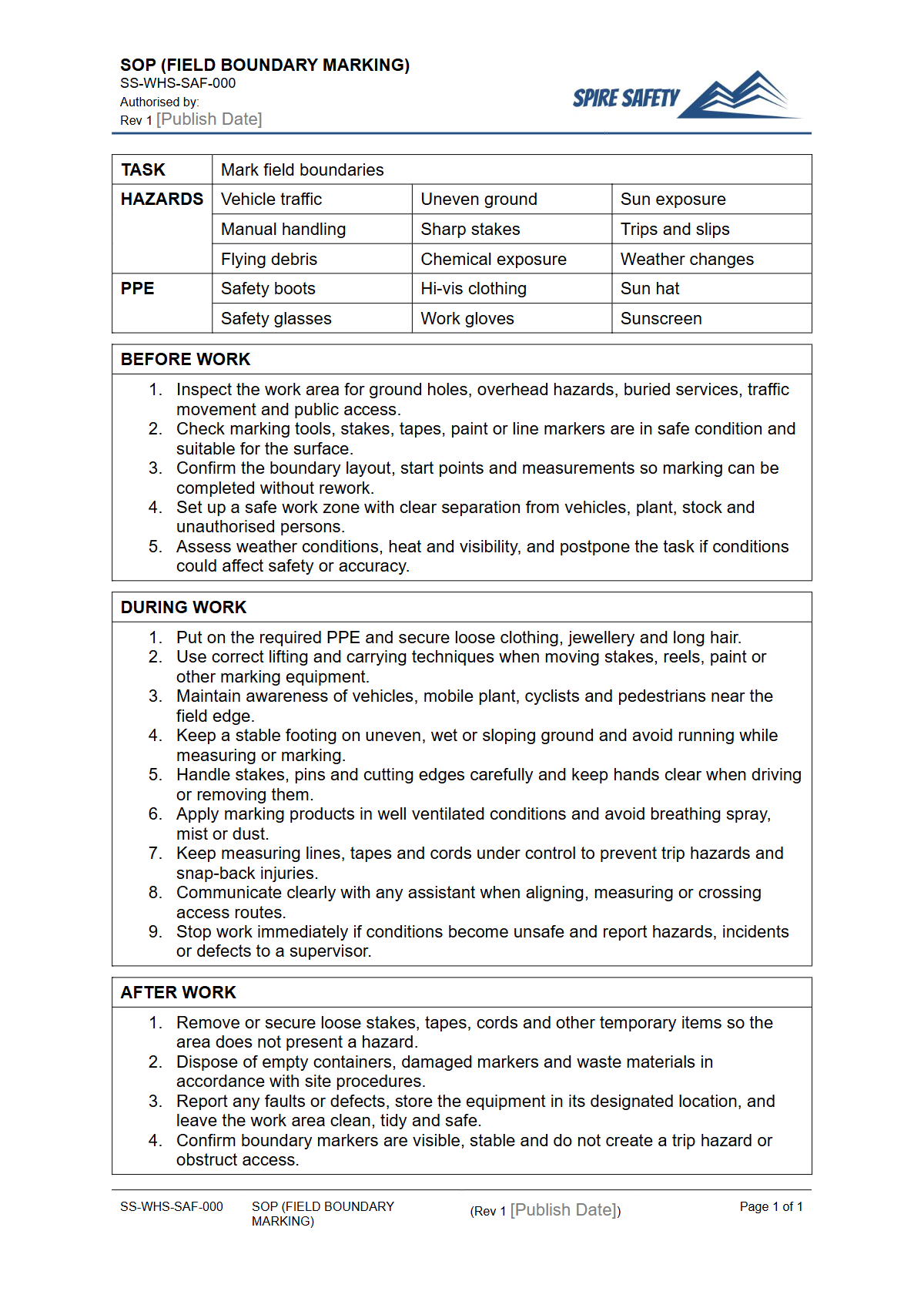
Download our free Safe Operating Procedure for Field Boundary Marking to standardise safety protocols. This template helps outline hazards and controls.
Free Safe Operating Procedure (Field Boundary Marking) Template
DOCX • 126 KB + PDF
Updated Oct 2026
No signup required
Purpose of the Free Safe Operating Procedure (Field Boundary Marking) Template
This Free Safe Operating Procedure (Field Boundary Marking) Template provides a structured framework for safely marking out perimeters in agricultural, construction, or recreational settings. Its primary purpose is to help you formalise a safe system of work by identifying potential hazards and outlining clear control measures.
By documenting the process, you create a consistent, repeatable, and safe method for all workers to follow, reducing the risk of injuries and incidents.
A documented SOP serves as a critical training tool for new employees and a refresher for experienced staff. It ensures everyone understands the expected safety standards, the correct use of equipment—from simple pegs and tape to powered line markers—and the emergency procedures.
This is particularly important when tasks involve multiple workers or interaction with vehicles. Having documented procedures for machinery like those in our free Spreader SOP Template is a key part of demonstrating WHS due diligence.
Video walkthrough
How to use the Free Safe Operating Procedure (Field Boundary Marking) Template
Download the template in your preferred format (DOCX for easy editing or PDF for straightforward printing) and begin adapting it to your specific operational context. The document is designed as a comprehensive starting point aligned with Australian WHS principles, but it is not a complete, out-of-the-box solution.
Effective implementation requires customisation to reflect the unique aspects of your site, the specific equipment used, and the competency of your personnel.
Important: It is crucial that you customise this template for your specific workplace. We provide this document as a starting point, but your final Safe Operating Procedure must reflect the unique hazards, equipment, and environment of your operations to be effective. An SOP is a living document that forms an essential part of your site's overall WHS management systems.
Key Sections to Customise
- Personal Protective Equipment (PPE): List the mandatory PPE required for the task, such as high-visibility clothing, steel-capped boots, sun protection (hat, sunscreen), and gloves. If using chemical sprays, specify respiratory or eye protection as per the Safety Data Sheet (SDS).
- Hazard Identification and Risk Control: This is the most critical section. Walk the area to be marked and identify all potential hazards. These may include uneven ground, hidden obstacles, overhead powerlines, vehicle traffic, and environmental risks like heat or snakes. For each hazard, specify the control measure to be implemented.
- Step-by-Step Procedure: Detail the task from start to finish. Include pre-start checks of any equipment (e.g., line markers, GPS units), communication protocols between workers, methods for securing the area, and the clean-up process. This methodical approach is similar to the process for other specialised tasks outlined in our free Trencher SOP Template.
- Emergency Procedures: Outline the response plan for potential incidents, including first aid for injuries, chemical spills, or contact with unexpected services. Ensure emergency contact numbers and the location of first aid kits are clearly stated. If you require expert guidance, our WHS consulting services can assist in developing robust procedures.
When to use this Safe Operating Procedure
This Safe Operating Procedure should be developed, approved, and communicated before any field boundary marking activities commence. It is a vital document for pre-start meetings and toolbox talks, allowing teams to discuss the specific risks of the day's task and location.
It should also be a core part of inducting new workers or contractors who will be performing or working near this activity.
The SOP is relevant across various industries, including agriculture for defining paddocks, construction for setting out site boundaries and exclusion zones, and sports turf management for marking playing fields. It is also applicable to related activities such as clearing and levelling ground, which is detailed in our free Grader SOP Template.
Who should use this Safe Operating Procedure
This document is intended for use by anyone responsible for workplace safety and operational management. Site supervisors and team leaders should use it to instruct and supervise workers, ensuring the agreed-upon safety measures are followed.
Workers and machinery operators performing the task must be trained on the SOP and follow its directives to protect themselves and others.
Work Health and Safety (WHS) managers and coordinators will find the template useful for building a consistent safety framework across the organisation. It provides tangible evidence of a safe system of work, which can be reviewed during internal safety checks or a formal WHS compliance auditing engagement. For more templates and safety guides, browse our entire free WHS resources library.
Common mistakes
Common mistakes to avoid
- Using a generic template without site-specific customisation for terrain and equipment.
- Failing to physically walk the area to assess for trip hazards, uneven ground, or hidden obstacles before starting.
- Neglecting to check the Safety Data Sheet (SDS) for marking paints or aerosol chemicals.
- Not establishing clear communication protocols between workers, especially when vehicles or machinery are operating nearby.
Legal references
Legal considerations
The following legal requirements may be relevant to this type of work.
- Work Health and Safety Act (Harmonised) — Provides the primary duties for protecting workers and other people from work health and safety risks.
- Work Health and Safety Regulations (Harmonised) — Sets out requirements supporting the management of workplace hazards and risks.
The following codes may be relevant to this type of work.
- Managing WHS Risks Code of Practice — Provides practical guidance on identifying hazards, assessing risks and applying effective controls.
- Work Health and Safety Consultation, Cooperation and Coordination Code of Practice — Provides practical guidance on consulting workers and coordinating with other duty holders.
- Managing the Work Environment and Facilities Code of Practice — Provides practical guidance on safe work environments, workplace facilities and related controls.
Did you know
Precision Agriculture
Modern boundary marking often uses GPS and auto-steer technology, reducing operator fatigue and improving accuracy to within centimetres. This technology significantly minimises overlap and gaps in field applications like spraying and seeding.
Line Marking History
The first automated line marker for sports fields was invented in the early 1900s, revolutionising a task previously done by hand with buckets of whitewash and brushes.
FAQ
Frequently asked questions
01What hazards are involved in field boundary marking?
02Is a Safe Operating Procedure legally required for field boundary marking in Australia?
03How often should a Field Boundary Marking SOP be reviewed?
04Can this template be used for GPS-guided boundary marking?
Share this resource
Free Safe Operating Procedure (Field Boundary Marking) Template
Browse Categories
How To Use It
- 1Download and open in Word or PDF.
- 2Replace the placeholders with your business details.
- 3Get it reviewed by a WHS specialist before rollout.
Need it customised?
Our WHS consultants can adapt this template to your site, run a gap analysis, or audit what you already have in place.
Book a Free Consultation WHS consulting servicesor call 1300 156 382
Related templates
- Free Safe Operating Procedure (Field Drain Clearing) Template
- Free Safe Operating Procedure (Field Gate Maintenance) Template
- Free Safe Operating Procedure (Filling Machine) Template
- Free Safe Operating Procedure (Filter Replacement) Template
- Free Safe Operating Procedure (Fire Alarm Panel) Template
- Free Safe Operating Procedure (Fire Blanket Use) Template