
Free Safe Operating Procedure (Fertiliser Mixing) Template
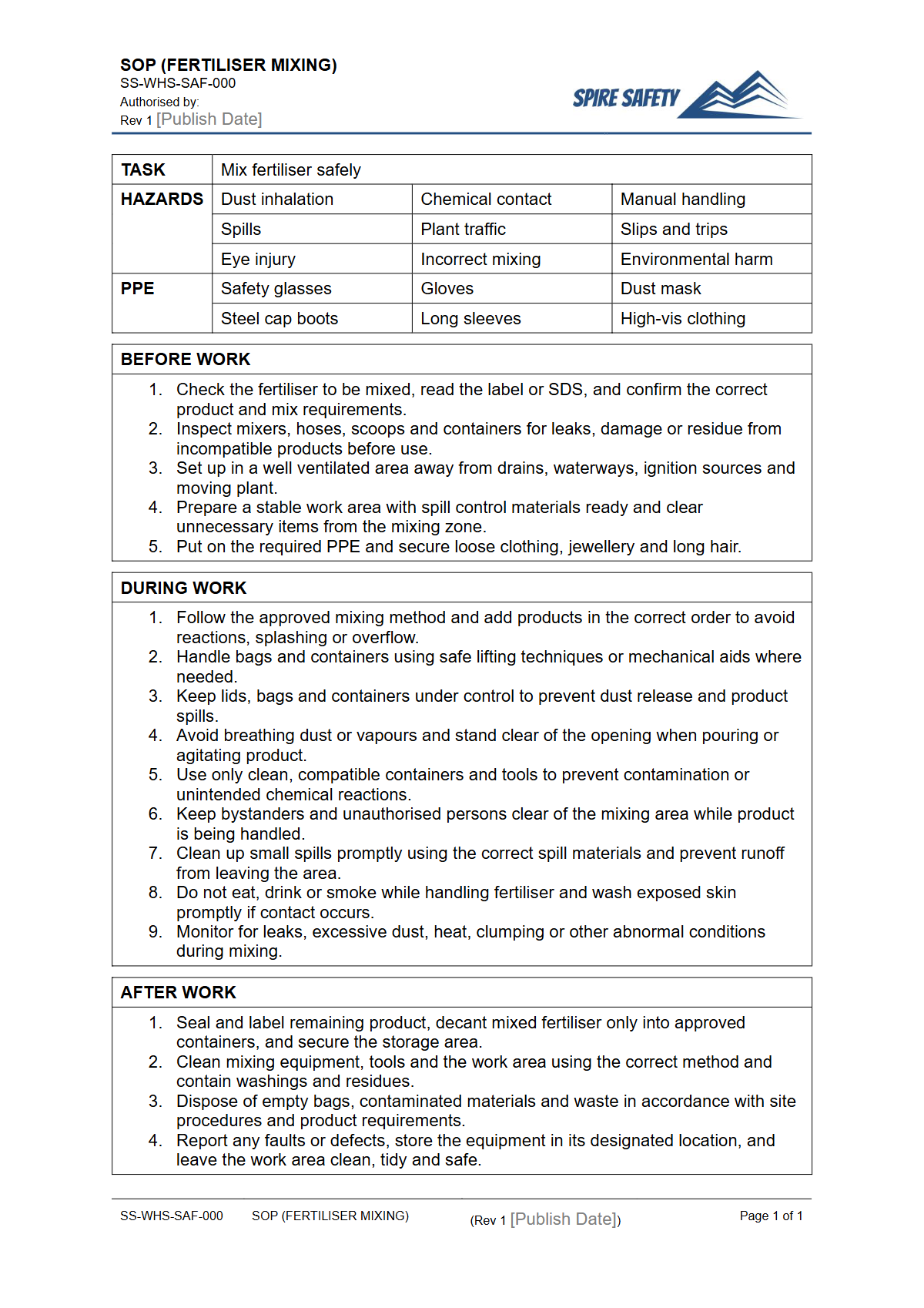
Download our free Safe Operating Procedure for fertiliser mixing to create a safer workplace.
Free Safe Operating Procedure (Fertiliser Mixing) Template
DOCX • 126 KB + PDF
Updated Oct 2026
No signup required
Purpose of the Free Safe Operating Procedure (Fertiliser Mixing) Template
Handling and mixing fertilisers can expose workers to significant health and safety risks, including chemical burns, respiratory irritation from dust and fumes, and musculoskeletal injuries from manual handling. This free Safe Operating Procedure (Fertiliser Mixing) Template provides a structured framework for documenting the safest way to perform this common agricultural and horticultural task.
A documented SOP is a critical tool for training staff, standardising work methods, and demonstrating a commitment to risk management.
By clearly outlining the required steps, personal protective equipment (PPE), and emergency procedures, this SOP helps your organisation meet its duty of care. Integrating task-specific procedures like this one is a fundamental part of developing comprehensive WHS management systems that protect your workers and ensure operational consistency.
What is a Safe Operating Procedure?
A Safe Operating Procedure, or SOP, is a written document that provides step-by-step instructions on how to safely perform a specific task or operate a piece of machinery. The goal is to minimise risks to people, property, and the environment.
An effective SOP is created in consultation with the workers who actually perform the task and is based on a thorough risk assessment.
Video walkthrough
How to use the Free Safe Operating Procedure (Fertiliser Mixing) Template
This template is available for download as a DOCX file for easy editing, or as a PDF for reference. To use it effectively, you must adapt its contents to reflect the specific circumstances of your workplace.
Review each section and add, remove, or modify information based on the types of fertilisers used, the mixing equipment available, and the environment where the work is performed. Always consult the Safety Data Sheet (SDS) for each chemical product to ensure your procedure includes accurate information on hazards, handling, storage, and first aid.
Important: This is a template document that requires customisation. It is not a complete, ready-to-use SOP.
We strongly recommend that a competent person within your organisation reviews, modifies, and approves the final document to ensure it is suitable for your specific operational needs and control measures. If you are unsure, engaging professional WHS consulting services can provide clarity and expert guidance.
If your process involves moving large or bulk bags of fertiliser with machinery, you must also have procedures for the safe use of that equipment. For example, many sites use telehandlers for this purpose, which requires its own set of controls outlined in a document like our Telehandler SOP template.
When to use this Safe Operating Procedure
This SOP should be used as a primary reference document before and during any fertiliser mixing activities. It serves multiple functions throughout the safety lifecycle, including as a core component of worker induction and training for new employees.
It should also be used for regular refresher training to ensure established safety practices are maintained. For supervisors, it is a tool for monitoring compliance and conducting workplace inspections.
In the event of a near miss or incident, the SOP becomes a benchmark for investigation and review.
After mixing, the next step is often application. This requires its own distinct procedure to manage the risks associated with the application machinery and the process itself.
For example, if you use a tractor-pulled spreader, you may find value in our free Spreader SOP to document that part of the job.
Who should use this document
This document is intended for use by a range of personnel within an organisation. Primarily, agricultural workers, farmhands, horticulturalists, and groundskeeping staff who perform the task of mixing fertilisers must be trained in and follow the procedure.
Supervisors and managers are responsible for implementing the SOP, providing adequate training, and ensuring it is followed correctly. WHS officers and safety representatives will also use this document as part of their role in developing, reviewing, and auditing the organisation's safety systems.
Safe operations often involve a chain of activities, each with its own set of risks. For example, before mixing, fertiliser bags might be moved into position using mechanised equipment.
If your workplace uses belt systems for this, it is essential to have a specific Conveyer System SOP to manage the associated hazards.
Key Hazards in Fertiliser Mixing
A robust SOP must be built on a clear understanding of the hazards involved. Key risks include:
- Chemical Exposure: Inhalation of dusts or vapours can cause serious respiratory issues. Direct contact with skin or eyes can lead to irritation or chemical burns. Always refer to the SDS for each product.
- Manual Handling: Lifting, carrying, and decanting heavy bags of fertiliser (often 25kg or more) can cause sprains, strains, and other musculoskeletal injuries.
- Equipment Hazards: Mixing machinery, such as augers or paddle mixers, can present entanglement, crushing, or amputation risks if not properly guarded and operated.
Developing SOPs for all high-risk tasks is a cornerstone of farm safety. This might include procedures for other common equipment, which you can document using resources like our Grain Drill SOP to ensure all parts of your operation are covered.
By using this template as a foundation, you can build a comprehensive procedure that effectively controls these hazards. Remember to explore our full free WHS resources library for other templates that can support your safety management efforts.
Common mistakes
Common mistakes to avoid
- Failing to read and follow the specific instructions on the Safety Data Sheet (SDS) for each product.
- Using incorrect or poorly maintained Personal Protective Equipment (PPE), especially respiratory and eye protection.
- Mixing chemicals in a poorly ventilated area, leading to a build-up of hazardous dust or fumes.
- Neglecting to properly train workers on the procedure or assuming they have prior knowledge.
Legal references
Legal considerations
The following legal requirements may be relevant to this type of work.
- Work Health and Safety Act (Harmonised) — Provides the primary duties for protecting workers and other people from work health and safety risks.
- Work Health and Safety Regulations (Harmonised) — Sets out requirements supporting the management of workplace hazards and risks.
The following codes may be relevant to this type of work.
- Managing WHS Risks Code of Practice — Provides practical guidance on identifying hazards, assessing risks and applying effective controls.
- Work Health and Safety Consultation, Cooperation and Coordination Code of Practice — Provides practical guidance on consulting workers and coordinating with other duty holders.
- Managing the Work Environment and Facilities Code of Practice — Provides practical guidance on safe work environments, workplace facilities and related controls.
Did you know
Chemical Reactivity
Some fertilisers, like ammonium nitrate, are strong oxidising agents. If mixed with incompatible substances such as fuels or organic materials, they can create a serious fire or explosion hazard.
Manual Handling in Agriculture
The agriculture sector has one of the highest rates of serious workers' compensation claims in Australia, with hazardous manual tasks being a leading cause of injury. A 25kg bag of fertiliser exceeds the weight recommended for safe lifting by a single person in many situations.
FAQ
Frequently asked questions
01What should be included in a Safe Operating Procedure for fertiliser mixing?
02Why is a specific SOP needed for mixing fertilisers?
03Who is responsible for writing and implementing a fertiliser mixing SOP?
04How often should a fertiliser mixing SOP be reviewed?
Share this resource
Free Safe Operating Procedure (Fertiliser Mixing) Template
Browse Categories
How To Use It
- 1Download and open in Word or PDF.
- 2Replace the placeholders with your business details.
- 3Get it reviewed by a WHS specialist before rollout.
Need it customised?
Our WHS consultants can adapt this template to your site, run a gap analysis, or audit what you already have in place.
Book a Free Consultation WHS consulting servicesor call 1300 156 382
Related templates
- Free Safe Operating Procedure (Fertiliser Spreading) Template
- Free Safe Operating Procedure (Fiber Opener) Template
- Free Safe Operating Procedure (Field Bin Handling) Template
- Free Safe Operating Procedure (Field Boundary Marking) Template
- Free Safe Operating Procedure (Field Drain Clearing) Template
- Free Safe Operating Procedure (Field Gate Maintenance) Template