
Free Safe Operating Procedure (Fertiliser Loading) Template
Formalise your agricultural safety processes with our comprehensive Fertiliser Loading Safe Operating Procedure template. Download the free DOCX or PDF today.
Free Safe Operating Procedure (Fertiliser Loading) Template
DOCX • 126 KB + PDF
Updated Oct 2026
No signup required
Purpose of the Free Safe Operating Procedure (Fertiliser Loading) Template
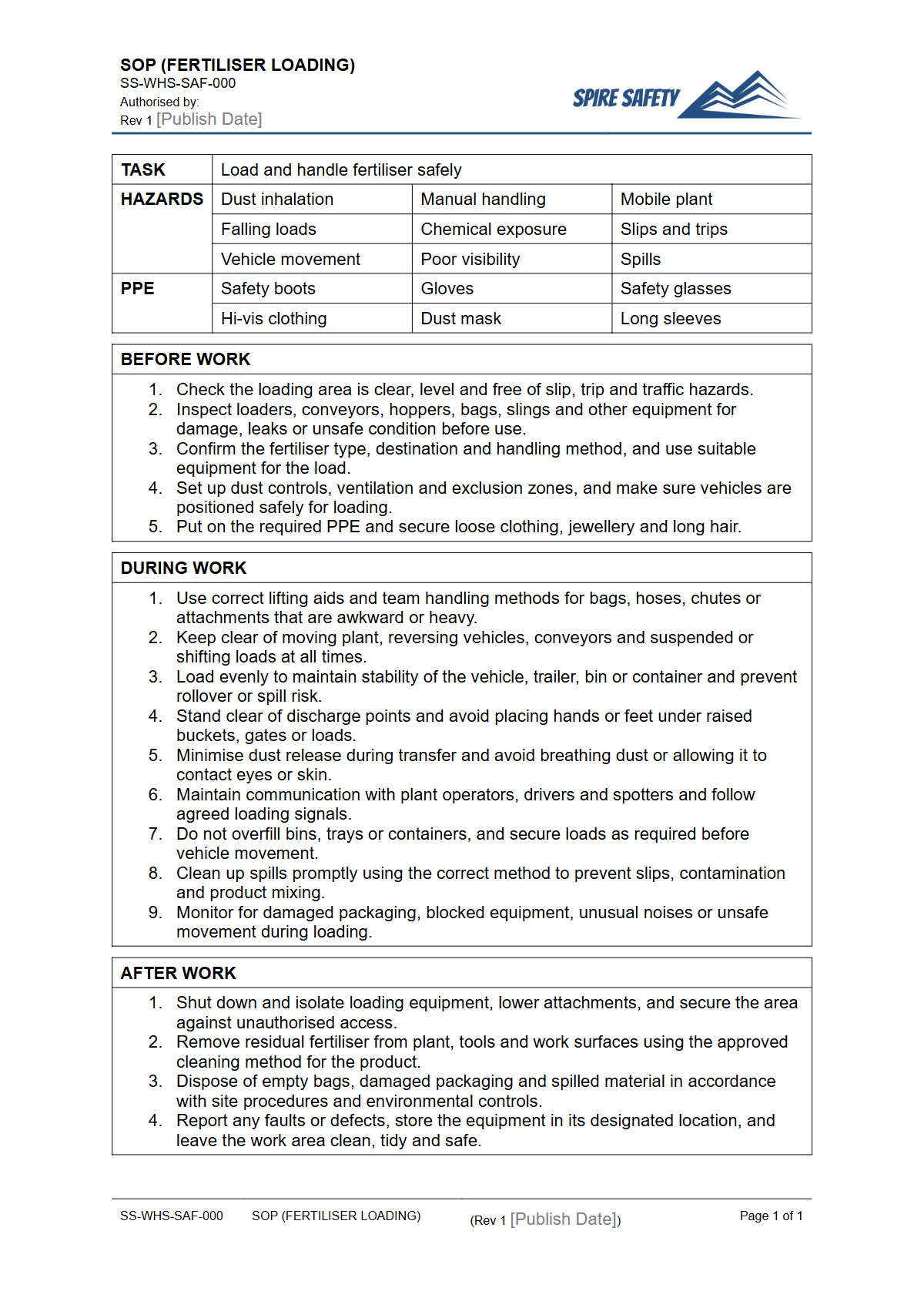
Loading fertiliser, whether in bulk bags, smaller sacks, or via augers, presents a unique combination of manual handling, chemical exposure, and machinery-related risks. This free Safe Operating Procedure (Fertiliser Loading) template provides a structured starting point for organisations to document and control these hazards.
By establishing a clear, step-by-step process, you can minimise the risk of musculoskeletal injuries, respiratory illness from dust inhalation, and serious incidents involving mobile plant or equipment.
A well-drafted SOP is a critical tool for ensuring tasks are performed consistently and safely by all workers. It forms a key part of your overall safety management system, providing a practical method for implementing the findings from your risk assessments.
This document helps you define required personal protective equipment (PPE), pre-operational checks, and emergency procedures specific to the task of loading fertiliser.
Video walkthrough
How to use the Free Safe Operating Procedure (Fertiliser Loading) Template
This document is a fully editable template provided in both Microsoft Word (DOCX) and PDF formats. Download the file and integrate the procedure into your existing safety documentation.
The primary value of this template is as a framework; it must be adapted to your specific operational context to be effective and support your WHS duties.
Important: We've created this template to provide a solid foundation based on established WHS principles. However, to be effective, you must customise it to reflect your specific site, machinery (such as front-end loaders or augers), fertiliser products, and storage facilities.
Your final SOP should be developed in consultation with the workers who actually perform the task. Once customised, the SOP should be integrated into your broader WHS management systems.
When to use a Fertiliser Loading SOP
A Safe Operating Procedure for fertiliser loading should be used as a primary reference document in several key situations. It should be the basis for all initial training for new operators and a central resource for periodic refresher training to prevent procedural drift.
Supervisors can use the SOP as a checklist for observations and to confirm that the agreed safe work methods are being followed consistently.
The SOP should be readily accessible in the work area, either in hard copy or digitally, so workers can refer to it before starting a non-routine loading task. It is also an essential document to review during incident investigations or after a near miss to identify if procedural failures contributed to the event. For related agricultural tasks, a similar structured approach is beneficial, as shown in our free Spreader SOP template.
Who should use this SOP
This Safe Operating Procedure is intended for use by a range of personnel within an agricultural or horticultural business.
Equipment Operators
Workers who are directly responsible for operating machinery like tractors, front-end loaders, or using equipment like augers and conveyors to load fertiliser are the primary users. They must understand and follow the procedure to ensure their own safety and the safety of those around them. Often, loading fertiliser involves equipment like a telehandler; operators must be competent, and a specific telehandler SOP should be used for that machine.
Supervisors and Farm Managers
Managers and supervisors are responsible for ensuring workers are trained on the SOP and for monitoring compliance. They use the document as a tool for instruction, supervision, and performance management related to safety.
During routine safety checks or more formal WHS compliance audits, the SOP serves as the benchmark for correct procedure.
WHS Advisors and Officers
Safety professionals use this template as a starting point to develop a site-specific procedure. They guide the consultation process with workers and management to ensure the final document accurately reflects the risks of the workplace and includes effective control measures.
They also manage the review and update process for the entire suite of procedural documents, which might include a grain drill SOP or other equipment-specific guides. You can browse our complete free WHS resources library for more templates.
Common mistakes
Common mistakes to avoid
- Using the generic template without customising it for specific equipment and site conditions.
- Failing to consult the fertiliser's Safety Data Sheet (SDS) for specific handling and PPE requirements.
- Neglecting to train workers on the finalised SOP and verify their understanding.
- Storing the SOP in an office, making it inaccessible to workers at the point of use.
Legal references
Legal considerations
The following legal requirements may be relevant to this type of work.
- Work Health and Safety Act (Harmonised) — Provides the primary duties for protecting workers and other people from work health and safety risks.
- Work Health and Safety Regulations (Harmonised) — Sets out requirements supporting the management of workplace hazards and risks.
The following codes may be relevant to this type of work.
- Managing WHS Risks Code of Practice — Provides practical guidance on identifying hazards, assessing risks and applying effective controls.
- Work Health and Safety Consultation, Cooperation and Coordination Code of Practice — Provides practical guidance on consulting workers and coordinating with other duty holders.
- Managing the Work Environment and Facilities Code of Practice — Provides practical guidance on safe work environments, workplace facilities and related controls.
Did you know
Oxidising Agent
Some fertilisers, like ammonium nitrate, are classified as oxidising agents. This means they can cause or contribute to the combustion of other materials, requiring specific storage and handling procedures separate from fuels and other flammable substances.
Dust Dangers
Besides being a respiratory irritant, dust from certain fertilisers can be combustible. An accumulation of fine dust in a confined space can create an explosion hazard if an ignition source is present.
FAQ
Frequently asked questions
01What are the main hazards when loading fertiliser?
02How often should a fertiliser loading SOP be reviewed?
03Who is responsible for creating a fertiliser loading SOP?
04What PPE is required for loading fertiliser?
Share this resource
Free Safe Operating Procedure (Fertiliser Loading) Template
Browse Categories
How To Use It
- 1Download and open in Word or PDF.
- 2Replace the placeholders with your business details.
- 3Get it reviewed by a WHS specialist before rollout.
Need it customised?
Our WHS consultants can adapt this template to your site, run a gap analysis, or audit what you already have in place.
Book a Free Consultation WHS consulting servicesor call 1300 156 382
Related templates
- Free Safe Operating Procedure (Fertiliser Mixing) Template
- Free Safe Operating Procedure (Fertiliser Spreading) Template
- Free Safe Operating Procedure (Fiber Opener) Template
- Free Safe Operating Procedure (Field Bin Handling) Template
- Free Safe Operating Procedure (Field Boundary Marking) Template
- Free Safe Operating Procedure (Field Drain Clearing) Template