
Free Safe Operating Procedure (Fence Vegetation Clear) Template
Download our free Safe Operating Procedure for clearing fence vegetation. This customisable template helps you create a safe system of work for your team.
Free Safe Operating Procedure (Fence Vegetation Clear) Template
DOCX • 126 KB + PDF
Updated Oct 2026
No signup required
Purpose of the Free Safe Operating Procedure (Fence Vegetation Clear) Template
Effectively managing vegetation along fence lines is crucial for property maintenance, fire prevention, and biosecurity. However, the task involves significant risks, from operating machinery to encountering environmental hazards.
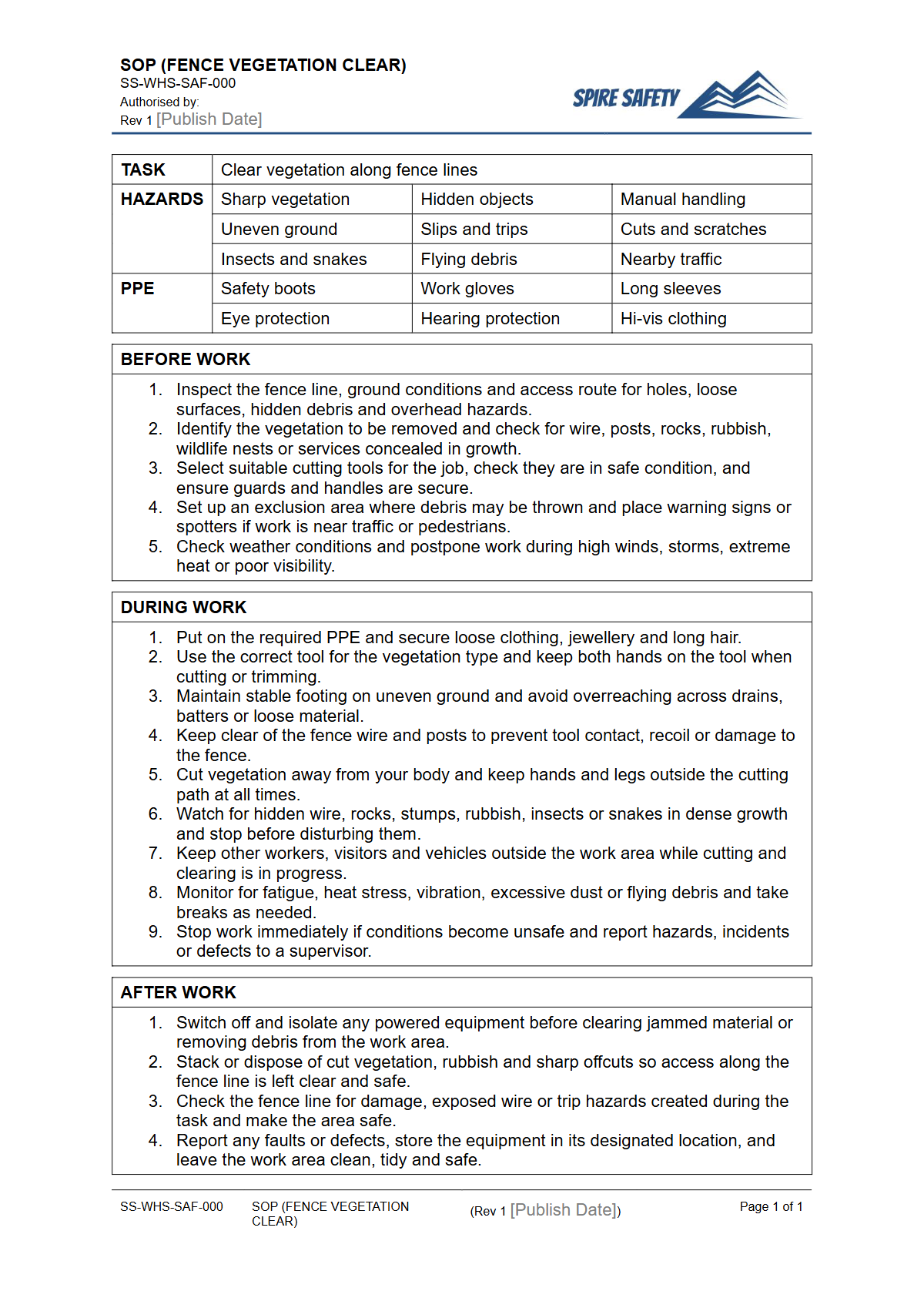
This Free Safe Operating Procedure (Fence Vegetation Clear) Template provides a structured starting point for organisations to document a safe system of work. It helps businesses meet their duty of care by outlining key steps, identifying hazards, and establishing control measures before work begins.
Using a formal SOP ensures that all workers, regardless of experience, follow a consistent and safe process. It covers critical areas such as pre-start checks, hazard identification (e.g., snakes, unstable ground, hidden services), correct use of equipment like line trimmers and chainsaws, and emergency procedures.
Properly implemented, this procedure helps minimise the risk of injury and demonstrates a proactive approach to workplace safety. This document is a foundational component for anyone serious about developing a WHS management system within their organisation.
Video walkthrough
How to use the Free Safe Operating Procedure (Fence Vegetation Clear) Template
This template is available for download in both DOCX for easy editing and PDF for straightforward distribution. To use it effectively, you must adapt its contents to your specific operational context.
This is not a finished document; it is a framework designed to be populated with your site-specific details, equipment models, and organisational procedures.
Important: You must customise this template to align with your workplace. We provide this as a starting point, but you are responsible for ensuring the final document reflects the unique hazards and control measures relevant to your specific tasks, tools, environment, and workers.
Be sure to conduct a thorough risk assessment and consult with your team to ensure the SOP is practical and comprehensive. For complex tasks involving various types of equipment, a specific circular saw SOP may also be necessary as a supplementary document.
Key sections to customise include:
- Personal Protective Equipment (PPE): List the exact PPE required, such as safety glasses, hearing protection, steel-capped boots, and cut-resistant gloves.
- Equipment: Name the specific makes and models of tools used (e.g., Stihl FS 460 C-EM, Husqvarna 450 Rancher).
- Site-Specific Hazards: Add risks unique to your location, such as proximity to power lines, steep terrain, or local venomous fauna.
- Emergency Contacts: Update the emergency procedures with your site's specific contact numbers and personnel.
When to use this Safe Operating Procedure
This Safe Operating Procedure should be used whenever workers are tasked with clearing vegetation from or near a fence line. It is a critical tool for planning and executing the work safely. Common scenarios for its application include:
- Routine property maintenance to prevent vegetation from damaging fences or becoming a fire hazard.
- Preparing an area for the installation of a new fence, which may also require a separate procedure like our free trencher SOP for groundwork.
- Clearing fallen branches and overgrown vegetation after a storm or flood event.
- Preparing firebreaks along property boundaries ahead of the bushfire season.
- Controlling noxious weeds as part of an environmental management plan, which may also involve the safe use of spreaders for herbicides.
Who should use it
This SOP is intended for a range of personnel involved in groundskeeping and property maintenance. The primary users are the workers performing the clearing activities, as it provides them with clear, step-by-step instructions for completing the job safely. It is also an essential resource for:
- Supervisors and Team Leaders: To assist with planning, instructing workers, and monitoring adherence to safe work practices.
- WHS Managers and Advisors: As a tool for risk management and a key document within the overall safety framework. Regular reviews ensure it remains current, a process often checked when organisations conduct WHS compliance audits.
- Property Owners and Managers (PCBUs): To help fulfil their legal obligation to provide and maintain a safe working environment and safe systems of work.
- Training Coordinators: As a foundational document for inducting new employees and conducting refresher training on safe work methods. If you're looking for more templates, you can browse our complete free WHS resources library.
Common mistakes
Common mistakes to avoid
- Forgetting to check for hidden services like underground pipes, cables, or irrigation before starting.
- Using incorrect or poorly maintained personal protective equipment (PPE), especially eye and hearing protection.
- Failing to assess the area for environmental hazards such as snakes, wasps, unstable ground, or poisonous plants.
- Neglecting to properly train workers on the specific hazards and controls for the equipment being used.
Legal references
Legal considerations
The following legal requirements may be relevant to this type of work.
- Work Health and Safety Act (Harmonised) — Provides the primary duties for protecting workers and other people from work health and safety risks.
- Work Health and Safety Regulations (Harmonised) — Sets out requirements supporting the management of workplace hazards and risks.
The following codes may be relevant to this type of work.
- Managing WHS Risks Code of Practice — Provides practical guidance on identifying hazards, assessing risks and applying effective controls.
- Work Health and Safety Consultation, Cooperation and Coordination Code of Practice — Provides practical guidance on consulting workers and coordinating with other duty holders.
- Managing the Work Environment and Facilities Code of Practice — Provides practical guidance on safe work environments, workplace facilities and related controls.
Did you know
Tool Vibration Risks
Prolonged use of vibrating tools like line trimmers or chainsaws can lead to Hand-Arm Vibration Syndrome (HAVS), a permanent and debilitating condition affecting nerves, blood vessels, and joints.
FAQ
Frequently asked questions
01What hazards are involved in clearing vegetation from a fence line?
02Is a Safe Operating Procedure legally required for this task in Australia?
03Can I use this template for both commercial and residential work?
04What other documents should accompany this SOP?
Share this resource
Free Safe Operating Procedure (Fence Vegetation Clear) Template
Browse Categories
How To Use It
- 1Download and open in Word or PDF.
- 2Replace the placeholders with your business details.
- 3Get it reviewed by a WHS specialist before rollout.
Need it customised?
Our WHS consultants can adapt this template to your site, run a gap analysis, or audit what you already have in place.
Book a Free Consultation WHS consulting servicesor call 1300 156 382
Related templates
- Free Safe Operating Procedure (Fence Wire Strainer) Template
- Free Safe Operating Procedure (Fertiliser Loading) Template
- Free Safe Operating Procedure (Fertiliser Mixing) Template
- Free Safe Operating Procedure (Fertiliser Spreading) Template
- Free Safe Operating Procedure (Fiber Opener) Template
- Free Safe Operating Procedure (Field Bin Handling) Template