
Free Safe Operating Procedure (Fence Wire Strainer) Template
Formalise safety protocols for using a fence wire strainer with our structured template. Download the free, customisable DOCX and PDF to improve your WHS documentation.
Free Safe Operating Procedure (Fence Wire Strainer) Template
DOCX • 126 KB + PDF
Updated Oct 2026
No signup required
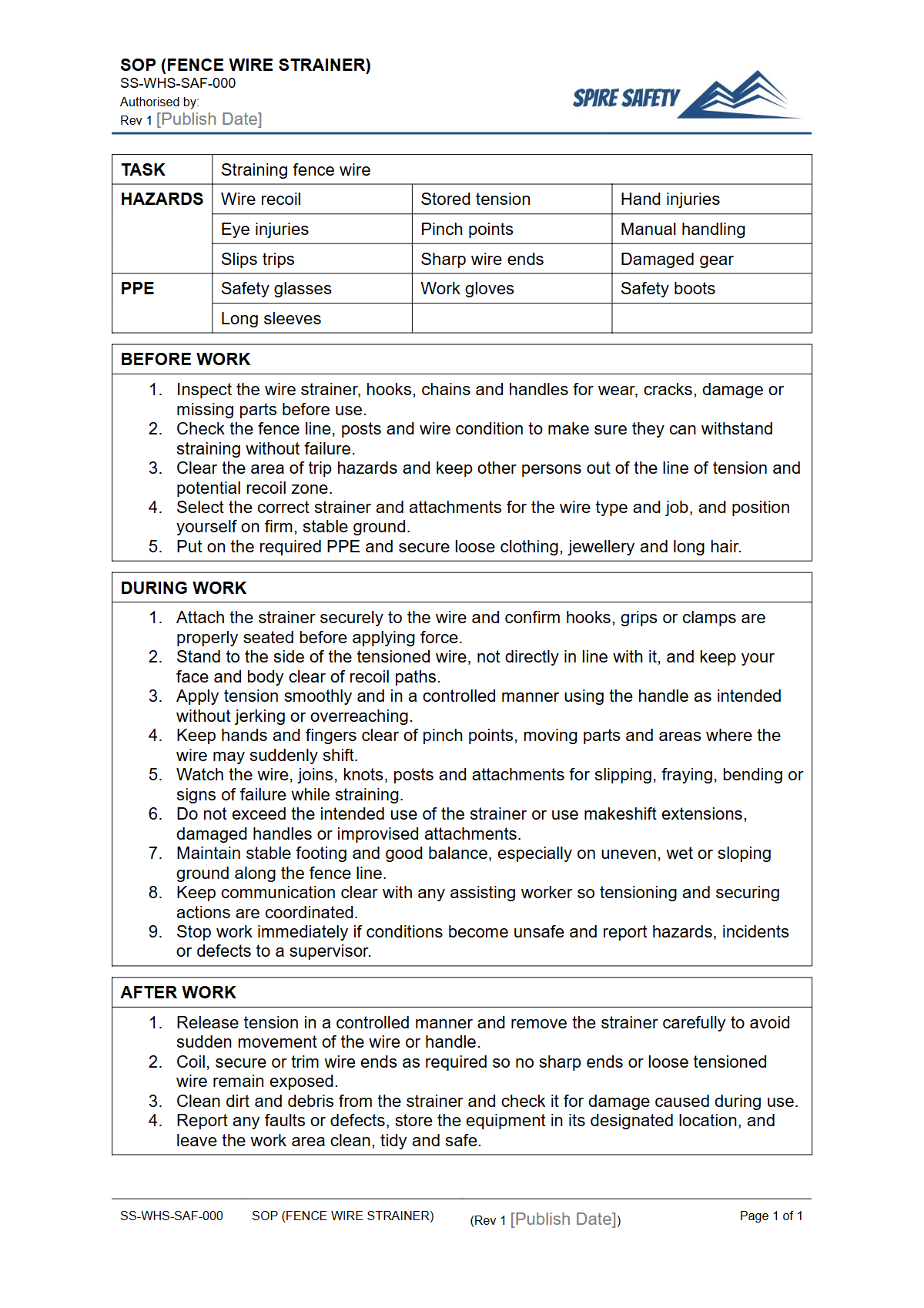
Purpose of the Free Safe Operating Procedure (Fence Wire Strainer) Template
Operating a fence wire strainer, while a common task in agriculture and construction, involves significant hazards if not performed correctly. This free Safe Operating Procedure (Fence Wire Strainer) Template provides a structured framework for documenting the safe use of this equipment.
Its primary purpose is to help Persons Conducting a Business or Undertaking (PCBUs) manage risks associated with wire tensioning, such as the sudden release of stored energy, cuts, and manual handling injuries.
By establishing a clear, step-by-step process, this SOP helps ensure that all workers understand the required safety measures before, during, and after the task. Formalising your procedures is a key step in fulfilling your primary duty of care under WHS legislation.
This template acts as a practical tool for training, risk management, and demonstrating a commitment to workplace safety, much like our specific Spreader SOP template does for other agricultural equipment.
Video walkthrough
How to use the Free Safe Operating Procedure (Fence Wire Strainer) Template
This resource is available for immediate download in both DOCX and PDF formats. The DOCX file is fully editable, allowing you to tailor the content to the specific types of strainers, wire, and environments found in your workplace. A well-developed SOP is a critical component of comprehensive WHS management systems.
To use the template effectively:
- Download the DOCX file.
- Review each section with a competent person who is experienced in fencing tasks.
- Customise the content, adding details about your specific tools, required Personal Protective Equipment (PPE), and site conditions.
- Incorporate findings from a site-specific risk assessment.
- Train all relevant workers on the finalised SOP and ensure they understand every step.
- Display the SOP in an accessible location and use it for inductions and refresher training.
IMPORTANT: This document is a template and must be customised to your specific needs. We have provided a foundation based on common safety practices, but you must adapt it to reflect the actual equipment, tasks, and hazards present in your workplace.
Generic procedures are not sufficient for ensuring safety or supporting WHS compliance.
When to use it
A Safe Operating Procedure for a fence wire strainer should be integrated into your daily operations. It is not a document to be filed away and forgotten. Use it as an active safety tool in several scenarios, including:
- Worker Training and Induction: Introduce new workers to the safe method for tensioning wire before they perform the task for the first time.
- Pre-Task Planning: Review the SOP as part of a pre-start meeting or toolbox talk to refresh workers' knowledge of the risks and controls.
- Competency Assessments: Use the procedure as a checklist to verify a worker’s ability to use the equipment safely and correctly.
- Incident Investigations: After a near miss or incident, the SOP should be reviewed to identify any gaps or weaknesses in the procedure.
- Routine Safety Audits: The procedure provides a benchmark against which actual work practices can be audited. This process is similar to how you would verify safe practices for other equipment, such as with a Circular Saw SOP.
Who should use it
This template is designed for a range of personnel within an organisation. Primarily, it should be used by:
- Workers and Operators: Farmhands, fencing contractors, construction labourers, and maintenance staff who directly use fence wire strainers must be trained on and follow the SOP.
- Supervisors and Team Leaders: These individuals are responsible for ensuring work is carried out according to the SOP and for providing adequate supervision.
- WHS Managers and Safety Officers: They will use the template to develop, implement, and review safety documentation as part of the broader safety management system. They may engage expert WHS consulting to ensure procedures are robust.
- Business Owners and PCBUs: This document helps owners meet their legal obligations by providing a formal system for managing a known workplace risk.
Key Safety Considerations for Fence Wire Strainers
When customising your SOP, ensure it addresses the key hazards of the task. These include the proper inspection and use of tools similar to what would be outlined in a trencher SOP for groundwork equipment.
Pre-Operational Checks
Before each use, the strainer must be inspected for signs of wear, deformation, cracks, or damage to the gripping mechanism. A faulty tool can fail under load, leading to immediate danger.
Also, check that the wire to be tensioned is free from kinks or significant rust that could create a weak point.
Personal Protective Equipment (PPE)
The SOP must specify mandatory PPE. As a minimum, this includes wrap-around safety glasses to protect from snapping wire and heavy-duty, cut-resistant leather or synthetic gloves to protect hands from wire and the tool itself.
Steel-capped boots are also recommended.
Stored Energy Hazard
The single greatest hazard is the uncontrolled release of stored kinetic energy. The SOP must include clear instructions to never stand in the direct line of a tensioned wire.
Always position yourself to the side. Ensure other workers and bystanders are kept clear of the work area. To discover more templates for other machinery, explore our free WHS resources library.
Common mistakes
Common mistakes to avoid
- Using damaged or inappropriate strainers for the wire gauge or type.
- Standing in the direct line of a tensioned wire, increasing the risk of injury if it snaps.
- Failing to wear appropriate personal protective equipment (PPE), especially safety glasses and heavy-duty gloves.
- Applying excessive tension, exceeding the wire's breaking strain or the strainer's capacity.
Legal references
Legal considerations
The following legal requirements may be relevant to this type of work.
- Work Health and Safety Act (Harmonised) — Provides the primary duties for protecting workers and other people from work health and safety risks.
- Work Health and Safety Regulations (Harmonised) — Sets out requirements supporting the management of workplace hazards and risks.
The following codes may be relevant to this type of work.
- Managing WHS Risks Code of Practice — Provides practical guidance on identifying hazards, assessing risks and applying effective controls.
- Work Health and Safety Consultation, Cooperation and Coordination Code of Practice — Provides practical guidance on consulting workers and coordinating with other duty holders.
- Managing the Work Environment and Facilities Code of Practice — Provides practical guidance on safe work environments, workplace facilities and related controls.
Did you know
Stored Energy
High-tensile fencing wire can store a significant amount of kinetic energy when tensioned. A sudden failure can release this energy with enough force to cause serious or fatal injuries, acting like a whip.
Tool Evolution
Modern fence strainers are a significant evolution from older, more hazardous methods like using a vehicle to tension wire, which is now strongly discouraged due to the lack of control and high risk.
FAQ
Frequently asked questions
01What hazards are associated with using a fence wire strainer?
02Is this fence wire strainer SOP template sufficient for WHS compliance?
03Who is considered a competent person to use a fence wire strainer?
04How often should a Safe Operating Procedure for a fence wire strainer be reviewed?
Share this resource
Free Safe Operating Procedure (Fence Wire Strainer) Template
Browse Categories
How To Use It
- 1Download and open in Word or PDF.
- 2Replace the placeholders with your business details.
- 3Get it reviewed by a WHS specialist before rollout.
Need it customised?
Our WHS consultants can adapt this template to your site, run a gap analysis, or audit what you already have in place.
Book a Free Consultation WHS consulting servicesor call 1300 156 382
Related templates
- Free Safe Operating Procedure (Fertiliser Loading) Template
- Free Safe Operating Procedure (Fertiliser Mixing) Template
- Free Safe Operating Procedure (Fertiliser Spreading) Template
- Free Safe Operating Procedure (Fiber Opener) Template
- Free Safe Operating Procedure (Field Bin Handling) Template
- Free Safe Operating Procedure (Field Boundary Marking) Template