
Free Safe Operating Procedure (Fence Post Replacement) Template
Streamline your safety processes with our structured Safe Operating Procedure for fence post replacement.
Free Safe Operating Procedure (Fence Post Replacement) Template
DOCX • 126 KB + PDF
Updated Oct 2026
No signup required
Purpose of the Free Safe Operating Procedure (Fence Post Replacement) Template
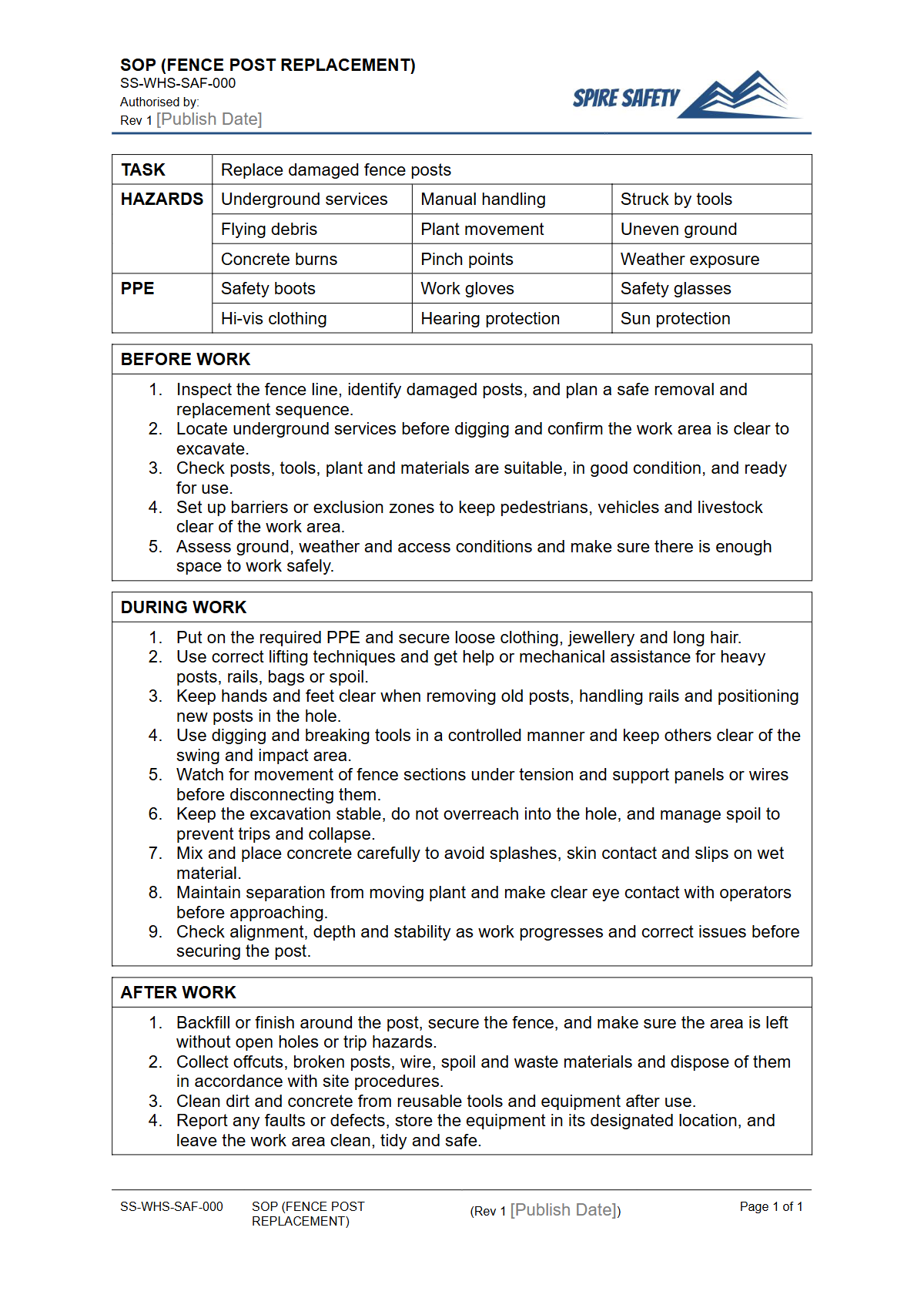
Replacing fence posts, whether on a rural property, commercial site, or residential block, involves significant hazards that must be managed. This Free Safe Operating Procedure (Fence Post Replacement) Template provides a structured framework for documenting the safest way to perform the task.
It guides you in identifying potential risks such as manual handling injuries, striking underground services, and incidents with tools, and prompts you to implement effective control measures. A well-developed SOP is a key component of a robust safety system, demonstrating a commitment to protecting workers and meeting your duty of care obligations under Australian WHS legislation.
By formalising your process, you create a clear, repeatable, and trainable method that minimises guesswork and reduces the likelihood of incidents. This document serves as a critical tool within your broader WHS management systems, helping ensure that safety is integrated into every stage of the job, from planning to clean-up.
Video walkthrough
How to use the Free Safe Operating Procedure (Fence Post Replacement) Template
This template is a starting point, not a finished document. To make it effective, you must customise it to reflect the specific circumstances of your workplace, the equipment used, the ground conditions, and the workers involved.
True safety management is a collaborative process.
Important: We have provided a comprehensive foundation based on common industry practice, but every worksite is unique. You must consult with your workers—the people who actually do the job—to identify all site-specific hazards.
Review and adapt each section of this template to ensure it accurately reflects your operational reality and control measures before implementation.
Before Starting Work
The preparation phase is critical for preventing incidents. Use the template to outline pre-start checks.
This includes a thorough site assessment to identify hazards like overhead powerlines, uneven ground, or public access. A crucial step is checking for underground services using the Dial Before You Dig service and a cable locator.
The SOP should also list required personal protective equipment (PPE) such as steel-capped boots, gloves, and eye protection, as well as procedures for inspecting all tools and equipment, from post-hole diggers to power tools.
During the Task
Detail the step-by-step sequence of the replacement process. This should cover the safe removal of the old post, correct techniques for digging the new hole, and methods for lifting and placing the new post to avoid musculoskeletal injuries.
If mechanical aids or specific equipment like augers are used, their safe operation must be included. For tasks involving digging, a FREE Trencher SOP Template can provide additional specific guidance that you can incorporate.
The SOP should also specify procedures for mixing and pouring concrete, bracing the post, and maintaining a tidy, hazard-free work area.
Completing the Task
The procedure doesn't end until the site is clean and safe. The final section should cover waste disposal (e.g., old post, excess soil, concrete bags), cleaning and storing tools, and conducting a final inspection of the work area to ensure it is left in a safe condition.
If a circular saw was used to trim posts, refer to our FREE Circular Saw SOP (Safe Operating Procedure) Template for specific safety controls.
When to use a Fence Post Replacement SOP
A Safe Operating Procedure for fence post replacement should be used consistently as part of your standard work practices. It is particularly important in several key situations:
- Training: Use it to induct new employees or contractors, ensuring they understand the approved, safe method from day one.
- High-Risk Scenarios: It is essential when the task involves higher risks, such as working near live services, on a slope, or in a public area.
- Refresher Training: Use the SOP as a basis for periodic refresher training or toolbox talks to reinforce safe work habits.
- Incident Investigation: Following an incident or near-miss, the SOP should be reviewed and updated to prevent a recurrence. Expert WHS consulting can provide valuable external perspective during these reviews.
Who should use this SOP
This SOP is designed for use by multiple roles within an organisation, promoting a shared understanding of safety responsibilities:
- Persons Conducting a Business or Undertaking (PCBUs): Business owners and managers use the SOP to fulfil their primary duty of care to provide and maintain a safe system of work.
- Supervisors and Team Leaders: They use it to direct work, monitor compliance, and conduct pre-start briefings and toolbox talks.
- Workers: The individuals performing the fence post replacement use the SOP as a clear guide to follow, empowering them to work safely and identify when conditions deviate from the approved procedure.
- WHS Professionals: Safety officers and advisors use the template as part of the overall risk management framework, integrating it into inductions, training programs, and site audits. It is one of many documents available in our free WHS resources library.
Common mistakes
Common mistakes to avoid
- Failing to check for underground utilities before any digging begins.
- Using poor manual handling techniques (e.g., lifting with the back instead of the legs) when moving heavy posts or bags of concrete.
- Neglecting to wear appropriate PPE, particularly safety glasses when digging or cutting, and sturdy gloves.
- Using damaged or unsuitable tools, such as a shovel with a splintered handle or an incorrect saw blade.
Legal references
Legal considerations
The following legal requirements may be relevant to this type of work.
- Work Health and Safety Act (Harmonised) — Provides the primary duties for protecting workers and other people from work health and safety risks.
- Work Health and Safety Regulations (Harmonised) — Sets out requirements supporting the management of workplace hazards and risks.
The following codes may be relevant to this type of work.
- Managing WHS Risks Code of Practice — Provides practical guidance on identifying hazards, assessing risks and applying effective controls.
- Work Health and Safety Consultation, Cooperation and Coordination Code of Practice — Provides practical guidance on consulting workers and coordinating with other duty holders.
- Managing the Work Environment and Facilities Code of Practice — Provides practical guidance on safe work environments, workplace facilities and related controls.
Did you know
Dial Before You Dig
Striking underground services is a primary risk in any excavation. Using the free Dial Before You Dig service is a critical first step, but it must be supplemented with on-site location services and cautious digging, as asset plans are not always precise.
Manual Handling Limits
There is no 'safe' weight for lifting, as risk depends on posture, frequency, and other factors. A 20kg concrete bag or a heavy timber post can easily cause a serious back injury if lifted incorrectly, making mechanical aids or team lifting essential controls.
FAQ
Frequently asked questions
01What are the main hazards in fence post replacement?
02Is a Safe Operating Procedure legally required for this task in Australia?
03How often should a Fence Post Replacement SOP be reviewed?
04Can I use this template for both commercial and residential work?
Share this resource
Free Safe Operating Procedure (Fence Post Replacement) Template
Browse Categories
How To Use It
- 1Download and open in Word or PDF.
- 2Replace the placeholders with your business details.
- 3Get it reviewed by a WHS specialist before rollout.
Need it customised?
Our WHS consultants can adapt this template to your site, run a gap analysis, or audit what you already have in place.
Book a Free Consultation WHS consulting servicesor call 1300 156 382
Related templates
- Free Safe Operating Procedure (Fence Vegetation Clear) Template
- Free Safe Operating Procedure (Fence Wire Strainer) Template
- Free Safe Operating Procedure (Fertiliser Loading) Template
- Free Safe Operating Procedure (Fertiliser Mixing) Template
- Free Safe Operating Procedure (Fertiliser Spreading) Template
- Free Safe Operating Procedure (Fiber Opener) Template