
Free Safe Operating Procedure (Feeder Breaker) Template
Download our free Safe Operating Procedure (Feeder Breaker) template to formalise your safety processes.
Free Safe Operating Procedure (Feeder Breaker) Template
DOCX • 126 KB + PDF
Updated Oct 2026
No signup required
Purpose of the Free Safe Operating Procedure (Feeder Breaker) Template
Operating a feeder breaker involves significant risks, including entanglement, crushing injuries, and electrical hazards. A Safe Operating Procedure (SOP) is a critical document that provides clear, step-by-step instructions for performing a task safely.
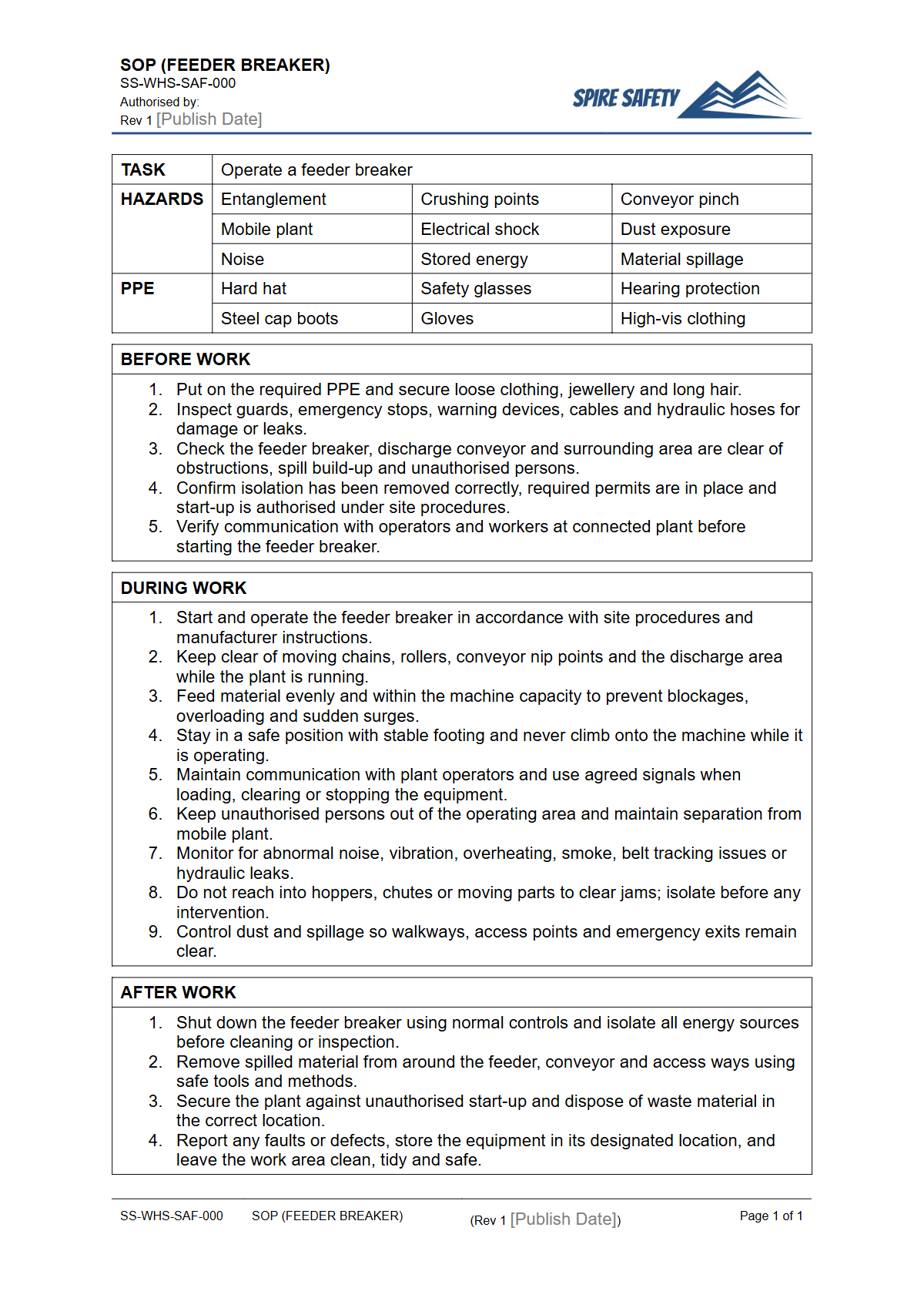
This Free Safe Operating Procedure (Feeder Breaker) Template is designed to help you formalise these instructions, identify potential hazards, and specify the control measures required to protect your workers. By systematically outlining the process from pre-start checks to shutdown, this SOP serves as a foundational component of a safe system of work, helping to minimise risks and ensure operational consistency.
This template provides a structured starting point aligned with Australian WHS principles. It guides you through documenting essential safety information, including required Personal Protective Equipment (PPE), emergency procedures, and isolation protocols.
Using a standardised SOP helps ensure that all operators, regardless of experience level, follow the same approved, safe methods for using the machinery.
Video walkthrough
How to use the Free Safe Operating Procedure (Feeder Breaker) Template
This resource is available as a fully editable DOCX file and a print-ready PDF. The DOCX version allows for complete customisation to suit your specific operational needs.
It is crucial to understand that this is a template, not a finished, universally document. We have provided a comprehensive starting point, but you must adapt it to reflect the specific feeder breaker model, site conditions, and unique processes at your workplace.
We strongly recommend consulting with the operators and supervisors who use the equipment daily to ensure the final SOP is practical, accurate, and effective.
What's included in this Safe Operating Procedure?
Our template prompts you to detail all phases of the feeder breaker's operation to create a comprehensive guide. Key sections covered include:
- PPE Requirements: Specifies necessary personal protective equipment such as hard hats, high-visibility clothing, steel-capped boots, gloves, and hearing protection.
- Hazard Identification: A list of common hazards associated with feeder breakers and their associated controls.
- Pre-Operational Checks: A checklist for inspecting guarding, emergency stops, hydraulic systems, and the surrounding work area before operation begins.
- Operating Steps: A sequential guide to starting, operating, and stopping the machine safely. This includes managing material flow and clearing blockages.
- Emergency Shutdown & Isolation: Clear instructions for emergency stops and Lock-Out Tag-Out (LOTO) procedures for maintenance or clearing jams. Because feeder breakers are often integrated with other machinery, you may also find our free Conveyer System SOP a useful supplementary resource.
When to use a Feeder Breaker SOP
A Safe Operating Procedure for a feeder breaker should be an active, accessible document used in multiple scenarios. It is essential for training new operators and verifying their competency.
It should also be used for refresher training for experienced workers to prevent complacency and reinforce safe work habits. Furthermore, the SOP is an invaluable reference tool during routine operations and a critical document to review during incident investigations or when planning non-routine tasks like maintenance or repairs.
Integrating it into your comprehensive WHS management systems ensures safety is systematically embedded in your operations.
Who should use this Safe Operating Procedure
This SOP is intended for a range of personnel within an organisation. Operators are the primary users who must understand and follow the procedure during their daily work.
Supervisors and managers must use the SOP to oversee work, conduct safety observations, and supports your compliance efforts with established protocols. WHS managers and safety officers will use it as a key document for risk assessments, training development, and safety audits.
By providing a clear standard, the SOP ensures everyone involved shares a common understanding of how to operate the feeder breaker safely. Regular reviews and WHS compliance auditing can help verify that the documented procedures are being followed correctly in practice.
Beyond this specific piece of equipment, a consistent approach to documenting procedures for all heavy machinery is best practice. If your site also uses other plant, you might find our SOP for a scraper or our Grader SOP template useful for building a consistent library of safety documents.
You can browse our complete free WHS resources library for more templates and checklists to support your safety management system.
Common mistakes
Common mistakes to avoid
- Using a generic template without customising it for the specific make, model, and site conditions.
- Failing to consult with experienced operators during the drafting and review process.
- Neglecting to review and update the SOP after an incident, near miss, or change in procedure.
- Treating the SOP as a pure compliance document instead of a practical tool for training and daily use.
Legal references
Legal considerations
The following legal requirements may be relevant to this type of work.
- Work Health and Safety Act (Harmonised) — Provides the primary duties for protecting workers and other people from work health and safety risks.
- Work Health and Safety Regulations (Harmonised) — Sets out requirements supporting the management of workplace hazards and risks.
The following codes may be relevant to this type of work.
- Managing WHS Risks Code of Practice — Provides practical guidance on identifying hazards, assessing risks and applying effective controls.
- Work Health and Safety Consultation, Cooperation and Coordination Code of Practice — Provides practical guidance on consulting workers and coordinating with other duty holders.
- Managing the Work Environment and Facilities Code of Practice — Provides practical guidance on safe work environments, workplace facilities and related controls.
Did you know
Integrated Design
Feeder breakers were developed to improve mining efficiency and safety by combining material crushing/sizing and conveyor feeding into a single, robust machine.
Leading Cause of Injury
A significant number of serious injuries involving machinery like feeder breakers and their associated conveyor systems are related to inadequate guarding and failure to follow correct lockout/tagout procedures during maintenance or clearing blockages.
FAQ
Frequently asked questions
01Is a Safe Operating Procedure a legal requirement for feeder breakers in Australia?
02What's the difference between a SWMS and an SOP for a feeder breaker?
03Who is responsible for writing and approving the feeder breaker SOP?
04How often should we review our feeder breaker SOP?
Share this resource
Free Safe Operating Procedure (Feeder Breaker) Template
Browse Categories
How To Use It
- 1Download and open in Word or PDF.
- 2Replace the placeholders with your business details.
- 3Get it reviewed by a WHS specialist before rollout.
Need it customised?
Our WHS consultants can adapt this template to your site, run a gap analysis, or audit what you already have in place.
Book a Free Consultation WHS consulting servicesor call 1300 156 382
Related templates
- Free Safe Operating Procedure (Fence Cleaning) Template
- Free Safe Operating Procedure (Fence Line Clearing) Template
- Free Safe Operating Procedure (Fence Post Replacement) Template
- Free Safe Operating Procedure (Fence Vegetation Clear) Template
- Free Safe Operating Procedure (Fence Wire Strainer) Template
- Free Safe Operating Procedure (Fertiliser Loading) Template