
Free Safe Operating Procedure (Fence Cleaning) Template
Download our free Safe Operating Procedure for fence cleaning to formalise your safety processes.
Free Safe Operating Procedure (Fence Cleaning) Template
DOCX • 126 KB + PDF
Updated Oct 2026
No signup required
Purpose of the Free Safe Operating Procedure (Fence Cleaning) Template
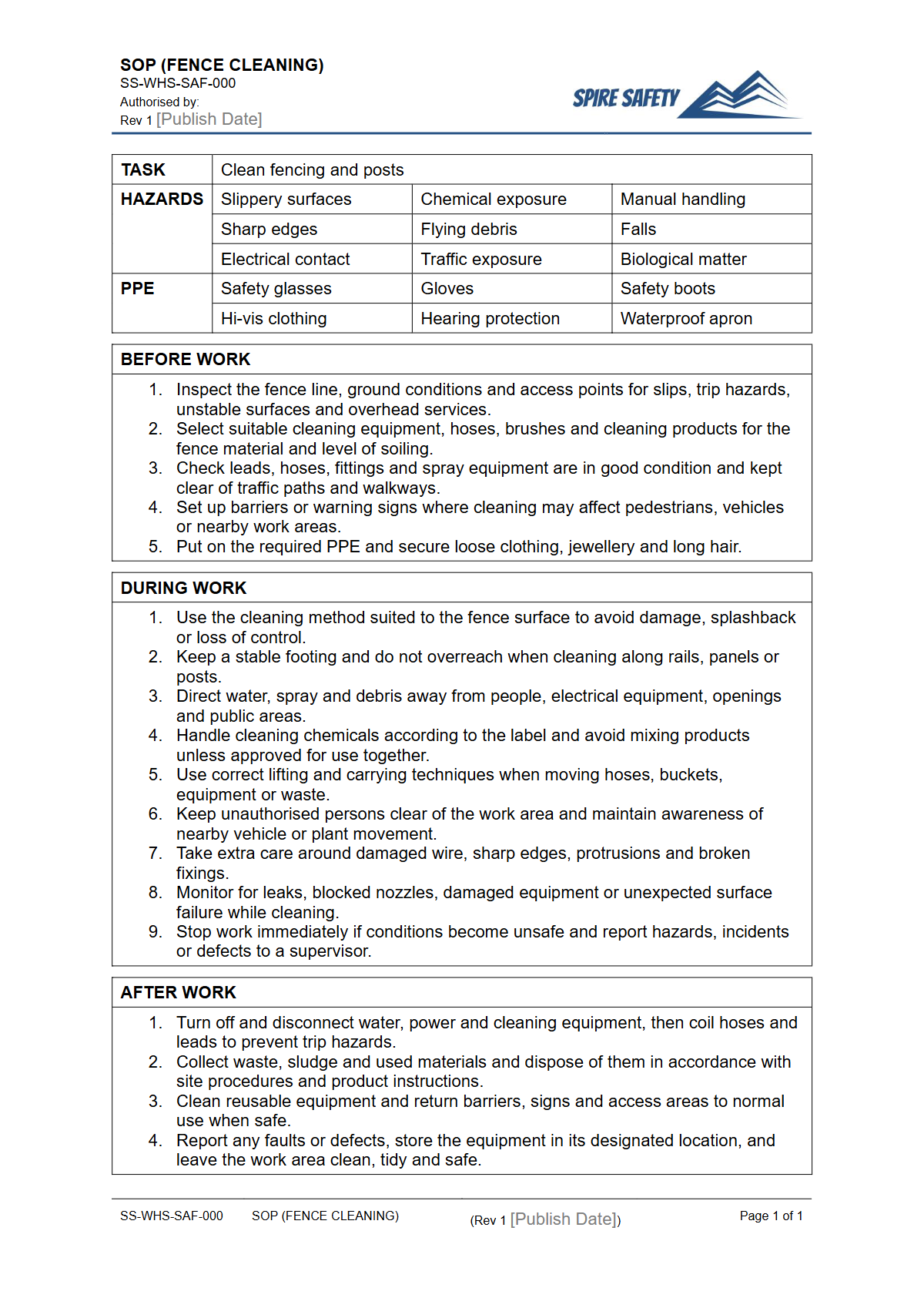
This Free Safe Operating Procedure (Fence Cleaning) Template provides a structured framework for documenting the risks and controls associated with cleaning various types of fencing. Fence cleaning can involve significant hazards, including high-pressure water, chemical exposure, electrical risks, manual handling, and slips, trips, and falls.
A documented SOP is a critical tool for ensuring these tasks are performed safely and consistently every time.
The purpose of this document is to help you clearly define pre-operational checks, required Personal Protective Equipment (PPE), the step-by-step work method, and emergency procedures. By formalising your process, you create a reliable resource for worker training, competency assessments, and supervision.
It forms a key component of your overall safety management, demonstrating a commitment to proactively managing workplace risks. Just as you would for specific machinery, documenting the process for tasks like this is essential.
For example, our Free Air Compressor SOP details the safe use of plant that might power equipment like pressure washers.
Key Objectives of this Safe Operating Procedure
- To identify potential hazards associated with fence cleaning activities.
- To implement robust risk control measures to prevent injury or illness.
- To provide clear, step-by-step instructions for workers to follow.
- To supports your compliance efforts with a PCBU’s primary duty of care under WHS legislation.
- To create a standardised process for training and inducting new workers.
Video walkthrough
How to use the Free Safe Operating Procedure (Fence Cleaning) Template
This template is available for download in both DOCX and PDF formats. The DOCX file is fully editable, allowing you to tailor it to the specific requirements of your workplace.
To use it effectively, download the file and systematically work through each section, replacing the placeholder text with information relevant to your operations.
Important: This is a template, not a finished document. Before use, you must customise it to reflect the specific equipment (e.g., pressure washers, brushes), chemicals, work environment, and local regulations relevant to your site.
We have provided a framework, but the final responsibility for accuracy and completeness rests with the Person Conducting a Business or Undertaking (PCBU). Detailing procedures for different tasks is a common requirement across all industries; for instance, the steps in a commercial kitchen are just as vital, which is why we also offer resources like a Safe Operating Procedure for a deep fryer.
When to use a Fence Cleaning SOP
A Safe Operating Procedure for fence cleaning should be developed and implemented before any worker undertakes the task. It is particularly crucial in the following situations:
- For High-Risk Activities: Whenever workers are using high-pressure water jetters, hazardous chemicals, or working at height to clean tall fences.
- Worker Training and Induction: Use the SOP as the foundation for training new employees or as a refresher for existing staff to ensure consistent, safe practices.
- Scheduled Maintenance: Integrate the SOP into your regular property maintenance schedule to ensure safety is considered part of the routine.
- Following an Incident: If a near miss or incident occurs during fence cleaning, the SOP should be reviewed and updated to prevent a recurrence.
Having clearly documented procedures is a fundamental aspect of workplace safety that is often examined during a WHS compliance audit, making this document a valuable piece of evidence for your safety systems.
Who should use this Safe Operating Procedure
This template is designed for use by anyone responsible for health and safety in a workplace where fence cleaning is performed. This includes:
- Persons Conducting a Business or Undertaking (PCBUs): Business owners and directors can use this to help meet their legal duty of care.
- WHS Managers and Safety Officers: Professionals responsible for developing and implementing safety documentation and procedures.
- Supervisors and Team Leaders: To manage their teams safely, provide clear instructions, and monitor work on the ground.
- Workers: As a practical reference guide to follow before and during the cleaning task to ensure they are working safely.
Effectively implementing task-specific documents like this SOP is a core function of successful WHS management systems, helping to embed a positive safety culture throughout the organisation. For additional guidance, you can explore our complete free WHS resources library for more templates and tools to support your safety efforts.
Common mistakes
Common mistakes to avoid
- Using the template 'as-is' without customising it for specific site hazards, chemicals, and equipment.
- Failing to provide workers with adequate training on the finalised SOP before they start work.
- Neglecting to specify the correct Personal Protective Equipment (PPE) in the SOP, such as safety glasses, gloves, and waterproof boots.
- Forgetting to include emergency procedures for chemical spills, electric shock, or high-pressure injection injuries.
Legal references
Legal considerations
The following legal requirements may be relevant to this type of work.
- Work Health and Safety Act (Harmonised) — Provides the primary duties for protecting workers and other people from work health and safety risks.
- Work Health and Safety Regulations (Harmonised) — Sets out requirements supporting the management of workplace hazards and risks.
The following codes may be relevant to this type of work.
- Managing WHS Risks Code of Practice — Provides practical guidance on identifying hazards, assessing risks and applying effective controls.
- Work Health and Safety Consultation, Cooperation and Coordination Code of Practice — Provides practical guidance on consulting workers and coordinating with other duty holders.
- Managing the Work Environment and Facilities Code of Practice — Provides practical guidance on safe work environments, workplace facilities and related controls.
Did you know
Water Injection Injury
High-pressure water from a pressure washer can penetrate the skin and underlying tissues, causing severe internal damage that requires immediate medical attention, even if the external wound appears minor.
Toxic Gas Risk
Never mix different cleaning chemicals, especially bleach and ammonia-based products. This combination creates highly toxic chloramine gas, which can cause severe respiratory damage or death upon inhalation.
FAQ
Frequently asked questions
01What are the main hazards involved in fence cleaning?
02Is a Safe Operating Procedure legally required for fence cleaning in Australia?
03How often should a Fence Cleaning SOP be reviewed?
04Can I use this template for a commercial pressure washing business?
Share this resource
Free Safe Operating Procedure (Fence Cleaning) Template
Browse Categories
How To Use It
- 1Download and open in Word or PDF.
- 2Replace the placeholders with your business details.
- 3Get it reviewed by a WHS specialist before rollout.
Need it customised?
Our WHS consultants can adapt this template to your site, run a gap analysis, or audit what you already have in place.
Book a Free Consultation WHS consulting servicesor call 1300 156 382
Related templates
- Free Safe Operating Procedure (Fence Line Clearing) Template
- Free Safe Operating Procedure (Fence Post Replacement) Template
- Free Safe Operating Procedure (Fence Vegetation Clear) Template
- Free Safe Operating Procedure (Fence Wire Strainer) Template
- Free Safe Operating Procedure (Fertiliser Loading) Template
- Free Safe Operating Procedure (Fertiliser Mixing) Template