
Free Safe Operating Procedure (Feed Mill) Template
Streamline your agricultural safety protocols with our free Safe Operating Procedure for feed mills. Download this customisable template to get started.
Free Safe Operating Procedure (Feed Mill) Template
DOCX • 126 KB + PDF
Updated Oct 2026
No signup required
Purpose of the Free Safe Operating Procedure (Feed Mill) Template
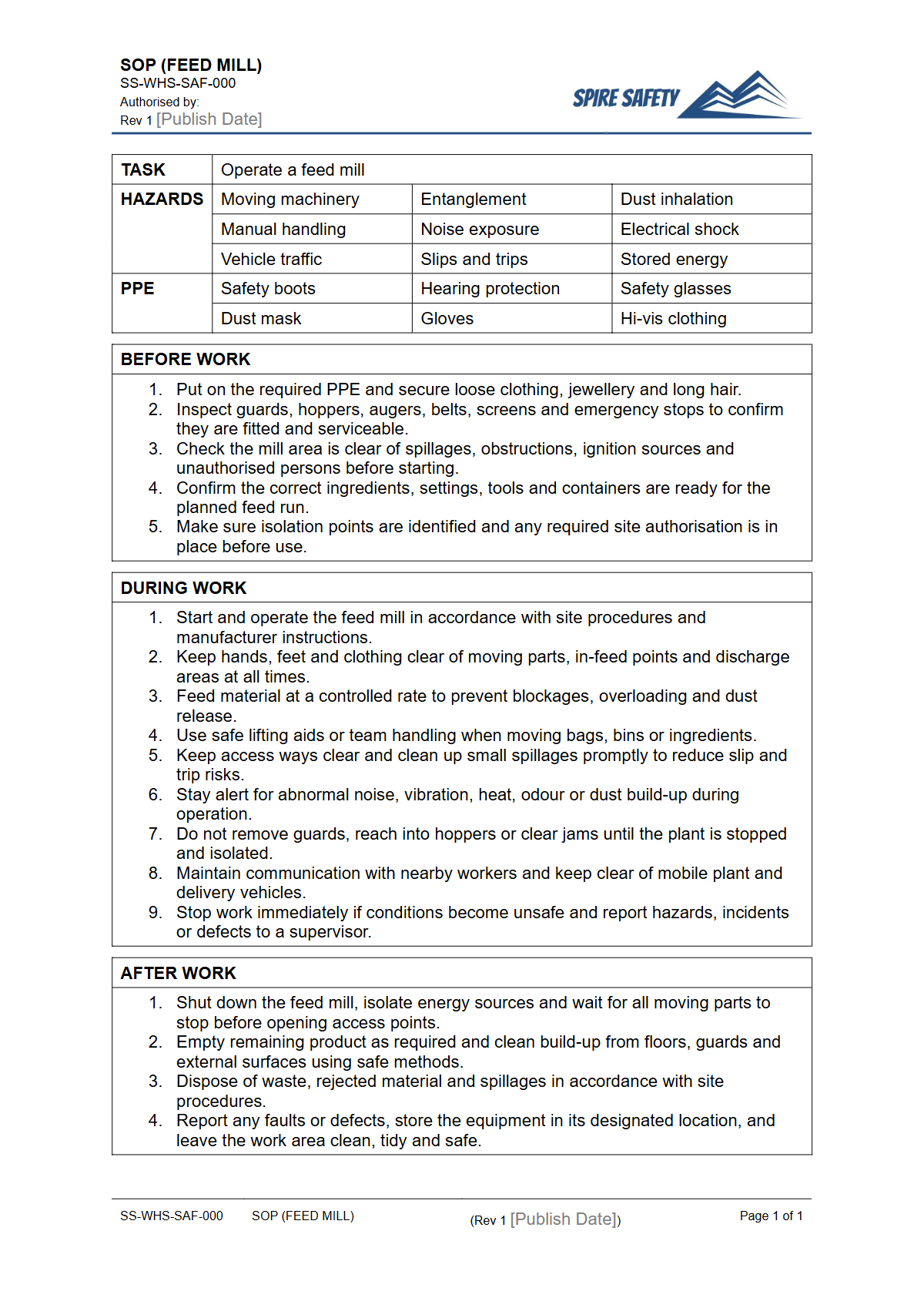
A Safe Operating Procedure (SOP) is a foundational document for managing high-risk tasks. The purpose of this feed mill SOP is to provide clear, step-by-step instructions that standardise the operation of your equipment.
It outlines pre-operational checks, operational steps, shutdown procedures, and emergency responses. Implementing a documented procedure helps fulfil your duty of care as a Person Conducting a Business or Undertaking (PCBU) under Australian WHS legislation.
It serves as a critical training tool for new operators and a reference for experienced staff, ensuring consistency and minimising the risk of incidents. Properly integrated SOPs form a key component of effective WHS management systems.
Documenting processes for all high-risk agricultural machinery, from processing to harvesting, is vital. You can find similar structured guidance in our Free Thresher SOP Template to help standardise safety across different farm activities.
Video walkthrough
How to use the Free Safe Operating Procedure (Feed Mill) Template
This template is provided in both DOCX and PDF formats for your convenience. The DOCX version is fully editable, allowing you to tailor it to your specific operational needs. To use the template effectively, follow these steps:
- Download the document and review its contents against your current practices.
- Conduct a site-specific risk assessment for your feed mill and associated equipment. Identify all potential hazards.
- Consult with the workers who operate the machinery. Their hands-on experience is invaluable for creating a practical and effective procedure.
- Modify the template to include details specific to your machinery model, workplace layout, and the types of feed being processed.
- Once finalised, have the SOP approved by a manager or supervisor.
- Use the finalised SOP to train all relevant workers, ensuring they understand every step and sign off on their training.
Important: We've created this document as a starting point. You must customise it to reflect the unique machinery, environment, and processes of your workplace to ensure it is effective. Many feed mill setups include integrated machinery, so you may also need to develop procedures for specific components, such as those covered in our FREE Conveyer System SOP Template.
When should this Safe Operating Procedure be used?
An SOP is not a document to be filed away and forgotten. It should be a living document that is actively used in your daily operations. Use this Safe Operating Procedure in the following situations:
- Worker Training: As the primary document for inducting and training new feed mill operators.
- Refresher Training: For periodic retraining of existing staff to prevent complacency and reinforce safe work habits.
- Pre-Task Reference: Workers should be encouraged to review the SOP before starting a non-routine or complex task involving the feed mill.
- Incident Investigation: As a benchmark to determine if procedures were followed correctly during an incident or near-miss.
- Audits and Reviews: During safety inspections and formal audits to verify that documented procedures are practical and are being followed. Regular reviews are essential to maintain safety standards, a process which can be verified through WHS compliance auditing.
Who is this procedure for?
This SOP is intended for use by various personnel within an organisation to ensure a collaborative approach to safety:
- Workers/Operators: The primary users, who must follow the procedure to perform their work safely.
- Supervisors and Managers: Responsible for ensuring workers are trained on the SOP and follow it correctly. They also oversee its regular review and update.
- Health and Safety Representatives (HSRs): Use the SOP as a tool during workplace inspections and when consulting with management on safety matters.
- PCBU/Business Owners: Ultimately responsible for providing a safe system of work, for which this SOP is a key part.
Documenting procedures for all high-risk agricultural equipment is crucial for a safe workplace. For related tasks, you may find our FREE Grain Drill SOP Template helpful in standardising other critical farm operations.
By establishing and maintaining a clear SOP for your feed mill, you create a safer environment, improve operational efficiency, and demonstrate a commitment to workplace health and safety. You can find more templates to support your safety framework in our free WHS resources library.
Common mistakes
Common mistakes to avoid
- Failing to customise the generic template for specific site machinery and conditions.
- Not consulting with equipment operators during the drafting process, resulting in an impractical procedure.
- Neglecting to include specific lockout-tagout steps for cleaning, maintenance, and clearing blockages.
- Using the SOP for one-off induction but failing to integrate it into regular refresher training and daily pre-start checks.
Legal references
Legal considerations
The following legal requirements may be relevant to this type of work.
- Work Health and Safety Act (Harmonised) — Provides the primary duties for protecting workers and other people from work health and safety risks.
- Work Health and Safety Regulations (Harmonised) — Sets out requirements supporting the management of workplace hazards and risks.
The following codes may be relevant to this type of work.
- Managing WHS Risks Code of Practice — Provides practical guidance on identifying hazards, assessing risks and applying effective controls.
- Work Health and Safety Consultation, Cooperation and Coordination Code of Practice — Provides practical guidance on consulting workers and coordinating with other duty holders.
- Managing the Work Environment and Facilities Code of Practice — Provides practical guidance on safe work environments, workplace facilities and related controls.
Did you know
Combustible Dust
Grain dust is highly combustible. When suspended in the air in the right concentration, it can be ignited by a spark or hot surface, causing a violent explosion.
Entanglement Risks
Many serious agricultural machinery incidents happen not during normal operation, but during maintenance or while clearing blockages. This highlights the critical need for robust lockout-tagout procedures in every SOP.
FAQ
Frequently asked questions
01What are the main hazards of operating a feed mill?
02Does this SOP template meet all legal WHS requirements?
03How often should a feed mill SOP be reviewed?
04Who is responsible for developing a feed mill SOP?
Share this resource
Free Safe Operating Procedure (Feed Mill) Template
Browse Categories
How To Use It
- 1Download and open in Word or PDF.
- 2Replace the placeholders with your business details.
- 3Get it reviewed by a WHS specialist before rollout.
Need it customised?
Our WHS consultants can adapt this template to your site, run a gap analysis, or audit what you already have in place.
Book a Free Consultation WHS consulting servicesor call 1300 156 382
Related templates
- Free Safe Operating Procedure (Feed Mixer) Template
- Free Safe Operating Procedure (Feeder Breaker) Template
- Free Safe Operating Procedure (Fence Cleaning) Template
- Free Safe Operating Procedure (Fence Line Clearing) Template
- Free Safe Operating Procedure (Fence Post Replacement) Template
- Free Safe Operating Procedure (Fence Vegetation Clear) Template