
Free Safe Operating Procedure (Facade Glass Cleaning) Template
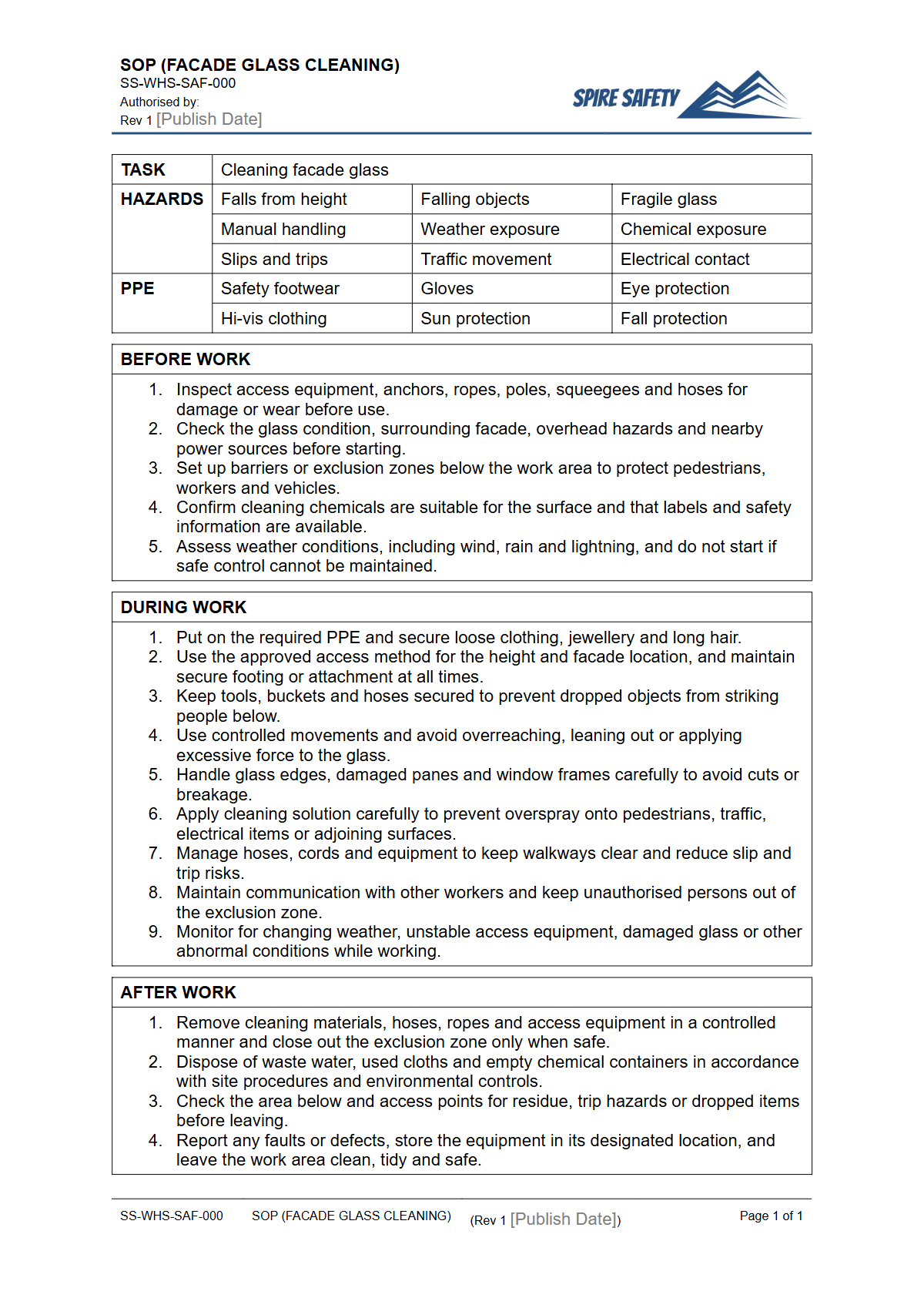
Download our free Safe Operating Procedure (Facade Glass Cleaning) Template to manage high-risk work. This customisable DOCX helps formalise safety processes.
Free Safe Operating Procedure (Facade Glass Cleaning) Template
DOCX • 126 KB + PDF
Updated Oct 2026
No signup required
Purpose of the Free Safe Operating Procedure (Facade Glass Cleaning) Template
This free Safe Operating Procedure (Facade Glass Cleaning) Template provides a structured framework for documenting the safety requirements for cleaning building exteriors. Facade cleaning is a high-risk activity involving working at height, potentially hazardous chemicals, and specialised equipment.
A documented Safe Operating Procedure is essential for managing these risks and ensuring work is performed consistently and safely by all personnel. This template helps you outline the step-by-step process, required personal protective equipment (PPE), and emergency protocols specific to your worksite.
The primary purpose of this Safe Operating Procedure is to provide a clear, documented process that minimises the risk of injury. It acts as a critical control measure for hazards such as falls from height, chemical exposure, and equipment-related incidents.
By standardising the task, you create a reliable benchmark for performance and safety. This document forms a key component of your overall WHS management systems, demonstrating your organisation's commitment to proactive risk management.
It also serves as a vital training tool for new and existing workers, ensuring everyone understands the expected safe work practices before commencing the task.
Video walkthrough
How to use the Free Safe Operating Procedure (Facade Glass Cleaning) Template
This template is provided in both DOCX and PDF formats for your convenience. To use it effectively, download the DOCX file and adapt it to the unique conditions of your workplace.
This involves a thorough risk assessment of the specific building, access methods (e.g., elevated work platform, rope access), equipment, and cleaning agents to be used.
- Detail the specific make and model of equipment used.
- List the exact chemical products and refer to their Safety Data Sheets (SDS).
- Outline site-specific emergency and rescue plans.
- Consult with your workers and incorporate their valuable feedback.
Important Note: This is a template, not a finished document. We are not a law firm; this document is a starting point and must be customised by a competent person to suit your specific circumstances, state/territory legislation, and the risks present in your workplace.
For guidance on developing and implementing robust safety documentation, consider engaging professional WHS consulting services.
When to use this Safe Operating Procedure
An SOP for facade glass cleaning should be developed and implemented before any such work begins. It should be used as a primary reference document during the planning and execution of the task. Specifically, it is used for:
- Inducting new workers or contractors onto the job.
- Conducting pre-start meetings and toolbox talks.
- Providing refresher training for experienced personnel.
- Investigating incidents or near misses to identify procedural gaps.
- Informing a WHS compliance auditing program to verify that procedures are followed correctly.
Who should use this procedure
This Safe Operating Procedure should be used by multiple people within an organisation. Persons Conducting a Business or Undertaking (PCBUs) and their management team are responsible for ensuring such procedures are in place and effective.
Supervisors must use it to direct and monitor work on-site. Most importantly, the workers and contractors performing the glass cleaning must be trained on and follow the procedure meticulously to ensure their own safety and the safety of others.
Similar documented procedures are necessary for any high-risk task on site, which is why we also offer templates like our Telehandler SOP for specialised mobile plant. You can find more examples in our free WHS resources library.
A consistent approach to high-risk work
Adopting a formalised, documented approach is fundamental to modern safety management. It moves your organisation beyond verbal instructions to a system of verifiable controls.
This structured approach is vital for all high-risk tasks, whether it involves facade access, using powerful tools as detailed in our Air Compressor SOP, or operating other site equipment. A comprehensive suite of SOPs demonstrates due diligence and creates a safer, more predictable work environment for everyone. This level of detail is also crucial for tasks that might seem simpler but still carry significant risk, as shown in our free Circular Saw SOP template.
Common mistakes
Common mistakes to avoid
- Using a generic template without customising it for the specific building and access method.
- Failing to consult with the workers who actually perform the cleaning task.
- Neglecting to provide adequate, hands-on training on the finalised procedure.
- Not reviewing the SOP after an incident, near miss, or change in process.
Legal references
Legal considerations
The following legal requirements may be relevant to this type of work.
- Work Health and Safety Act (Harmonised) — Provides the primary duties for protecting workers and other people from work health and safety risks.
- Work Health and Safety Regulations (Harmonised) — Sets out requirements supporting the management of workplace hazards and risks.
The following codes may be relevant to this type of work.
- Managing WHS Risks Code of Practice — Provides practical guidance on identifying hazards, assessing risks and applying effective controls.
- Work Health and Safety Consultation, Cooperation and Coordination Code of Practice — Provides practical guidance on consulting workers and coordinating with other duty holders.
- Managing the Work Environment and Facilities Code of Practice — Provides practical guidance on safe work environments, workplace facilities and related controls.
Did you know
Falls From Height
Falls are a leading cause of traumatic workplace fatalities in Australia. A detailed, site-specific Safe Operating Procedure is a critical administrative control for preventing falls from height.
Chemical Safety Data Sheets (SDS)
For every hazardous chemical used, such as industrial cleaning agents, a Safety Data Sheet (SDS) must be readily available to workers. Your SOP should reference the key safety information from the SDS.
FAQ
Frequently asked questions
01What should a Safe Operating Procedure for facade cleaning include?
02Is this template enough for WHS compliance?
03How often should we review our Facade Glass Cleaning SOP?
04Who needs to be trained on this Safe Operating Procedure?
Share this resource
Free Safe Operating Procedure (Facade Glass Cleaning) Template
Browse Categories
How To Use It
- 1Download and open in Word or PDF.
- 2Replace the placeholders with your business details.
- 3Get it reviewed by a WHS specialist before rollout.
Need it customised?
Our WHS consultants can adapt this template to your site, run a gap analysis, or audit what you already have in place.
Book a Free Consultation WHS consulting servicesor call 1300 156 382
Related templates
- Free Safe Operating Procedure (Facade Washdown) Template
- Free Safe Operating Procedure (Fall Arrest Harness) Template
- Free Safe Operating Procedure (Falls Mat Cleaning) Template
- Free Safe Operating Procedure (Falls Mat Placement) Template
- Free Safe Operating Procedure (Fan Coil Unit Cleaning) Template
- Free Safe Operating Procedure (Feed Mill) Template