
Free Safe Operating Procedure (Facade Washdown) Template
Download our free Safe Operating Procedure (Facade Washdown) template to manage high-risk work safely. Get your DOCX and PDF template to get started now.
Free Safe Operating Procedure (Facade Washdown) Template
DOCX • 126 KB + PDF
Updated Oct 2026
No signup required
Purpose of the Free Safe Operating Procedure (Facade Washdown) Template
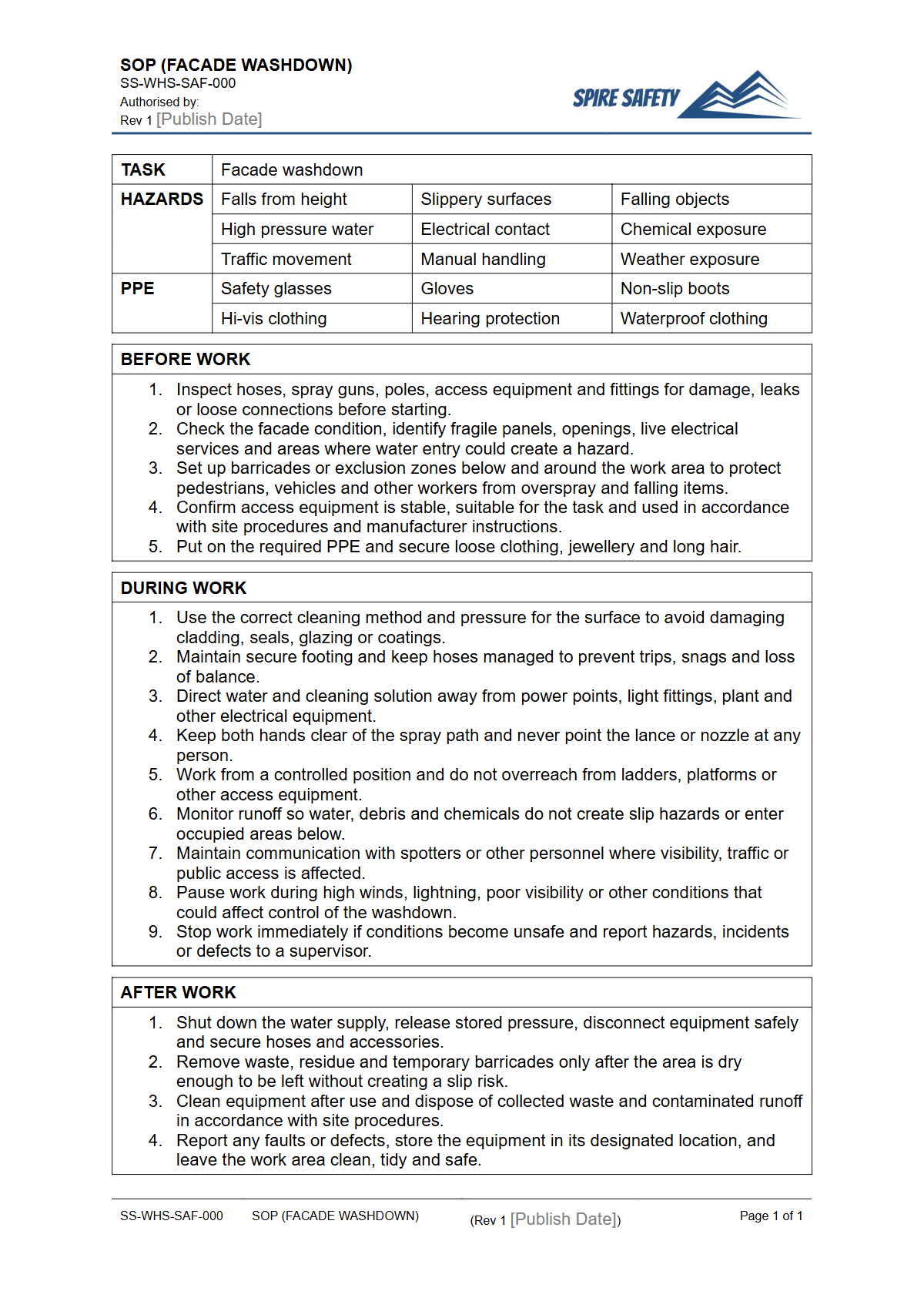
Facade washdown is a high-risk activity involving potential exposure to hazardous chemicals, working at heights, and operating high-pressure equipment. A documented Safe Operating Procedure (SOP) is crucial for outlining a safe and consistent method for this task.
This free Safe Operating Procedure (Facade Washdown) template provides a structured starting point for your organisation to define these steps, identify risks, and implement effective control measures. It helps meet your duty of care under Australian WHS laws by ensuring tasks are performed safely and systematically, minimising the risk of injury to workers and the public.
The SOP serves as a vital training tool for workers and a reference point for supervisors. It formalises the sequence of actions required before, during, and after the washdown process.
By standardising the procedure, you reduce the likelihood of errors and ensure that critical safety checks, such as equipment inspections and the use of Personal Protective Equipment (PPE), are never overlooked. This document is an essential component of a comprehensive safety management system.
Video walkthrough
How to use the Free Safe Operating Procedure (Facade Washdown) Template
This resource is available for download in both DOCX and PDF formats. The DOCX file is fully editable, allowing you to tailor the content to your specific operational needs. To use the template effectively, follow these steps:
- Download the DOCX version.
- Conduct a thorough risk assessment for facade washdown activities at your specific worksite.
- Insert your company name, logo, and relevant site details.
- Review and amend each section to reflect your unique equipment, chemicals, work environment, and control measures.
- Consult with your workers and health and safety representatives during the customisation process.
Important: This is a template only. It is not a complete, ready-to-use document.
We have drafted it to align with the model WHS framework, but every workplace is different. You must customise this Safe Operating Procedure to address the specific hazards and risks present in your work environment.
Failure to do so could result in an unsafe system of work and non-compliance with your legal obligations.
Key elements of a Facade Washdown SOP
A robust SOP for facade washing should cover all phases of the operation. Key sections include the required PPE (e.g., harnesses, eye protection, chemical-resistant gloves), pre-operational checks, and step-by-step instructions.
The procedure should detail how to set up exclusion zones, manage pedestrian traffic, and safely handle and store cleaning chemicals according to their Safety Data Sheets (SDS).
The document must also list the specific plant and equipment used for the task. For example, if your team uses elevated work platforms or telehandlers, the SOP should reference the need for competent and licensed operators.
For complex machinery, you may need a dedicated procedure, such as our free Telehandler SOP template, to complement this document. It's crucial to outline the safe use, inspection, and maintenance requirements for all tools, from high-pressure water cleaners to squeegees and brushes.
Emergency procedures are another critical component. The SOP must clearly state what to do in case of a chemical spill, equipment failure, fall, or medical emergency.
This includes the location of first aid kits, emergency contact numbers, and specific response actions. If your pressure washing system relies on a separate power source, such as a generator or compressor, you should also consider its safe operation; our free Air Compressor SOP template can provide a useful reference for this.
When to use this Safe Operating Procedure
An SOP for facade washdown should be developed and implemented before any such work commences. It should be used as a primary reference document for planning the job, inducting new workers, and conducting refresher training for existing staff.
Supervisors should use it during pre-start meetings to review the day's tasks, confirm safety controls, and ensure all workers understand their roles and responsibilities. It is a living document that forms a core part of your overall WHS management systems.
Who should use it
This SOP is intended for use by multiple roles within an organisation:
- Persons Conducting a Business or Undertaking (PCBUs) use it to establish and document a safe system of work, fulfilling their primary duty of care.
- Managers and Supervisors use it to train, supervise, and monitor workers, ensuring the agreed-upon safety standards are consistently met.
- Workers use it to understand the correct, safe way to perform the task, including all necessary precautions and emergency actions.
- Health and Safety Representatives (HSRs) use it during consultation and workplace inspections to verify that risks are being managed effectively.
The document also serves as important evidence during safety audits. An auditor performing WHS compliance auditing will expect to see documented procedures for high-risk activities, demonstrating how the organisation systematically manages its safety obligations.
For more templates and safety documents covering a wide range of tasks and equipment, browse our complete free WHS resources library. We provide a variety of tools to help you build a safer workplace.
Common mistakes
Common mistakes to avoid
- Using the template without customising it for the specific site, equipment, and chemicals.
- Failing to establish and signpost adequate exclusion zones to protect the public.
- Neglecting to inspect and test all equipment before use, especially fall arrest systems and EWPs.
- Not having the correct Safety Data Sheets (SDS) readily available for all chemicals on site.
Legal references
Legal considerations
The following legal requirements may be relevant to this type of work.
- Work Health and Safety Act (Harmonised) — Provides the primary duties for protecting workers and other people from work health and safety risks.
- Work Health and Safety Regulations (Harmonised) — Sets out requirements supporting the management of workplace hazards and risks.
The following codes may be relevant to this type of work.
- Managing WHS Risks Code of Practice — Provides practical guidance on identifying hazards, assessing risks and applying effective controls.
- Work Health and Safety Consultation, Cooperation and Coordination Code of Practice — Provides practical guidance on consulting workers and coordinating with other duty holders.
- Managing the Work Environment and Facilities Code of Practice — Provides practical guidance on safe work environments, workplace facilities and related controls.
Did you know
Working at Height Risk
According to Safe Work Australia, falls from height remain a leading cause of workplace fatalities and serious injuries, accounting for a significant percentage of all serious claims.
Chloramine Gas Danger
Never mix cleaning agents containing bleach with those containing ammonia. The combination creates toxic chloramine gas, which can cause severe respiratory damage or even death upon inhalation.
FAQ
Frequently asked questions
01What are the main hazards in facade washdown?
02Is a Safe Work Method Statement (SWMS) always required for facade washdown?
03How often should a Facade Washdown SOP be reviewed?
04What specific training is needed for facade washdown tasks?
Share this resource
Free Safe Operating Procedure (Facade Washdown) Template
Browse Categories
How To Use It
- 1Download and open in Word or PDF.
- 2Replace the placeholders with your business details.
- 3Get it reviewed by a WHS specialist before rollout.
Need it customised?
Our WHS consultants can adapt this template to your site, run a gap analysis, or audit what you already have in place.
Book a Free Consultation WHS consulting servicesor call 1300 156 382
Related templates
- Free Safe Operating Procedure (Fall Arrest Harness) Template
- Free Safe Operating Procedure (Falls Mat Cleaning) Template
- Free Safe Operating Procedure (Falls Mat Placement) Template
- Free Safe Operating Procedure (Fan Coil Unit Cleaning) Template
- Free Safe Operating Procedure (Feed Mill) Template
- Free Safe Operating Procedure (Feed Mixer) Template