
Free Safe Operating Procedure (Falls Mat Placement) Template
Download our free Safe Operating Procedure (Falls Mat Placement) template to document safety protocols. Get your customisable DOCX and PDF resource now.
Free Safe Operating Procedure (Falls Mat Placement) Template
DOCX • 126 KB + PDF
Updated Oct 2026
No signup required
Purpose of the Free Safe Operating Procedure (Falls Mat Placement) Template
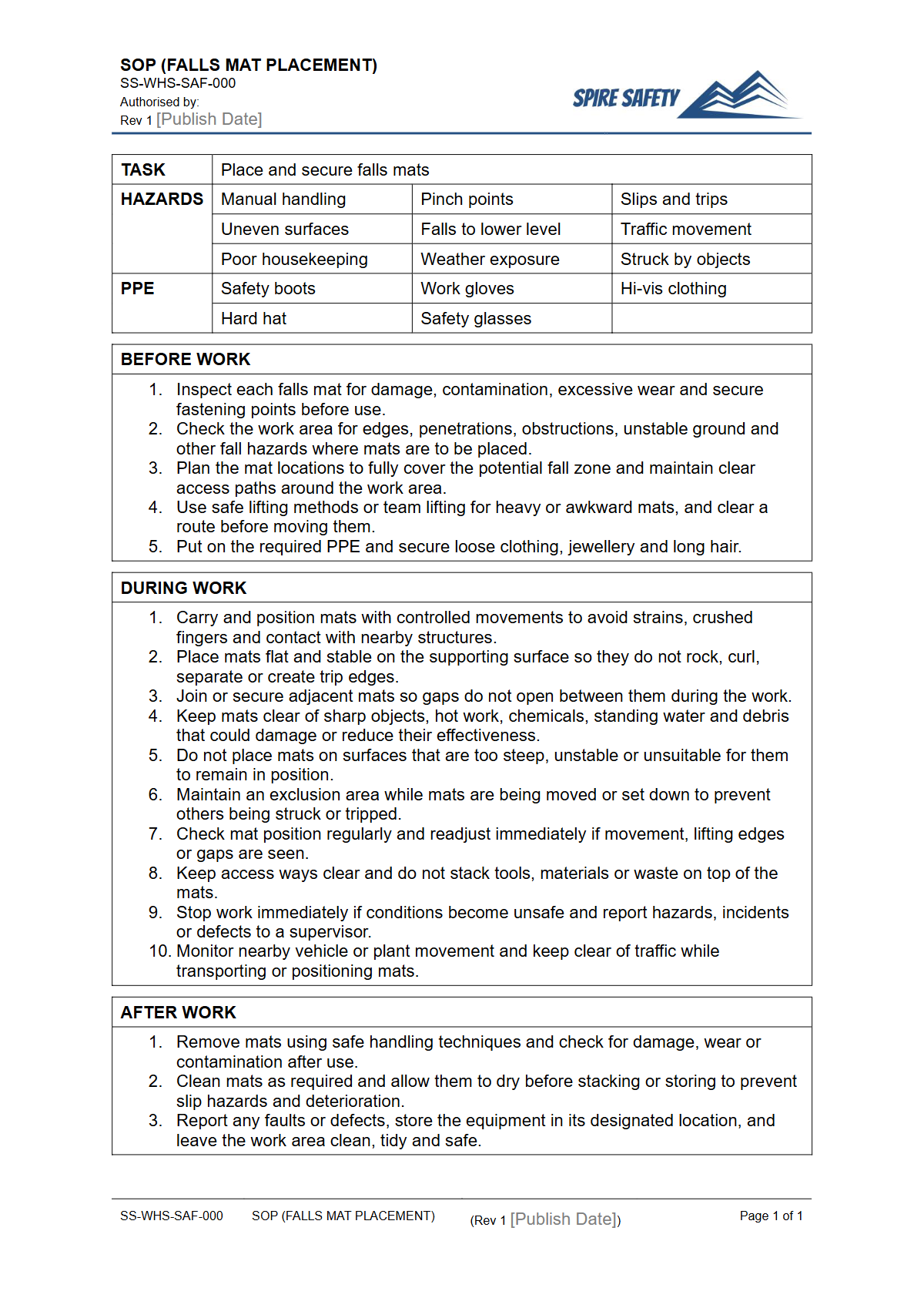
This Free Safe Operating Procedure (Falls Mat Placement) Template provides a structured framework for documenting the correct method for placing, inspecting, and storing falls mats. Using this SOP helps ensure that these critical safety devices are used effectively to minimise the severity of injuries from falls, particularly in healthcare, aged care, and disability support settings.
Implementing a formal procedure demonstrates a commitment to resident and patient safety, standardises practices for all staff, and serves as a vital training tool for new employees. It forms a key part of your administrative controls and contributes to a robust safety management system.
A documented SOP is a fundamental component of a proactive safety culture. It provides clear, unambiguous instructions that reduce the chance of error and help your organisation meet its duty of care under Australian WHS legislation.
Integrating such procedures is a cornerstone of effective WHS management systems, providing auditable evidence that risks are being systematically managed.
Video walkthrough
How to use the Free Safe Operating Procedure (Falls Mat Placement) Template
To access the template, simply select your preferred format (DOCX for easy editing or PDF for straightforward printing) and download the file. The document is designed as a comprehensive starting point, pre-filled with standard sections including required PPE, risk controls, pre-operational checks, step-by-step procedural instructions, and post-task clean-up.
You can explore many other templates in our free WHS resources library to build out your safety documentation.
Important: This document is a template and must be adapted to your specific workplace. We recommend a competent person customises the following sections:
- Add your company name, logo, and other business details.
- Review the risk assessment section and add any site-specific hazards.
- Incorporate the specific make and model of falls mats used at your facility.
- Update contact details and emergency procedures to reflect your site's protocols.
- Consult with workers and other stakeholders during the customisation process to ensure the procedure is practical and effective.
When to use a Safe Operating Procedure for Falls Mats
An SOP for falls mat placement should be used in any environment where these mats are deployed as a control measure against fall-related injuries. This is most common in:
- Aged Care Facilities: Beside the beds of residents identified as having a high risk of falling.
- Hospitals: In wards with vulnerable patients, such as geriatric, neurological, or rehabilitation units.
- Disability Support Services: Within homes or centres where clients have mobility challenges.
- Gymnastics and Sporting Clubs: For training areas where falls are anticipated.
Documenting a procedure ensures every worker performs the task to the same safety standard, whether they are handling falls mats or performing other tasks with inherent risks. Just as you would require a deep fryer SOP in a commercial kitchen, this procedure formalises safety for a specific task.
Who should use this Safe Operating Procedure
This Safe Operating Procedure is intended for several key roles within an organisation:
- Care Staff, Nurses, and Support Workers: The primary users who are responsible for the daily placement and removal of falls mats. The SOP provides them with a clear, step-by-step guide to do so safely and effectively.
- Supervisors and Team Leaders: To use as a benchmark for training, competency assessment, and performance monitoring. It ensures they are coaching their teams to a consistent and safe standard.
- WHS Managers and Coordinators: To integrate into the organisation's overall risk management framework for falls. It serves as documented proof of an administrative control measure.
Integrating with Your Overall Risk Management
This SOP should not exist in isolation. It is an administrative control that functions within the broader hierarchy of risk controls.
Your fall prevention strategy should always prioritise higher-level controls like eliminating trip hazards or using low-low beds before relying solely on administrative actions or PPE. Developing a comprehensive falls management plan can be complex, and expert advice can help ensure all obligations are met.
Guidance from professional WHS consulting services can help you build a robust safety system tailored to your specific needs.
Documenting Other Task-Specific Procedures
The principle of documenting a safe procedure applies to any task involving risk. Whether it's preventing falls or managing hazards from equipment, a clear SOP is essential.
For instance, in a workshop setting, a FREE Circular Saw SOP (Safe Operating Procedure) Template would be used to ensure operators follow critical safety steps, mitigating risks of cuts and other injuries.
Review and Auditing
Safe Operating Procedures are living documents. They must be reviewed regularly—typically annually or after any incident—to ensure they remain accurate and effective.
This review process is a key part of continuous improvement and is often a focus during safety audits. Regular WHS compliance auditing can help verify that your SOPs are not only documented but are also being followed correctly by workers on the floor.
Managing Falls in All Workplace Environments
While this document focuses on falls mats common in healthcare, the risk of falls exists in every industry. In industrial settings, falls from heights or slips and trips around machinery are significant hazards.
Documenting procedures for working safely around equipment, such as our FREE Conveyer System SOP (Safe Operating Procedure) Template, is equally critical for managing these risks and ensuring worker safety.
Common mistakes
Common mistakes to avoid
- Placing mats on uneven, wet, or cluttered floors, creating a trip hazard.
- Using worn, damaged, or incorrect types of mats that do not provide adequate impact absorption.
- Failing to train workers on the correct placement, inspection, and storage procedures outlined in the SOP.
- Storing mats in a way that creates a trip hazard or causes damage to the mat itself.
Legal references
Legal considerations
The following legal requirements may be relevant to this type of work.
- Work Health and Safety Act (Harmonised) — Provides the primary duties for protecting workers and other people from work health and safety risks.
- Work Health and Safety Regulations (Harmonised) — Sets out requirements supporting the management of workplace hazards and risks.
The following codes may be relevant to this type of work.
- Managing WHS Risks Code of Practice — Provides practical guidance on identifying hazards, assessing risks and applying effective controls.
- Work Health and Safety Consultation, Cooperation and Coordination Code of Practice — Provides practical guidance on consulting workers and coordinating with other duty holders.
- Managing the Work Environment and Facilities Code of Practice — Provides practical guidance on safe work environments, workplace facilities and related controls.
Did you know
Falls are a Major Hazard
Slips, trips, and falls are the second leading cause of serious workers' compensation claims in Australia, highlighting the critical need for effective control measures like documented safety procedures.
FAQ
Frequently asked questions
01What is a falls mat and when is it used?
02Is a Safe Operating Procedure legally required for placing falls mats in Australia?
03How often should an SOP for falls mat placement be reviewed?
04Can I use this template for other types of fall prevention equipment?
Share this resource
Free Safe Operating Procedure (Falls Mat Placement) Template
Browse Categories
How To Use It
- 1Download and open in Word or PDF.
- 2Replace the placeholders with your business details.
- 3Get it reviewed by a WHS specialist before rollout.
Need it customised?
Our WHS consultants can adapt this template to your site, run a gap analysis, or audit what you already have in place.
Book a Free Consultation WHS consulting servicesor call 1300 156 382
Related templates
- Free Safe Operating Procedure (Fan Coil Unit Cleaning) Template
- Free Safe Operating Procedure (Feed Mill) Template
- Free Safe Operating Procedure (Feed Mixer) Template
- Free Safe Operating Procedure (Feeder Breaker) Template
- Free Safe Operating Procedure (Fence Cleaning) Template
- Free Safe Operating Procedure (Fence Line Clearing) Template