
Free Safe Operating Procedure (Fall Arrest Harness) Template
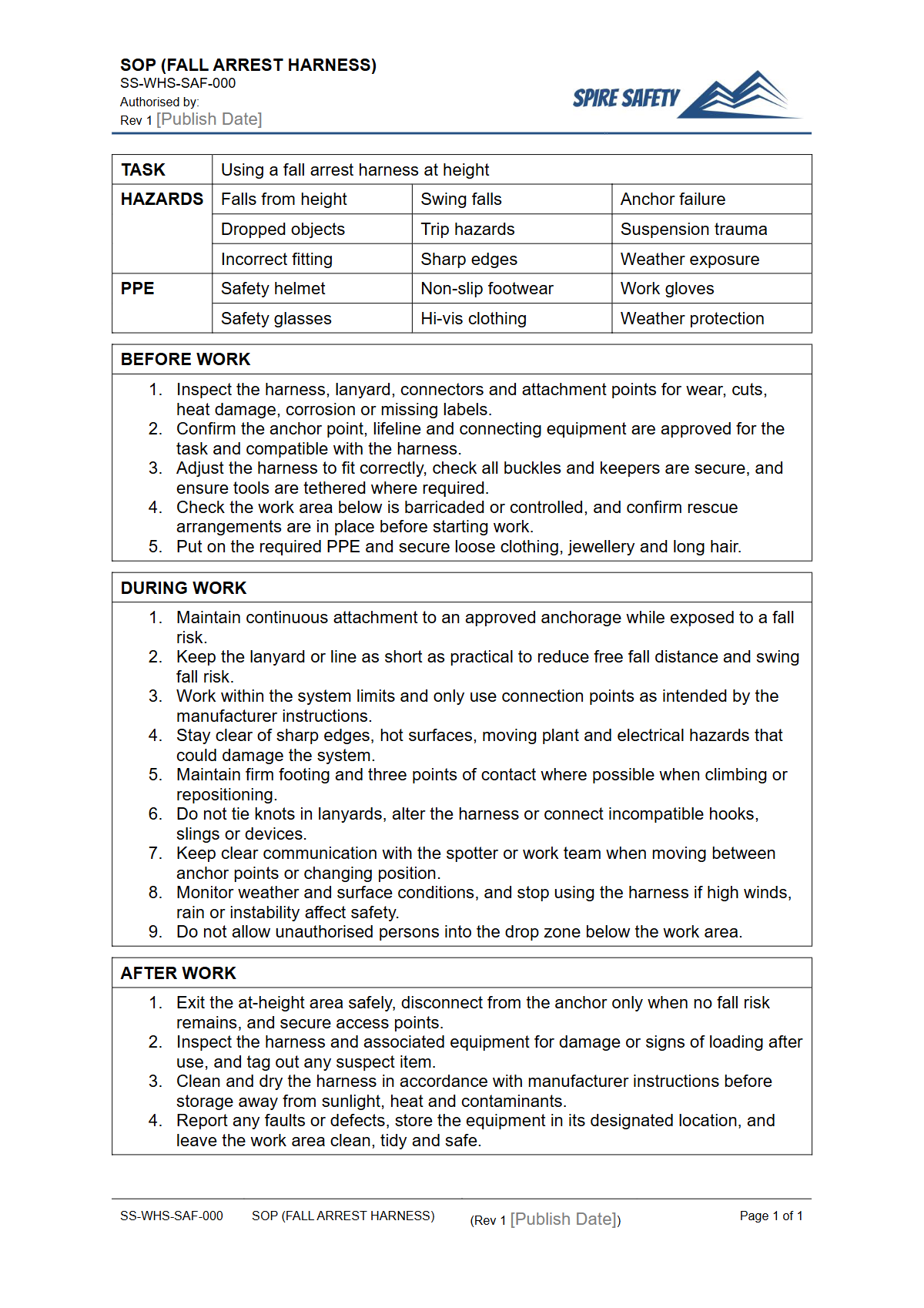
Download our free Safe Operating Procedure template for fall arrest harnesses. This customisable DOCX and PDF helps you document safe work practices for working at heights.
Free Safe Operating Procedure (Fall Arrest Harness) Template
DOCX • 126 KB + PDF
Updated Oct 2026
No signup required
Purpose of the Free Safe Operating Procedure (Fall Arrest Harness) Template
Effectively managing the risks of working at height is a critical WHS responsibility for any Person Conducting a Business or Undertaking (PCBU). Our Free Safe Operating Procedure (Fall Arrest Harness) Template provides a structured starting point for documenting the safe use, inspection, and maintenance of personal fall arrest systems in your workplace.
This document is designed to give clear, unambiguous instructions to workers, helping to prevent catastrophic falls and ensure a consistent approach to safety across your team.
A documented SOP serves as a key administrative control, demonstrating due diligence in managing workplace hazards. It formalises your processes for harness selection, pre-start checks, proper fitting, and connection to suitable anchor points.
Integrating this procedure into your overarching safety framework is a vital step in building robust WHS management systems that protect your workers and your organisation.
Video walkthrough
How to use the Free Safe Operating Procedure (Fall Arrest Harness) Template
This resource is available for download in both DOCX and PDF formats. The DOCX version is fully editable, allowing you to tailor the content to the specific fall arrest equipment, tasks, and environment at your worksite.
You can add your company branding, site-specific hazard information, and details of your emergency and rescue plans.
Important: This document is a template and must be customised. We have drafted it as a comprehensive starting point aligned with Australian WHS principles, but it is not a complete, out-of-the-box solution.
You must adapt it to reflect the specific hazards, equipment, control measures, and legislation relevant to your workplace. Once customised, the SOP should be reviewed and approved by a competent person before being issued to workers.
Implementing an SOP is not a 'set and forget' activity. Its effectiveness should be regularly monitored and reviewed to ensure it remains current and practical.
This review process can form part of your internal safety reviews or be incorporated into formal WHS compliance auditing to verify that procedures are being followed correctly in practice.
When to Use a Fall Arrest Harness SOP
A Safe Operating Procedure for fall arrest harnesses is required whenever workers are exposed to a fall risk that cannot be eliminated or controlled by higher-order measures like guardrails or scaffolding. It provides essential guidance for tasks where personal fall protection is the primary means of risk control. Common scenarios include:
- Working on roofs with no edge protection
- Operating near unprotected edges of floors, shafts, or excavations
- Erecting or dismantling structural steel
- Working from an elevating work platform (EWP) where a harness is required
- Performing maintenance or inspections on tall structures or equipment
For complex systems where workers may need to access elevated sections for maintenance, this SOP should be integrated with equipment-specific procedures. For example, working on an elevated conveyor requires both harness protocols and knowledge of the machine's hazards, as outlined in a FREE Conveyer System SOP.
Who Should Use This Procedure
Responsibility for workplace safety is shared. This SOP is intended for several key groups within an organisation:
- Persons Conducting a Business or Undertaking (PCBUs): Have the primary duty of care to ensure the provision of safe work systems, including documented procedures like this SOP, and to provide the necessary equipment and training.
- Managers and Supervisors: Are responsible for implementing the SOP on-site, ensuring workers are trained in the procedure, monitoring its use, and enforcing compliance.
- Workers: Must follow the instructions outlined in the SOP, conduct pre-use inspections of their harness, report any faults or concerns, and actively participate in maintaining a safe work environment.
Clearly defining these roles and responsibilities is crucial for the procedure's success. If you require assistance in structuring your safety management framework or clarifying duties, engaging specialist WHS consulting services can provide valuable expert guidance.
Key Components of a Harness SOP
A comprehensive SOP for fall arrest harnesses goes beyond just wearing the equipment. Our template prompts you to consider and document several critical elements to create a complete safe system of work.
These include pre-use checks for damage or wear, step-by-step instructions for correct fitting, criteria for selecting a suitable anchor point, and methods for calculating fall clearance to prevent impact with a lower level. Crucially, it must also include a detailed emergency and rescue plan to retrieve a suspended worker promptly.
The use of a harness is often combined with the operation of other plant. When workers use equipment like a boom-type EWP or a workbox on a telehandler, their safety depends on integrating harness use with the machine's own operating procedures.
This SOP should be used alongside documents like our FREE Telehandler SOP Template to ensure a holistic approach to safety.
By customising this template to include these key components, you create a powerful tool for worker training and risk management. For more tools to support your safety systems, explore our complete free WHS resources library.
Common mistakes
Common mistakes to avoid
- Using damaged, dirty, or expired harnesses and lanyards.
- Incorrectly fitting the harness (too loose or too tight), reducing its effectiveness.
- Connecting to an anchor point that has not been rated for fall arrest forces.
- Failing to have a documented rescue plan in place before work begins.
Legal references
Legal considerations
The following legal requirements may be relevant to this type of work.
- Work Health and Safety Act (Harmonised) — Provides the primary duties for protecting workers and other people from work health and safety risks.
- Work Health and Safety Regulations (Harmonised) — Sets out requirements supporting the management of workplace hazards and risks.
The following codes may be relevant to this type of work.
- Managing WHS Risks Code of Practice — Provides practical guidance on identifying hazards, assessing risks and applying effective controls.
- Work Health and Safety Consultation, Cooperation and Coordination Code of Practice — Provides practical guidance on consulting workers and coordinating with other duty holders.
- Managing the Work Environment and Facilities Code of Practice — Provides practical guidance on safe work environments, workplace facilities and related controls.
Did you know
Suspension Trauma
Falling is not the only risk. A worker suspended in a harness after a fall can suffer from suspension trauma (orthostatic intolerance) in as little as five minutes, which can be fatal. This is why a rescue plan is a mandatory part of any fall protection plan.
Harness Lifespan
Most fabric-based fall protection equipment, like harnesses and lanyards, has a manufacturer-specified lifespan, often around 10 years from the date of manufacture, regardless of use. Always check the date and retire equipment once expired.
FAQ
Frequently asked questions
01What is a Safe Operating Procedure for a fall arrest harness?
02Is a fall arrest harness considered Personal Protective Equipment (PPE)?
03How often should fall arrest harnesses and equipment be inspected?
04Who is responsible for providing the fall arrest equipment?
Share this resource
Free Safe Operating Procedure (Fall Arrest Harness) Template
Browse Categories
How To Use It
- 1Download and open in Word or PDF.
- 2Replace the placeholders with your business details.
- 3Get it reviewed by a WHS specialist before rollout.
Need it customised?
Our WHS consultants can adapt this template to your site, run a gap analysis, or audit what you already have in place.
Book a Free Consultation WHS consulting servicesor call 1300 156 382
Related templates
- Free Safe Operating Procedure (Falls Mat Cleaning) Template
- Free Safe Operating Procedure (Falls Mat Placement) Template
- Free Safe Operating Procedure (Fan Coil Unit Cleaning) Template
- Free Safe Operating Procedure (Feed Mill) Template
- Free Safe Operating Procedure (Feed Mixer) Template
- Free Safe Operating Procedure (Feeder Breaker) Template