
Free Safe Operating Procedure (Fabric Cutter) Template
Establish clear safety guidelines for operating fabric cutters with our comprehensive template. This free resource helps you document risks and controls.
Free Safe Operating Procedure (Fabric Cutter) Template
DOCX • 126 KB + PDF
Updated Oct 2026
No signup required
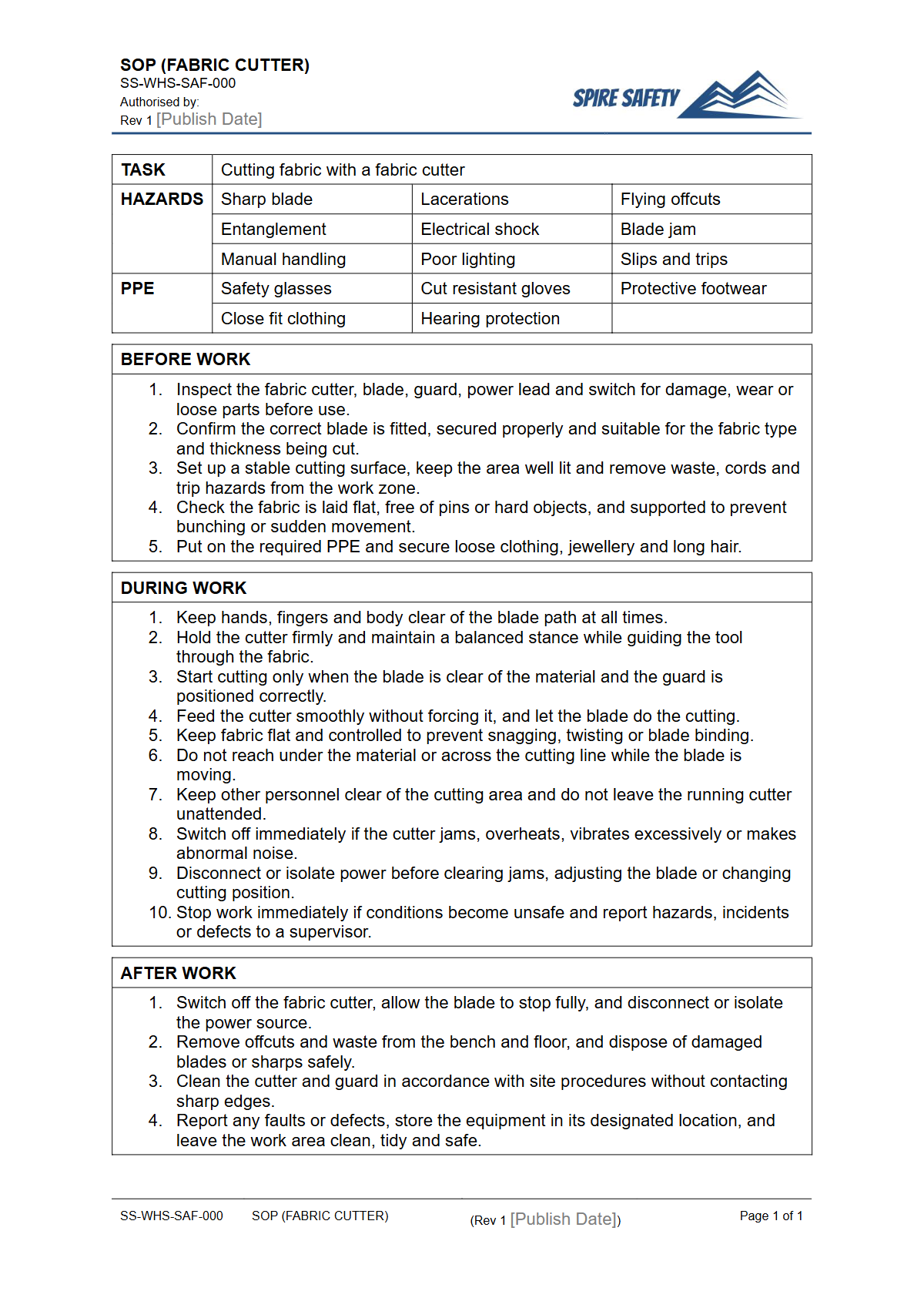
Purpose of the Free Safe Operating Procedure (Fabric Cutter) Template
Effectively managing workplace safety starts with clear, documented procedures. This free Safe Operating Procedure (Fabric Cutter) Template provides a structured framework for outlining the hazards and control measures associated with using industrial fabric cutters.
Fabric cutters, whether rotary, straight knife, or die-cutting, present significant risks, including severe cuts, amputations from sharp blades, entanglement in moving parts, and electrical hazards. Using this SOP helps a Person Conducting a Business or Undertaking (PCBU) fulfil their primary duty of care by establishing a safe system of work.
By systematically documenting steps for pre-operational checks, safe operation, shutdown, and maintenance, you create a vital tool for worker training and risk management. A well-developed SOP demonstrates a commitment to safety and provides a clear reference point for all personnel.
The principles of identifying and controlling cutting hazards are universal across many types of equipment; our free Circular Saw SOP provides another example of managing similar risks in a different context.
Video walkthrough
How to use the Free Safe Operating Procedure (Fabric Cutter) Template
This template is provided in both DOCX and PDF formats for your convenience. The DOCX version is fully editable, allowing you to tailor the content to the specific make and model of the fabric cutter used in your workplace, as well as your operational environment.
It is crucial to replace the generic placeholder text with details relevant to your site-specific machinery, processes, and control measures.
Important: This document is a template only. You must customise it to reflect the actual hazards and risk controls in your workplace.
We recommend a consultation process involving the workers who operate the machinery, their supervisors, and a competent WHS professional to ensure the final SOP is practical, comprehensive, and effective. A robust SOP is a cornerstone of a safety framework, which can be expanded into comprehensive WHS management systems that cover all aspects of your organisation's safety.
Key Elements to Include in Your Fabric Cutter SOP
When customising your SOP, ensure you address the following critical areas:
- Plant and Equipment Details: Specify the make, model, and identification number of the fabric cutter.
- Required Personal Protective Equipment (PPE): List all mandatory PPE, such as cut-resistant gloves, safety glasses, and appropriate footwear. Avoid loose clothing and jewellery that could become entangled.
- Risk Control Measures: Detail all safety features, including blade guards, emergency stop buttons, two-hand controls, and light curtains. Document administrative controls like exclusion zones and safe work distances.
- Pre-start Checks: Outline a checklist for operators to complete before each use, such as inspecting blade condition, confirming guards are in place and functional, and checking for electrical cord damage.
- Step-by-Step Operating Instructions: Provide clear, sequential instructions for safely starting, operating, and stopping the machine. This should include how to correctly position and feed fabric to minimise hand exposure to the blade. Our Conveyer System SOP is another resource that details sequential processes for machinery with significant entanglement hazards.
- Emergency Procedures: Describe the procedure for responding to an emergency, including the location of emergency stops and first aid facilities, and how to report an incident.
- Lockout/Tagout (LOTO): Specify the LOTO procedure for maintenance, cleaning, or blade changes to ensure the machine is properly de-energised and cannot be started accidentally.
When to use it
A Safe Operating Procedure for a fabric cutter should be a core document in your safety management system. It should be used as the primary training document for new operators and for refresher training for existing staff.
The SOP should be readily accessible near the equipment for easy reference. It is also an essential document during safety audits, incident investigations, and risk assessments to verify that formalised, safe work methods are in place and being followed.
Regular WHS compliance auditing will often involve reviewing your SOPs to ensure they are current and implemented correctly.
Who should use it
This SOP template is designed for use by WHS managers, supervisors, and PCBUs in industries such as textiles, manufacturing, upholstery, and apparel production. Supervisors are responsible for ensuring operators are trained on the SOP and adhere to it.
Operators must use the SOP to understand how to perform their tasks safely and what to do in an emergency. For businesses needing support to develop and implement these critical documents, Spire Safety's WHS consulting services can provide expert guidance.
Ultimately, this document forms part of the information, training, and instruction that a PCBU must provide to workers. For more templates and guidance documents to support your safety management system, explore our complete free WHS resources library.
Common mistakes
Common mistakes to avoid
- Using a generic template without customising it for the specific machine and workplace.
- Failing to consult with the workers who actually operate the equipment when drafting the procedure.
- Not providing adequate training on the finalised SOP to all relevant workers.
- Neglecting to review and update the SOP after an incident, near-miss, or a change in process.
Legal references
Legal considerations
The following legal requirements may be relevant to this type of work.
- Work Health and Safety Act (Harmonised) — Provides the primary duties for protecting workers and other people from work health and safety risks.
- Work Health and Safety Regulations (Harmonised) — Sets out requirements supporting the management of workplace hazards and risks.
The following codes may be relevant to this type of work.
- Managing WHS Risks Code of Practice — Provides practical guidance on identifying hazards, assessing risks and applying effective controls.
- Work Health and Safety Consultation, Cooperation and Coordination Code of Practice — Provides practical guidance on consulting workers and coordinating with other duty holders.
- Managing the Work Environment and Facilities Code of Practice — Provides practical guidance on safe work environments, workplace facilities and related controls.
Did you know
Blade Safety
Industrial fabric cutting blades, whether rotary or straight-knife, can operate at thousands of revolutions or strokes per minute, making machine guarding and operator focus critical for preventing serious injuries.
Ergonomic Risk
Repetitive tasks associated with feeding fabric into a cutter can lead to musculoskeletal disorders. Implementing job rotation and ensuring the workstation is ergonomically designed are key preventative controls.
FAQ
Frequently asked questions
01What are the main hazards associated with fabric cutters?
02Is a Safe Operating Procedure a legal requirement in Australia?
03Who is responsible for writing a fabric cutter SOP?
04How often should a fabric cutter SOP be reviewed?
Share this resource
Free Safe Operating Procedure (Fabric Cutter) Template
Browse Categories
How To Use It
- 1Download and open in Word or PDF.
- 2Replace the placeholders with your business details.
- 3Get it reviewed by a WHS specialist before rollout.
Need it customised?
Our WHS consultants can adapt this template to your site, run a gap analysis, or audit what you already have in place.
Book a Free Consultation WHS consulting servicesor call 1300 156 382
Related templates
- Free Safe Operating Procedure (Facade Anchor Inspection) Template
- Free Safe Operating Procedure (Facade Glass Cleaning) Template
- Free Safe Operating Procedure (Facade Washdown) Template
- Free Safe Operating Procedure (Fall Arrest Harness) Template
- Free Safe Operating Procedure (Falls Mat Cleaning) Template
- Free Safe Operating Procedure (Falls Mat Placement) Template